


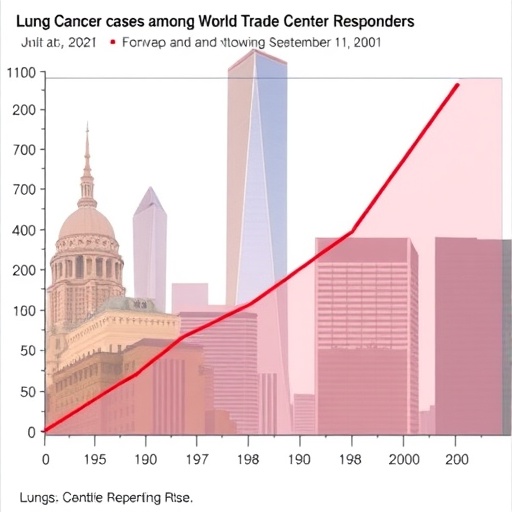
A recent comprehensive study focusing on responders to the World Trade Center (WTC) disaster has revealed compelling evidence linking increased exposure to particulate dust and debris with a significantly heightened risk of developing lung cancer. This research, grounded in extensive epidemiological analysis, addresses a pressing health concern for thousands of individuals who participated in rescue, recovery, and cleanup operations in the aftermath of the 9/11 attacks. The findings underscore the long-term consequences of environmental hazards encountered during such catastrophic events and signal a call for detailed mechanistic studies to unravel the pathophysiological underpinnings of these associations.
The study meticulously compared varying levels of exposure among WTC responders, stratifying participants based on self-reported data regarding the intensity and duration of contact with the complex chemical and particulate milieu generated by the collapse and burning of the towers. Researchers identified a clear positive correlation between higher exposure tiers and an elevated incidence rate of lung cancer diagnoses, contrasting sharply with the baseline risk observed in individuals reporting minimal contact. This dose-response relationship provides robust epidemiological evidence supporting a causal link between inhalation of WTC-derived particulates and carcinogenic outcomes.
Central to this investigation was the characterization of the complex dust cloud, a heterogeneous mixture comprising pulverized building materials, combustion byproducts, asbestos, heavy metals, and other noxious agents. The study emphasizes that the pathological impact on the pulmonary system likely arises from both acute insult and chronic inflammatory processes initiated by the deposition of these particles deep within the lung parenchyma. Persistent inflammation and oxidative stress are hypothesized to facilitate DNA damage, promoting oncogenic transformations in respiratory epithelial cells over time.
Methodologically, the research deployed sophisticated statistical models to adjust for potential confounders such as smoking history, age, and pre-existing pulmonary conditions. This rigorous approach ensured that the observed associations were not artifacts of underlying risk factors but reflective of the unique exposure burden borne by the WTC cohort. The findings contribute a crucial piece to the evolving puzzle of environmental carcinogenesis, particularly within the context of disaster-related occupational hazards.
Beyond establishing this epidemiological link, the investigators advocate for future multidisciplinary studies aimed at delineating the histopathological alterations induced by WTC dust exposure. Such work would employ advanced imaging modalities, molecular assays, and possibly lung biopsy analyses to capture cellular and tissue-level changes attributable to these environmental insults. Deciphering the biological mechanisms would not only enhance prognostic capabilities but could also inform targeted interventions to mitigate disease progression in affected populations.
Notably, the study invites scrutiny of prognostic factors associated with lung cancers emerging in this unique patient population. Given the distinct etiological context, tumoral genetic profiles, response to therapy, and overall survival metrics may differ from conventional lung cancer cases. Understanding these nuances could facilitate personalized treatment paradigms and guide healthcare policies tailored for the occupationally exposed cohort.
The implications of this research extend into public health policy, underscoring the imperative for long-term medical monitoring and support services for first responders and cleanup personnel. It also highlights the necessity for preparedness frameworks that incorporate robust respiratory protection measures and environmental hazard assessments in future disaster response protocols to minimize carcinogenic exposure risks.
Moreover, these findings resonate with broader environmental health concerns about airborne particulates and their carcinogenic potential. The WTC disaster serves as a poignant case study illustrating how acute, high-intensity exposures in industrial or urban catastrophes can translate into chronic disease burdens with significant morbidity and mortality implications.
In sum, the research presents a stark reminder of the latent health consequences faced by individuals exposed to complex environmental toxins under extraordinary circumstances. It calls for sustained vigilance, comprehensive healthcare strategies, and scientifically informed policy interventions to safeguard the long-term well-being of those who answered the call during one of modern history’s most devastating events.
Correspondingly, the medical and scientific communities are urged to deepen investigations into environmental carcinogens arising from anthropogenic disasters. This focus promises to enrich our understanding of cancer etiology, promote early detection efforts, and ultimately reduce the harmful legacy imposed on frontline responders.
By illustrating a strong link between particulate matter exposure specific to the WTC context and lung cancer risk, this study paves the way for a paradigm shift in occupational health risk assessment. The approach integrates environmental epidemiology with molecular pathology and clinical oncology, fostering a holistic perspective indispensable for addressing complex health threats in disaster aftermaths.
This work, therefore, holds significance not only for affected individuals but also for global medical researchers, public health officials, and policymakers. Understanding the ramifications of exposure to airborne particulate matter in critical incidents is essential for developing evidence-based guidelines that protect vulnerable populations and optimize resource allocation for healthcare systems.
As we continue to grapple with the aftermath of large-scale environmental catastrophes, this study sheds light on the tangible, often underestimated human health costs incurred and galvanizes action to improve future disaster response and recovery efforts with a proactive health risk framework at their core.
News Publication Date: Information not provided.
Web References: Information not provided.
References: (doi:10.1001/jamanetworkopen.2025.36655)
Cite Scienmag News
Nathaniel Bowman. (October 9, 2025). Rise in Lung Cancer Cases Among World Trade Center Responders Following September 11, 2001. Scienmag. https://scienmag.com/rise-in-lung-cancer-cases-among-world-trade-center-responders-following-september-11-2001/
Nathaniel Bowman. "Rise in Lung Cancer Cases Among World Trade Center Responders Following September 11, 2001." Scienmag, 9 October 2025, https://scienmag.com/rise-in-lung-cancer-cases-among-world-trade-center-responders-following-september-11-2001/. Accessed 4 September 2026.
Nathaniel Bowman. "Rise in Lung Cancer Cases Among World Trade Center Responders Following September 11, 2001." Scienmag. October 9, 2025. https://scienmag.com/rise-in-lung-cancer-cases-among-world-trade-center-responders-following-september-11-2001/


