


Climate change does not stop at grapevines. Too much sun means that the bouquet of German Riesling wines becomes dominated by a petrol note (some) customers do not appreciate. A research team from the Leibniz Institute for Food Systems Biology at the Technical University of Munich has now identified the human odorant receptor responsible for the perception of this special aroma note for the first time.

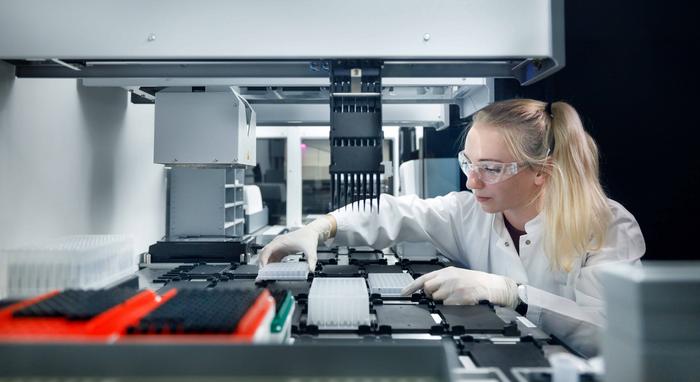
Credit: J. Krpelan / Leibniz-LSB@TUM
Climate change does not stop at grapevines. Too much sun means that the bouquet of German Riesling wines becomes dominated by a petrol note (some) customers do not appreciate. A research team from the Leibniz Institute for Food Systems Biology at the Technical University of Munich has now identified the human odorant receptor responsible for the perception of this special aroma note for the first time.
The grapevine (Vitis vinifera) is one of the most economically important fruit plants, with Riesling being one of the classic grape varieties. The bouquet of this white wine is characterized by floral, fruity and honey-like nuances, accompanied by a more or less pronounced petrol note. The latter is due to an odorant with the chemical name 1,1,6-trimethyl-1,2-dihydronaphthalene (TDN). Low and moderate concentrations of this odorant contribute to the complexity of the wine bouquet. However, wines with higher levels are often rejected by local consumers.
Increased sun exposure intensifies the petrol note
Compared to German Riesling, Riesling wines from South Africa or Australia generally have significantly higher concentrations of the aroma compound. The reason for this appears to be the higher UV exposure of the grapes in the southern hemisphere, which leads to increased carotenoid production in the plants. Like pigments in human skin, these natural colorants serve as sun protection, but at the same time are molecular precursors of the odorant TDN.
Various studies determined an odor detection threshold of TDN between approx. 2 and 20 micrograms per liter. Its odor quality is reminiscent of petroleum and kerosene. A human odorant receptor for this compound, however, was previously unknown. As the research team led by Dietmar Krautwurst has now shown for the first time, it is the odorant receptor OR8H1.
Receptor with a specific recognition profile
The team identified the odorant receptor using bidirectional receptor screenings. Using a cellular test system, they examined which of a total of 766 human odorant receptor variants react to the petroleum note. The OR8H1 receptor was the only one to respond to physiologically significant concentrations of the kerosene-like odorant. The team then investigated whether the identified receptor also reacted to other food-relevant odorants. Of the 180 substances tested, only seven, predominantly aromatic compounds, were able to significantly activate the receptor.
“The recognition spectrum of receptor OR8H1 is therefore very specific. Moreover, it complements the spectrum of another odorant receptor that recognizes a very broad range of food-relevant odorants,” reports first author Franziska Haag. Principal investigator Dietmar Krautwurst adds: “Our new findings help us to better understand the molecular mechanisms that contribute to our perception of foods as distinguishable odor objects, for example the complex bouquet of a wine.”
The researchers assume that a deeper understanding of the molecular background of odorant perception will lead to the development of new sensor technologies for food aromas in the long term. These could then be used for quality control purposes of not only the petrol note in wines, but also the occurrence of (off) flavors in other foods.
Publication: Haag, F., Frey, T., Ball, L., Hoffmann, S., and Krautwurst, D. (2024). Petrol Note in Riesling – 1,1,6-Trimethyl-1,2-dihydronaphthalene (TDN) Selectively Activates Human Odorant Receptor OR8H1. J Agric Food Chem. 10.1021/acs.jafc.3c08230.
Background information
About 1,1,6-trimethyl-1,2-dihydronaphthalene (TDN)
The TDN concentration in wine increases during bottle ageing due to the conversion of carotenoid precursors contained in the grapes or must. The amount of precursors depends on viticultural practices such as defoliation of the grapes, soil fertilization, irrigation and the selection of grape clones. Apart from this, higher temperatures and intense sunlight help to increase the formation of the odorous substance that smells of petrol. The yeast strains and the choice of bottle closures also influence the concentration of odorants in the wine. Storage conditions, especially elevated temperatures, have been shown to accelerate the formation of TDN.
The typical content of TDN in European Riesling wines is usually between 1 and 50 micrograms per liter, while in Australian wines it can reach up to 250 micrograms per liter and more.
Source: Tarasov A et al. 1,1,6-Trimethyl-1,2-dihydronaphthalenes (TDN) Sensory Thresholds in Riesling Wine. Foods. 2020 May 9;9(5):606. doi: 10.3390/foods9050606.
Human odorant receptors
Humans possess a total of around 400 different odorant receptor genes, which in turn encode up to 600 different allelic receptor variants in the nasal mucosa. The latter are responsible for the perception and differentiation of various odors. However, there is still a need for research to determine the exact number and function of all receptor variants. At present, it is only known for about 20 percent of human olfactory receptors which odorants they can recognize.
Source: Olender T et al. Personal receptor repertoires: olfaction as a model. BMC Genomics. 2012; 13:414; Haag F & Krautwurst D. Olfaction and the complex interaction between odorant ligands and their receptors. In: Comprehensive Analytical Chemistry (Elsevier Series, Ed.: Barcelo D). 2021; 96:1-40.
Test system used for screening
According to Dietmar Krautwurst, the cellular test system developed by the Leibniz researchers is unique in the world. He and his team have genetically modified the test cells so that they act like small biosensors for odorants. The researchers determine exactly which odorant receptor variant the test cells present on their surface. In this way, the researchers can specifically investigate which receptor reacts how strongly to which odorant. The Leibniz Institute has extensive collections of odorants and receptors, which it uses for its research work.
Contacts:
Expert contacts:
PD Dr. Dietmar Krautwurst
Leibniz Institute for Food Systems Biology
at the Technical University of Munich (Leibniz-LSB@TUM)
Lise-Meitner-Str. 34
85354 Freising
Phone: +49 8161 71-2634
E-mail: d.krautwurst.leibniz-lsb@tum.de
Dr. Franziska Haag
Leibniz-LSB@TUM
Phone: +49 8161 71-2716
E-mail: f.haag.leibniz-lsb@tum.de
Press contact at Leibniz-LSB@TUM:
Dr. Gisela Olias
Knowledge Transfer, Press and Public Relations
Phone: +49 8161 71-2980
E-mail: g.olias.leibniz-lsb@tum.de
www.leibniz-lsb.de
Information about the Institute:
The Leibniz Institute for Food Systems Biology at the Technical University of Munich (Leibniz-LSB@TUM) comprises a new, unique research profile at the interface of Food Chemistry & Biology, Chemosensors & Technology, and Bioinformatics & Machine Learning. As this profile has grown far beyond the previous core discipline of classical food chemistry, the institute spearheads the development of a food systems biology. Its aim is to develop new approaches for the sustainable production of sufficient quantities of food whose biologically active effector molecule profiles are geared to health and nutritional needs, but also to the sensory preferences of consumers. To do so, the institute explores the complex networks of sensorically relevant effector molecules along the entire food production chain with a focus on making their effects systemically understandable and predictable in the long term.
The Leibniz-LSB@TUM is a member of the Leibniz Association, which connects 97 independent research institutions. Their orientation ranges from the natural sciences, engineering and environmental sciences through economics, spatial and social sciences to the humanities. Leibniz Institutes devote themselves to social, economic and ecological issues. They conduct knowledge-oriented and application-oriented research, also in the overlapping Leibniz research networks, are or maintain scientific infrastructures and offer research-based services. The Leibniz Association focuses on knowledge transfer, especially with the Leibniz Research Museums. It advises and informs politics, science, business and the public. Leibniz institutions maintain close cooperation with universities – among others, in the form of the Leibniz Science Campuses, industry and other partners in Germany and abroad. They are subject to a transparent and independent review process. Due to their national significance, the federal government and the federal states jointly fund the institutes of the Leibniz Association. The Leibniz Institutes employ around 21,000 people, including almost 12,000 scientists. The entire budget of all the institutes is more than two billion euros.
+++ Stay up to date via our X (Twitter) channel twitter.com/LeibnizLSB +++
Climate change does not stop at grapevines. Too much sun means that the bouquet of German Riesling wines becomes dominated by a petrol note (some) customers do not appreciate. A research team from the Leibniz Institute for Food Systems Biology at the Technical University of Munich has now identified the human odorant receptor responsible for the perception of this special aroma note for the first time.
The grapevine (Vitis vinifera) is one of the most economically important fruit plants, with Riesling being one of the classic grape varieties. The bouquet of this white wine is characterized by floral, fruity and honey-like nuances, accompanied by a more or less pronounced petrol note. The latter is due to an odorant with the chemical name 1,1,6-trimethyl-1,2-dihydronaphthalene (TDN). Low and moderate concentrations of this odorant contribute to the complexity of the wine bouquet. However, wines with higher levels are often rejected by local consumers.
Increased sun exposure intensifies the petrol note
Compared to German Riesling, Riesling wines from South Africa or Australia generally have significantly higher concentrations of the aroma compound. The reason for this appears to be the higher UV exposure of the grapes in the southern hemisphere, which leads to increased carotenoid production in the plants. Like pigments in human skin, these natural colorants serve as sun protection, but at the same time are molecular precursors of the odorant TDN.
Various studies determined an odor detection threshold of TDN between approx. 2 and 20 micrograms per liter. Its odor quality is reminiscent of petroleum and kerosene. A human odorant receptor for this compound, however, was previously unknown. As the research team led by Dietmar Krautwurst has now shown for the first time, it is the odorant receptor OR8H1.
Receptor with a specific recognition profile
The team identified the odorant receptor using bidirectional receptor screenings. Using a cellular test system, they examined which of a total of 766 human odorant receptor variants react to the petroleum note. The OR8H1 receptor was the only one to respond to physiologically significant concentrations of the kerosene-like odorant. The team then investigated whether the identified receptor also reacted to other food-relevant odorants. Of the 180 substances tested, only seven, predominantly aromatic compounds, were able to significantly activate the receptor.
“The recognition spectrum of receptor OR8H1 is therefore very specific. Moreover, it complements the spectrum of another odorant receptor that recognizes a very broad range of food-relevant odorants,” reports first author Franziska Haag. Principal investigator Dietmar Krautwurst adds: “Our new findings help us to better understand the molecular mechanisms that contribute to our perception of foods as distinguishable odor objects, for example the complex bouquet of a wine.”
The researchers assume that a deeper understanding of the molecular background of odorant perception will lead to the development of new sensor technologies for food aromas in the long term. These could then be used for quality control purposes of not only the petrol note in wines, but also the occurrence of (off) flavors in other foods.
Publication: Haag, F., Frey, T., Ball, L., Hoffmann, S., and Krautwurst, D. (2024). Petrol Note in Riesling – 1,1,6-Trimethyl-1,2-dihydronaphthalene (TDN) Selectively Activates Human Odorant Receptor OR8H1. J Agric Food Chem. 10.1021/acs.jafc.3c08230.
Background information
About 1,1,6-trimethyl-1,2-dihydronaphthalene (TDN)
The TDN concentration in wine increases during bottle ageing due to the conversion of carotenoid precursors contained in the grapes or must. The amount of precursors depends on viticultural practices such as defoliation of the grapes, soil fertilization, irrigation and the selection of grape clones. Apart from this, higher temperatures and intense sunlight help to increase the formation of the odorous substance that smells of petrol. The yeast strains and the choice of bottle closures also influence the concentration of odorants in the wine. Storage conditions, especially elevated temperatures, have been shown to accelerate the formation of TDN.
The typical content of TDN in European Riesling wines is usually between 1 and 50 micrograms per liter, while in Australian wines it can reach up to 250 micrograms per liter and more.
Source: Tarasov A et al. 1,1,6-Trimethyl-1,2-dihydronaphthalenes (TDN) Sensory Thresholds in Riesling Wine. Foods. 2020 May 9;9(5):606. doi: 10.3390/foods9050606.
Human odorant receptors
Humans possess a total of around 400 different odorant receptor genes, which in turn encode up to 600 different allelic receptor variants in the nasal mucosa. The latter are responsible for the perception and differentiation of various odors. However, there is still a need for research to determine the exact number and function of all receptor variants. At present, it is only known for about 20 percent of human olfactory receptors which odorants they can recognize.
Source: Olender T et al. Personal receptor repertoires: olfaction as a model. BMC Genomics. 2012; 13:414; Haag F & Krautwurst D. Olfaction and the complex interaction between odorant ligands and their receptors. In: Comprehensive Analytical Chemistry (Elsevier Series, Ed.: Barcelo D). 2021; 96:1-40.
Test system used for screening
According to Dietmar Krautwurst, the cellular test system developed by the Leibniz researchers is unique in the world. He and his team have genetically modified the test cells so that they act like small biosensors for odorants. The researchers determine exactly which odorant receptor variant the test cells present on their surface. In this way, the researchers can specifically investigate which receptor reacts how strongly to which odorant. The Leibniz Institute has extensive collections of odorants and receptors, which it uses for its research work.
Contacts:
Expert contacts:
PD Dr. Dietmar Krautwurst
Leibniz Institute for Food Systems Biology
at the Technical University of Munich (Leibniz-LSB@TUM)
Lise-Meitner-Str. 34
85354 Freising
Phone: +49 8161 71-2634
E-mail: d.krautwurst.leibniz-lsb@tum.de
Dr. Franziska Haag
Leibniz-LSB@TUM
Phone: +49 8161 71-2716
E-mail: f.haag.leibniz-lsb@tum.de
Press contact at Leibniz-LSB@TUM:
Dr. Gisela Olias
Knowledge Transfer, Press and Public Relations
Phone: +49 8161 71-2980
E-mail: g.olias.leibniz-lsb@tum.de
www.leibniz-lsb.de
Information about the Institute:
The Leibniz Institute for Food Systems Biology at the Technical University of Munich (Leibniz-LSB@TUM) comprises a new, unique research profile at the interface of Food Chemistry & Biology, Chemosensors & Technology, and Bioinformatics & Machine Learning. As this profile has grown far beyond the previous core discipline of classical food chemistry, the institute spearheads the development of a food systems biology. Its aim is to develop new approaches for the sustainable production of sufficient quantities of food whose biologically active effector molecule profiles are geared to health and nutritional needs, but also to the sensory preferences of consumers. To do so, the institute explores the complex networks of sensorically relevant effector molecules along the entire food production chain with a focus on making their effects systemically understandable and predictable in the long term.
The Leibniz-LSB@TUM is a member of the Leibniz Association, which connects 97 independent research institutions. Their orientation ranges from the natural sciences, engineering and environmental sciences through economics, spatial and social sciences to the humanities. Leibniz Institutes devote themselves to social, economic and ecological issues. They conduct knowledge-oriented and application-oriented research, also in the overlapping Leibniz research networks, are or maintain scientific infrastructures and offer research-based services. The Leibniz Association focuses on knowledge transfer, especially with the Leibniz Research Museums. It advises and informs politics, science, business and the public. Leibniz institutions maintain close cooperation with universities – among others, in the form of the Leibniz Science Campuses, industry and other partners in Germany and abroad. They are subject to a transparent and independent review process. Due to their national significance, the federal government and the federal states jointly fund the institutes of the Leibniz Association. The Leibniz Institutes employ around 21,000 people, including almost 12,000 scientists. The entire budget of all the institutes is more than two billion euros.
+++ Stay up to date via our X (Twitter) channel twitter.com/LeibnizLSB +++
Journal
Journal of Agricultural and Food Chemistry
Method of Research
Experimental study
Subject of Research
Cells
Article Title
Petrol Note in Riesling – 1,1,6-Trimethyl-1,2-dihydronaphthalene (TDN) Selectively Activates Human Odorant Receptor OR8H1
Article Publication Date
23-Feb-2024
COI Statement
The authors declare no competing financial interest.
Cite Scienmag News
Drew Townsend. (April 16, 2024). Riesling wines: Human odorant receptor for characteristic petrol note identified for the first time. Scienmag. https://scienmag.com/riesling-wines-human-odorant-receptor-for-characteristic-petrol-note-identified-for-the-first-time/
Drew Townsend. "Riesling wines: Human odorant receptor for characteristic petrol note identified for the first time." Scienmag, 16 April 2024, https://scienmag.com/riesling-wines-human-odorant-receptor-for-characteristic-petrol-note-identified-for-the-first-time/. Accessed 3 September 2026.
Drew Townsend. "Riesling wines: Human odorant receptor for characteristic petrol note identified for the first time." Scienmag. April 16, 2024. https://scienmag.com/riesling-wines-human-odorant-receptor-for-characteristic-petrol-note-identified-for-the-first-time/

