

Saturday, September 5, 2026
Science
No Result
View All Result
  • Login
  • HOME
  • SCIENCE NEWS
  • CONTACT US
  • HOME
  • SCIENCE NEWS
  • CONTACT US
No Result
View All Result
Scienmag
No Result
View All Result
Home Science News Space

Rice’s Megan Reiter wins NSF CAREER Award to investigate planet-forming environments

April 11, 2024
in Space
Grant Pearson
By Grant Pearson Scienmag Editorial Profile - Observational Astronomy
Reading Time: 2 mins read
0
Rice’s Megan Reiter wins NSF CAREER Award to investigate planet-forming
67
SHARES
608
VIEWS
Share on FacebookShare on Twitter
ADVERTISEMENT

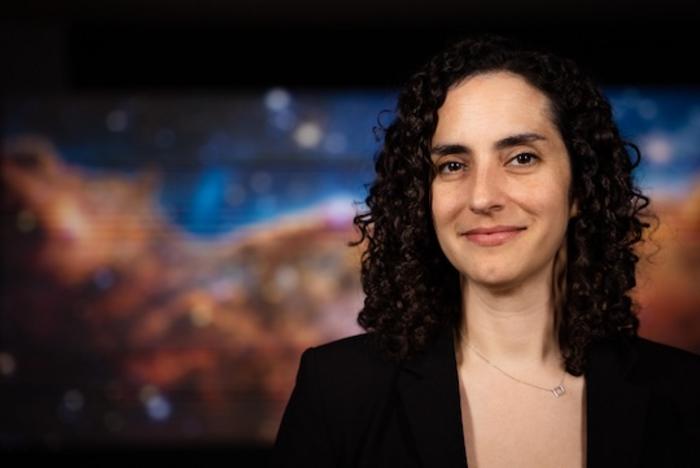
Megan Reiter, an assistant professor of physics and astronomy at Rice University, has won a National Science Foundation (NSF) CAREER Award to investigate the influence of neighboring stars on the formation of planets.

Megan Reiter

Credit: Photo courtesy of Brandon Martin/Rice University.

Megan Reiter, an assistant professor of physics and astronomy at Rice University, has won a National Science Foundation (NSF) CAREER Award to investigate the influence of neighboring stars on the formation of planets.

The research funded by Reiter’s five-year, $951,446 NSF grant will shed light on a phenomenon that could significantly impact our understanding of how planets are born.

“By exploring the intricate interplay between stars, planets and their environments, we hope to clarify the key forces that shape planet formation,” Reiter said.

Observations show planets form in the gas and dust disks surrounding young stars. But as these stars age, their disks disappear, limiting the opportunity for planets to form.

One factor contributing to this disappearance is external photoevaporation, or intense radiation from a nearby, brighter star that can rapidly strip away the material in the disk.

“While we’ve observed this phenomenon in a few cases, our goal is to quantify how significant it is in the larger picture of planet formation,” Reiter said.

The research team plans to leverage a vast dataset of young star clusters. The researchers will measure the disks, the impact of starlight on them and the matter streaming away from them.

It will involve observing thousands of low-mass stars and their disks in high-mass star-forming regions, providing insights into a sample size 100 times larger than previous studies.

Key to the research is the use of sophisticated telescopic technology, including the Multi-Unit Spectroscopic Explorer, an integral field unit spectrograph on the European Southern Observatory’s Very Large Telescope. It will allow the team to separate stellar emission from the nebular background, providing clear data on external photoevaporation and quantifying the mass-loss rate.

“The data we gather will enhance our understanding of planet formation and provide valuable insights for theorists as they model planetary demographics,” Reiter said.

The project also includes an educational component to promote interest and diversity in science, technology, engineering and mathematics. It will involve teacher training and curriculum development for Houston-area schools grades kindergarten to 12th and enhancements to observational lab courses at Rice.

Reiter earned a bachelor’s degree in physics and astrophysics from the University of California, Berkeley and a Ph.D. in astronomy from the University of Arizona. She joined the Rice faculty in 2022.

The highly competitive NSF grants are awarded each year to a select cohort of about 500 early career faculty across all disciplines engaged in groundbreaking research and committed to growing their field through outreach and education.


Subject of Research: Space

Article Title: Rice’s Megan Reiter wins NSF CAREER Award to investigate planet-forming environments

Article References: Original research article

Image Credits: AI Generated

DOI: Not provided

Keywords: Not provided

Cite Scienmag News

Grant Pearson. (April 11, 2024). Rice’s Megan Reiter wins NSF CAREER Award to investigate planet-forming environments. Scienmag. https://scienmag.com/rices-megan-reiter-wins-nsf-career-award-to-investigate-planet-forming-environments/

Grant Pearson. "Rice’s Megan Reiter wins NSF CAREER Award to investigate planet-forming environments." Scienmag, 11 April 2024, https://scienmag.com/rices-megan-reiter-wins-nsf-career-award-to-investigate-planet-forming-environments/. Accessed 5 September 2026.

Grant Pearson. "Rice’s Megan Reiter wins NSF CAREER Award to investigate planet-forming environments." Scienmag. April 11, 2024. https://scienmag.com/rices-megan-reiter-wins-nsf-career-award-to-investigate-planet-forming-environments/

Share27Tweet17
Previous Post

Prestigious European grant for research into biodegradable plastics

Next Post

University of Oklahoma engineer receives $3.1M grant for clean hydrogen technologies

Related Posts

Independent study confirms ice-rich deposits in Mars’ Medusae Fossae Formation
Space

Independent study confirms ice-rich deposits in Mars’ Medusae Fossae Formation

September 5, 2026
Dissipative Torsional Alfvén Waves Detected in Solar Photospheric Flux Tubes
Space

Dissipative Torsional Alfvén Waves Detected in Solar Photospheric Flux Tubes

September 5, 2026
Tangent bundle method computes geodesic deviation to every order
Space

Tangent bundle method computes geodesic deviation to every order

September 5, 2026
Fractal Quantum Mechanics Built on Nambu Dynamics
Space

Fractal Quantum Mechanics Built on Nambu Dynamics

September 5, 2026
New VDIF formatting and network designs enable real-time VLBI observations
Space

New VDIF formatting and network designs enable real-time VLBI observations

September 5, 2026
Closed-form analytical propagator developed for lunar satellite orbits
Space

Closed-form analytical propagator developed for lunar satellite orbits

September 5, 2026
Next Post
University of Oklahoma engineer receives $3.1M grant for clean hydrogen

University of Oklahoma engineer receives $3.1M grant for clean hydrogen technologies

  • Mothers who receive childcare support from maternal grandparents show more optimized

    Mothers who receive childcare support from maternal grandparents show more parental warmth, finds NTU Singapore study

    27656 shares
    Share 11059 Tweet 6912
  • University of Seville Breaks 120-Year-Old Mystery, Revises a Key Einstein Concept

    1061 shares
    Share 424 Tweet 265
  • Bee body mass, pathogens and local climate influence heat tolerance

    682 shares
    Share 273 Tweet 171
  • Researchers record first-ever images and data of a shark experiencing a boat strike

    546 shares
    Share 218 Tweet 137
  • Groundbreaking Clinical Trial Reveals Lubiprostone Enhances Kidney Function

    531 shares
    Share 212 Tweet 133
Science

Embark on a thrilling journey of discovery with Scienmag.com—your ultimate source for cutting-edge breakthroughs. Immerse yourself in a world where curiosity knows no limits and tomorrow’s possibilities become today’s reality!

RECENT NEWS

  • New Multi-Unary encoding scheme packs dense inputs into quantum circuits
  • Stable isotopes reveal passive versus active groundwater storage in fluviokarst systems
  • CFOSAT Ocean Wave Measurements Calibrated and Validated Across Multiple Platforms
  • Soil enzyme activity shows little adaptation to long-term geothermal warming

Categories

  • Agriculture
  • Anthropology
  • Archaeology
  • Athmospheric
  • Biology
  • Biotechnology
  • Blog
  • Bussines
  • Cancer
  • Chemistry
  • Climate
  • Earth Science
  • Editorial Policy
  • Marine
  • Mathematics
  • Medicine
  • Pediatry
  • Policy
  • Psychology & Psychiatry
  • Science Education
  • Social Science
  • Space
  • Technology and Engineering

Subscribe to Blog via Email

Enter your email address to subscribe to this blog and receive notifications of new posts by email.

Join 5,151 other subscribers

© 2025 Scienmag - Science Magazine

Welcome Back!

Login to your account below

Forgotten Password?

Retrieve your password

Please enter your username or email address to reset your password.

Log In
No Result
View All Result
  • HOME
  • SCIENCE NEWS
  • CONTACT US

© 2025 Scienmag - Science Magazine

Discover more from Science

Subscribe now to keep reading and get access to the full archive.

Continue reading