


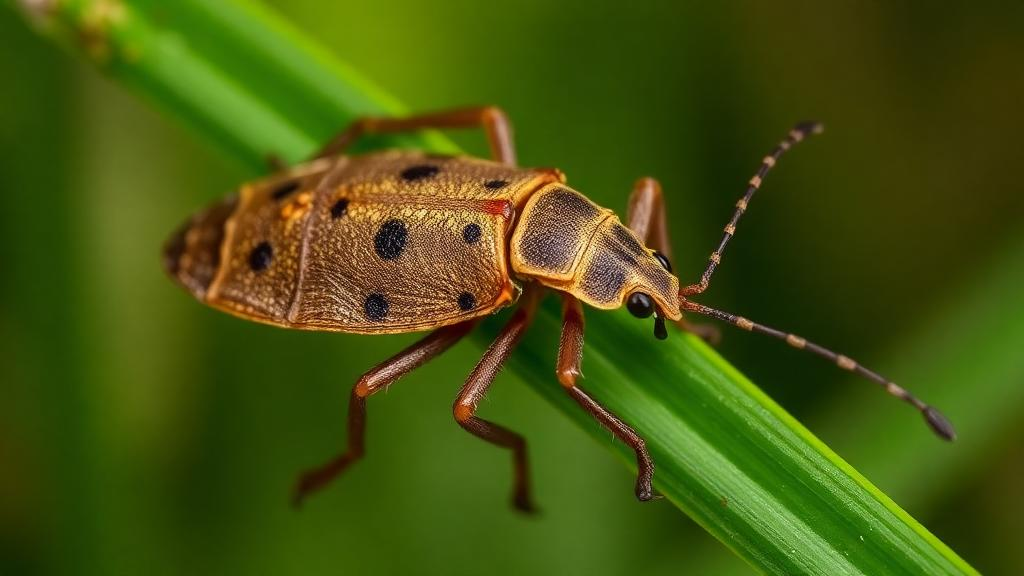
For decades, the rice stink bug has been a quiet but relentless adversary of one of humanity’s most important staple crops. Now, researchers in Arkansas have given the scientific community its most powerful tool yet for understanding the insect: the first chromosome-scale reference genome of Oebalus pugnax, assembled with advanced sequencing technologies and described in the Journal of Heredity. The achievement, led by scientists at the Arkansas Agricultural Experiment Station, the research arm of the University of Arkansas System Division of Agriculture, identifies more than 13,000 genes and opens the door to a new era of data-informed pest management for a crop that feeds nearly half the world’s population.
The significance of the work extends well beyond Arkansas, though the stakes in the Natural State are considerable. Rice is a major crop in Arkansas, which ranks among the leading rice-producing regions of the United States, and the rice stink bug ranks among the most significant threats to the crop. The insect’s feeding damages developing rice grains, reducing both yield and quality, and the economic toll is well documented: the pest cost Arkansas rice growers more than $16 million in 2017 alone, with similar losses estimated in 2018 and 2019, according to figures cited in the research team’s earlier population-genetic study. A reference genome does not eliminate those losses overnight, but it transforms the questions scientists can ask about the insect’s biology.
Rich Adams, an assistant professor of agricultural statistics for the Arkansas Agricultural Experiment Station and corresponding author of the study, described the assembly as a landmark for the field. “This gives us our first chromosome-scale view of the rice stink bug genome,” Adams said. “We were able to assemble much of the nuclear genome, identify more than 13,000 genes and uncover genetic features involved in the insect’s biology and interactions with agricultural systems. It creates a foundation and hypothesis for future studies of rice stink bug biology and management.” Adams is also a teaching faculty member in the department of entomology and plant pathology in the Dale Bumpers College of Agricultural, Food and Life Sciences at the University of Arkansas and a member of the experiment station’s Center for Agricultural Data Analytics.
Technically, the assembly is a substantial feat. Using modern sequencing approaches, the team reconstructed a genome of roughly 826 million base pairs with unprecedented resolution for this species, organizing much of the nuclear genome onto predicted chromosomes and annotating their gene content. Beyond the protein-coding genes, the analysis revealed evidence of approximately 21,000 non-coding RNAs, the regulatory molecules that increasingly are recognized as central players in how genomes orchestrate development and environmental response. The result is the most detailed genomic analysis to date of the rice stink bug and, more broadly, a valuable comparative resource for understanding genome structure and gene family evolution across the stink bug family Pentatomidae, a group that includes many of agriculture’s most notorious plant-feeding pests.
What excites agricultural scientists most, however, is not the raw sequence itself but what the gene content reveals about how this insect makes its living. The analysis identified genes with predicted roles in plant digestion, including carbohydrate-active enzymes, a class of proteins that allows herbivorous insects to break down the complex carbohydrates found in plant tissues. The researchers also uncovered expansions and contractions in gene families associated with key life history traits and agricultural impact, including families linked to feeding, host adaptation and detoxification. Detoxification genes, in particular, are of intense interest because they can underpin a pest’s ability to tolerate the chemical defenses of host plants and, in some cases, the synthetic insecticides deployed against it.
That last point carries real urgency. The rice stink bug feeds on more than 15 host plant species, including grain sorghum, an ecological breadth that reflects a remarkable capacity to adapt to different plant hosts. More troubling still, some populations of the insect have shown resistance to pyrethroid insecticides, the chemical class most commonly relied upon by growers to manage stink bug outbreaks. The new genome identifies genes that may play roles in insecticide resistance, giving researchers a concrete set of molecular targets to monitor. Rather than waiting for control failures to appear in the field, scientists can now look for the genetic signatures of resistance as they emerge, potentially years before they become a widespread management crisis.
Allen Szalanski, a professor of entomology and plant pathology for the experiment station and a co-author of the study, emphasized the breadth of the resource. “This genome provides a foundation for studying genome structure, gene family evolution, plant feeding, host adaptation, detoxification and potential insecticide resistance,” Szalanski said. The new research builds directly on findings from a previous study by Szalanski, Adams and colleagues with the University of Arkansas Division of Agriculture and Florida A&M University, which examined genetic variation among rice stink bug populations across Arkansas, Mississippi, Florida and Cuba. That earlier work, published in Florida Entomologist, analyzed a mitochondrial DNA marker and found high genetic diversity within O. pugnax populations, results that pointed to movement of rice stink bugs among southeastern states and suggested that two invasive Oebalus species found in Florida may have originated in Cuba.
The relationship between the two studies illustrates how modern pest science proceeds in layers. “The first study helped us understand how rice stink bug populations vary genetically and move across regions,” Szalanski said. “This new genome gives us the tools to investigate the biological mechanisms behind those differences and how this pest adapts to rice production systems.” In other words, the population genetics established where the insect goes and how its populations are connected; the genome now provides the mechanistic vocabulary to explain why. If bugs moving among states carry different feeding capacities or resistance profiles, researchers can begin to trace those differences to specific genes and gene families rather than inferring them from field observations alone.
Adams was careful to frame the assembly as a scientific starting point rather than a finished product. Genome assemblies are living resources: as additional data become available, from improved sequencing of wild populations to functional studies of individual genes, researchers can refine the assembly and use it to test new hypotheses about the evolution, behavior and management of rice stink bugs. This iterative model has already transformed the management of other agricultural pests worldwide, where reference genomes have enabled everything from pheromone-based monitoring to the identification of resistance mutations before they spread. The rice stink bug genome places this pest squarely within that modern framework, and the funding support from the Arkansas Biosciences Institute that made the work possible reflects a strategic bet on the value of such foundational resources.
For rice producers, the practical payoff may take years to fully materialize, but the trajectory is clear. “Knowing more about the genetic basis of these traits can ultimately help researchers develop better monitoring and management strategies for rice producers,” Szalanski said. Better monitoring could mean molecular surveillance of resistance alleles across the mid-South; better management could mean control strategies informed by a precise understanding of how the bug digests its host plants and adapts to new ones. The research team included first author Rokeya Akter, a graduate student in the department of entomology and plant pathology, along with co-authors Mahamad Sayab Miya, a senior research assistant, and Duane D. McKenna, the William Hill Professor of Biology and founding director of the Center for Biodiversity Research at the University of Memphis. Together, they have turned one of Arkansas agriculture’s costliest adversaries into one of its most genetically well-characterized insects, and in doing so they have given growers and scientists alike something they have never had before: a complete, chromosome-scale map of the enemy.
Subject of Research: Chromosome-scale genome assembly of the rice stink bug Oebalus pugnax
Article Title: Genome assembly of rice stink bug offers new data-informed tool in fight against costly pest
Article References: Genome assembly of rice stink bug offers new data-informed tool in fight against costly pest. (n.d.). Original publication
Image Credits: AI Generated
DOI: Not provided
Keywords: rice stink bug, genome assembly, Oebalus pugnax, entomology, insecticide resistance, rice production, gene family evolution, host adaptation, detoxification, Pentatomidae, agricultural pest management, Arkansas
Cite Scienmag News
Alan Morgan. (October 4, 2026). Rice stink bug genome decoded in Arkansas, arming scientists against a costly grain pest. Scienmag. https://scienmag.com/rice-stink-bug-genome-decoded-in-arkansas-arming-scientists-against-a-costly-grain-pest/
Alan Morgan. "Rice stink bug genome decoded in Arkansas, arming scientists against a costly grain pest." Scienmag, 4 October 2026, https://scienmag.com/rice-stink-bug-genome-decoded-in-arkansas-arming-scientists-against-a-costly-grain-pest/. Accessed 4 October 2026.
Alan Morgan. "Rice stink bug genome decoded in Arkansas, arming scientists against a costly grain pest." Scienmag. October 4, 2026. https://scienmag.com/rice-stink-bug-genome-decoded-in-arkansas-arming-scientists-against-a-costly-grain-pest/


