


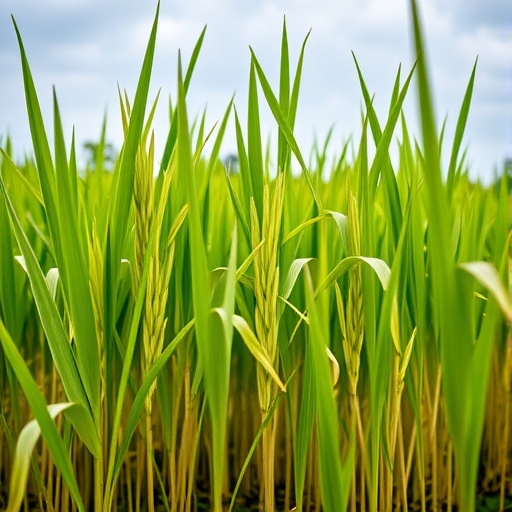
In a groundbreaking study that unravels the intricate biochemical dialogue between plants and their microbial allies, researchers have identified a complete molecular pathway by which rice roots actively recruit beneficial Bacillus bacteria from the rhizosphere. This discovery highlights the role of a mitogen-activated protein kinase (MAPK) cascade in orchestrating the production and secretion of a specific fatty acid, heptadecanoic acid, which in turn facilitates Bacillus colonization and significantly enhances rice’s defense against the devastating fungal pathogen responsible for rice blast disease.
For decades, scientists have understood that plants form complex relationships with soil microbiota, enlisting beneficial microbes to bolster their immunity and improve nutrient acquisition. However, the precise molecular frameworks enabling such selective microbial recruitment have remained elusive. This latest research, conducted by Zeng, Wen, Zhao, and colleagues, bridges that knowledge gap by comprehensively mapping the signaling cascade from pathogen detection to root secretions that modify the microbiome.
At the heart of this signaling network is the OsMKK4–OsMPK6 MAPK cascade, a well-conserved intracellular kinase module implicated in stress responses. Upon infection with Magnaporthe oryzae, the fungal agent of rice blast, this cascade is activated in root tissues, triggering downstream transcriptional regulators. Mutant rice lines deficient in OsMKK4 or OsMPK6 exhibited a dramatic reduction—over 80%—in rhizosphere Bacillus abundance, underscoring the indispensable role of this pathway.
Digging deeper into the molecular underpinnings, the team discovered that OsMPK6 phosphorylates several WRKY transcription factors, namely OsWRKY24, OsWRKY53, and OsWRKY70. These transcription factors act as critical switches that upregulate OsKCS2, a gene encoding β-ketoacyl-CoA synthase, a key enzyme catalyzing the biosynthesis of heptadecanoic acid, a 17-carbon saturated fatty acid not widely recognized for antimicrobial or signaling roles until now.
This intricate regulatory network culminates in the secretion of heptadecanoic acid from rice roots into the surrounding soil. Using advanced metabolomic analyses and root exudate profiling, the researchers demonstrated that wild-type rice plants secrete substantial levels of heptadecanoic acid upon infection, while mutants lacking OsWRKY24/53/70 or OsKCS2 show a 15–28% decrease in secretion. This reduced exudation is directly linked to impaired Bacillus recruitment, illustrating a direct mechanistic link between gene regulation, metabolite biosynthesis, and microbe recruitment.
Why is Bacillus colonization so crucial? Bacillus species are renowned for their plant growth-promoting and biocontrol properties. They produce antibiotics, stimulate plant immune responses, and compete with pathogens for niche space. In large-scale field trials, rice plants with enriched Bacillus populations in their rhizospheres exhibited markedly greater resistance to rice blast disease, highlighting the ecological and agricultural relevance of this recruitment strategy.
By applying exogenous heptadecanoic acid to the root environment, the study elegantly recapitulated Bacillus recruitment and bolstered disease resistance, further validating the functional importance of this fatty acid. This finding opens exciting possibilities for novel agricultural interventions that leverage natural plant–microbe communication pathways to enhance crop resilience in a sustainable manner.
This research integrates multi-omics approaches, combining transcriptomics, proteomics, and metabolomics with precise genetic manipulation to illuminate a heretofore unknown signaling axis controlling microbial recruitment. It establishes a direct conduit linking pathogen recognition, MAPK-driven transcriptional regulation, specialized lipid biosynthesis, and beneficial root microbiome assembly.
Moreover, the discovery of a fatty acid as an active rhizosphere recruitment signal is a conceptual breakthrough. It shifts the paradigm from the classical focus on flavonoids, sugars, and amino acids as root exudates that shape the microbiota, highlighting the diverse chemical language plants employ to sculpt their microbial communities.
The implications extend beyond rice or Bacillus alone. This work suggests that other crops may harness similar MAPK-dependent pathways to modulate their root exudates in response to biotic stress, driving protective microbiome configurations. Understanding these conserved or divergent mechanisms promises to revolutionize microbiome engineering for enhanced plant health.
From a mechanistic standpoint, the OsMAPK–OsWRKY–OsKCS2 axis represents a finely tuned regulatory module where environmental threat perception is transduced into a precise metabolic output, essential for recruiting beneficial microbes. It exemplifies sophisticated cross-kingdom communication encoded at the genetic and biochemical levels.
This study also opens new avenues for breeding and biotechnological approaches. By selecting or engineering crops with heightened responsiveness in this pathway or with enhanced biosynthetic capacity for specific root exudates like heptadecanoic acid, it may be possible to foster naturally disease-suppressive soil microbiomes.
In sum, the research conducted by Zeng et al. provides a vivid molecular portrait of how rice orchestrates its rhizosphere microbiome to defend against blast disease. The identification of heptadecanoic acid as a pivotal biochemical recruiter and the elucidation of the upstream MAPK signaling cascade offer transformative insights into plant immunity and microbiome interactions.
As the global challenge of crop disease intensification and climate stress escalates, strategies that exploit intrinsic plant–microbe partnerships will be paramount. This study lays foundational knowledge for such innovations, paving the path toward sustainable agriculture that harnesses the power of plant-root communication and microbiome engineering.
In closing, this pioneering work not only solves a scientific puzzle about microbial recruitment but also highlights the elegant complexity of the plant’s immune repertoire. It showcases how an ancient signaling cascade can be rewired to control metabolite production with profound ecological consequences.
Future research will likely explore the exact perception mechanisms of heptadecanoic acid by Bacillus, how widespread this recruitment strategy is across plant species, and what additional metabolites and pathways synergize in shaping rhizosphere communities. Such endeavors will ultimately draw a more comprehensive picture of the hidden chemical conversations beneath our feet.
By transforming our understanding of root exudate-mediated microbiome engineering through a defined genetic and biochemical framework, this study marks a milestone in plant science. It represents a major leap forward in decoding the molecular lexicon that enables plants to recruit their microscopic defenders and thrive in challenging environments.
Cite Scienmag News
Alan Morgan. (April 28, 2026). Rice Roots Attract Bacillus Using Heptadecanoic Acid. Scienmag. https://scienmag.com/rice-roots-attract-bacillus-using-heptadecanoic-acid/
Alan Morgan. "Rice Roots Attract Bacillus Using Heptadecanoic Acid." Scienmag, 28 April 2026, https://scienmag.com/rice-roots-attract-bacillus-using-heptadecanoic-acid/. Accessed 5 September 2026.
Alan Morgan. "Rice Roots Attract Bacillus Using Heptadecanoic Acid." Scienmag. April 28, 2026. https://scienmag.com/rice-roots-attract-bacillus-using-heptadecanoic-acid/


