


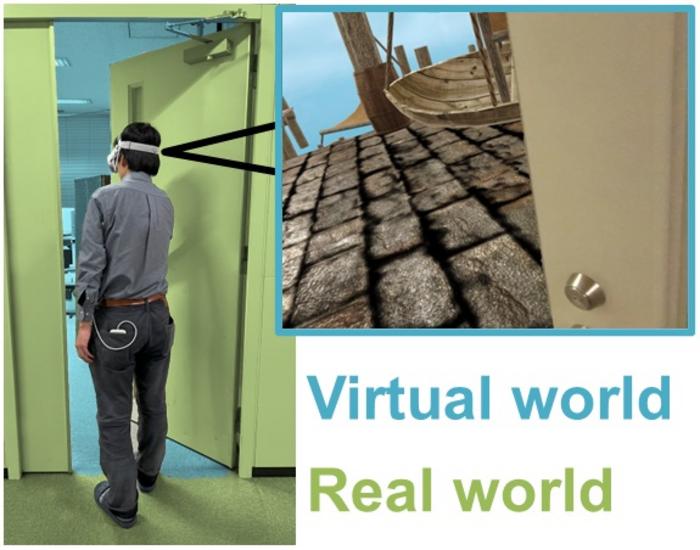
In a groundbreaking advancement in mixed reality, a research team from NTT DOCOMO, Inc. and the Nara Institute of Science and Technology (NAIST) in Japan has developed a novel technology that reimagines real-world doors as gateways to immersive virtual environments. This innovative approach addresses a long-standing challenge within virtual reality (VR) and mixed reality (MR) offerings: achieving seamless and intuitive transitions between the physical and digital realms. The technology promises to significantly enhance user engagement by allowing natural and immersive interactions with virtual spaces through everyday objects.
Historically, VR and MR technologies have struggled to create a genuinely immersive experience. Traditional applications typically rely on artificial barriers or sudden transitions, disrupting the user experience and detracting from the overall sense of presence in virtual environments. The efforts to enhance user immersion have often led to the development of high-end, expensive hardware and rigid systems that do not cater to intuitive human behavior. The innovative technology introduced by NTT DOCOMO and NAIST offers a solution that incorporates real-world architectural elements, such as doors, to serve as conceptual and physical portals to virtual spaces.
At the helm of this pioneering project is Dr. Daiki Hagimori of NTT DOCOMO, together with Professor Kiyoshi Kiyokawa from NAIST, whose collaboration has brought together expertise in telecommunications and mixed reality. Alongside fellow researchers Hideaki Uchiyama, Monica Perusquía-Hernández, and Yutaro Hirao, they have created a sophisticated software system that works seamlessly with head-mounted displays like the Apple Vision Pro. This integration enables users to enjoy a natural transition between physical rooms and their virtual counterparts, facilitating a more enriching user experience.
The team describes their technology’s unique functionality, which allows users to engage with a real-world door by marking its corners within their MR interface. This simple mechanism transforms the door into a smart portal, thus providing a sense of familiarity and ease of access. The moment users push the door open, the system renders a corresponding virtual space that can be tailored to the users’ experiences and preferences. Through this method, the technology enhances the sense of space, bridging the gap between their real-world setting and the newly introduced virtual environment.
Preparing for a transition into a virtual setting has never felt so natural. The researchers have developed advanced hand movement recognition technology that allows users to engage with doors without having to focus intently on the handle, thus promoting a seamless interaction. Once inside the virtual space, users can still see the door functioning as a dynamic window back to reality. Dr. Hagimori emphasized the significance of this feature, explaining that the technology capitalizes on built environments while enriching user engagement in the virtual realm.
This mixed reality technology has numerous implications across various sectors, promising to redefine experiences in tourism, real estate, entertainment, and education. Imagine stepping through a door and finding yourself transported to a remote landmark, or virtually exploring properties from the comfort of one’s home. With this technology, users can personalize their experience in a way that was previously unattainable. The possibilities are nearly endless, enabling businesses to create rich new experiences for their customers.
Tourism operators could leverage this innovation by allowing potential travelers to experience destinations through virtual doors, providing a taste of what they can expect before booking a trip. Meanwhile, real estate professionals could employ the technology to offer immersive property tours, allowing buyers to interact with various aspects of a property without ever physically visiting. This could significantly reduce the time and resources spent on viewings and increase customer satisfaction, as potential buyers can explore more properties in less time.
In the arts and entertainment sectors, this technology could reinvent storytelling and audience engagement. The incorporation of physical spaces as gateways to rich, interactive virtual worlds would allow artists and content creators to craft unique experiences that connect with audiences in meaningful ways. With the ability to capture users’ attention naturally, this development could mark a turning point in how art and stories are experienced across multiple platforms.
In line with their ambition to create personalized experiences, the research team is preparing to showcase their findings at the upcoming Keihanna Expo in Yumeshima, Japan, which forms part of Expo 2025. The event, scheduled for April 23 and September 19, 2025, promises to provide a platform for attendees to delve into this innovative approach to spatial computing. Such exhibitions provide an invaluable opportunity for technology enthusiasts and industry stakeholders to understand firsthand what mixed reality can accomplish.
Collectively, Dr. Hagimori and Professor Kiyokawa’s vision is to establish what they call “Personalized Reality,” focusing on tailored experiences that resonate with individuals on a unique level. Their collaborative research aims to delve deeper into how existing technology can adapt to better serve the multifaceted needs and desires of users. This drive for personalization stands to revolutionize user experiences, setting the stage for future developments in spatial computing.
As advancements in mixed reality and augmented reality continue to evolve, the collaboration between NTT DOCOMO and NAIST serves as a critical reminder of the potential for interdisciplinary partnerships to drive transformative innovation. With technological capabilities expanding at an unprecedented rate, this new technology marks a significant stride forward, integrating real-world interactions with the boundless possibilities of virtual engagement. As society moves toward an increasingly digital future, the inclusion of familiar objects like doors as transition points illustrates how technology can harmonize with everyday life.
Given the caliber of the team behind this technological innovation, one can anticipate further enhancements and applications to emerge as the research continues to evolve. The implications extend beyond mere convenience, beckoning a future where users may navigate seamlessly between realms, immersing themselves completely in experiences both rooted in reality and designed to ignite imagination.
As the collaboration progresses, industry experts and consumers alike will remain attentive to future developments that arise from this technology. With the ongoing support from both NTT DOCOMO and NAIST, the dual pursuit of academic rigor and practical application is set to inspire future innovations in spatial computing, potentially changing the landscape of user experiences across various industries around the globe.
In conclusion, the advent of mixed reality technologies that incorporate physical elements into the interaction process signifies a transformative moment in both the tech industry and daily life. This advancement not only enhances user immersion but also broadens the horizons for how we interact with digital content. Exploring new dimensions of mixed reality through the lens of real-world elements expands the realm of what’s possible, heralding an exciting future for interactive technologies.
Keywords
Mixed Reality, Virtual Reality, User Experience, Spatial Computing, Technology Innovation, Seamless Interaction, Immersive Environments, NTT DOCOMO, Nara Institute of Science and Technology, Personalized Reality, Hand Movement Recognition.
Cite Scienmag News
Denise Maddox. (April 11, 2025). Revolutionizing Entryways: The Future of Mixed Reality Through Transformative Doorways! Scienmag. https://scienmag.com/revolutionizing-entryways-the-future-of-mixed-reality-through-transformative-doorways/
Denise Maddox. "Revolutionizing Entryways: The Future of Mixed Reality Through Transformative Doorways!" Scienmag, 11 April 2025, https://scienmag.com/revolutionizing-entryways-the-future-of-mixed-reality-through-transformative-doorways/. Accessed 4 September 2026.
Denise Maddox. "Revolutionizing Entryways: The Future of Mixed Reality Through Transformative Doorways!" Scienmag. April 11, 2025. https://scienmag.com/revolutionizing-entryways-the-future-of-mixed-reality-through-transformative-doorways/


