


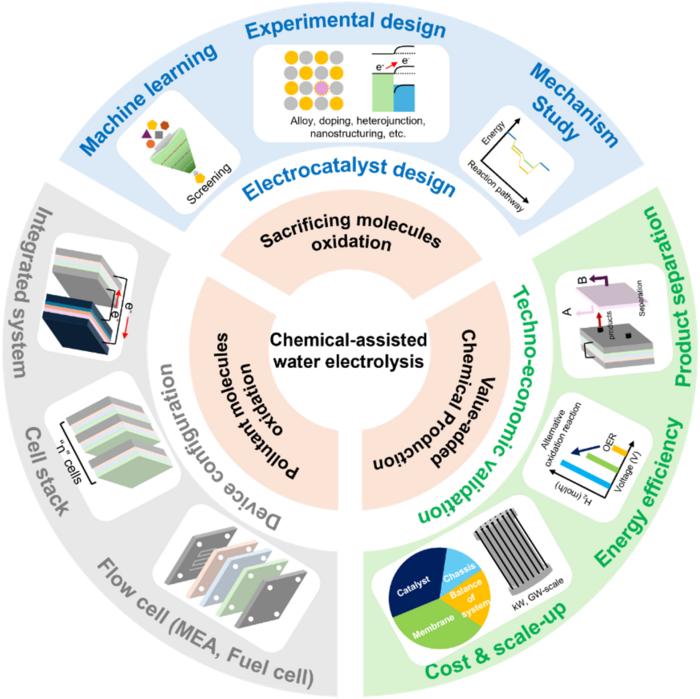
To combat the pressing challenges of climate change and environmental degradation, research in clean hydrogen production technologies is taking center stage. Among the leading contenders for sustainable hydrogen generation is water electrolysis, a process that produces hydrogen gas while circumventing carbon dioxide emissions. Despite its promise, traditional water electrolysis grapples with significant energy efficiency issues, primarily due to the elevated operating voltages required for the process to function optimally. A notable advancement in this arena is chemical water-assisted electrolysis, which has emerged as an innovative solution to these inefficiencies.
Chemical water-assisted electrolysis stands out as a transformative approach, addressing the high-voltage requirements by incorporating various chemical oxidation reactions. By utilizing reactants such as ammonia, alcohol, urea, and hydrazine to facilitate water splitting, this technology not only lowers the operational voltage but also enhances overall energy efficiency. This dual advantage of producing hydrogen while contributing to environmental sustainability positions chemical water-assisted electrolysis as a key player in the transition to cleaner energy sources.
The research community is fervently exploring this technology, leading to the development of various chemical water-assisted electrolysis systems. A recent study published in the journal Industrial Chemistry & Materials has systematically examined the latest catalyst design strategies tailored specifically for this purpose. The research aims to address the high overpotential issues that have historically hindered the efficiency of these reactions, marking a significant leap forward in unlocking the potential of chemical-assisted electrolysis for green hydrogen production.
Professor Ho Won Jang, a leading figure in this research from Seoul National University, emphasizes the importance of this technological evolution. He notes that chemical water-assisted electrolysis represents an innovative strategy to overcome the limitations inherent in conventional water electrolysis. Through a systematic compilation of the latest advancements in catalyst design, the study provides critical insights into enhancing the energy efficiency of diverse chemical water-assisted electrolysis reactions.
Despite the promising advancements, the technology faces several hurdles that must be overcome for broader industrial adoption. Achieving and maintaining catalyst durability during operation remains a challenge, particularly for extended periods. Furthermore, researchers are focused on ensuring low-voltage operational capabilities to make the technology competitive with traditional methods. Ongoing studies into electrochemical reaction mechanisms and the implementation of artificial intelligence in catalyst design are being actively explored to mitigate these issues and propel the technology forward.
Industrial applications of chemical water-assisted electrolysis necessitate robust performance metrics, including high current density and long-term stability—criteria that are critical for commercial viability. To meet these demands, researchers are currently focused on developing membrane electrode assemblies (MEAs). These innovative configurations amalgamate the anode, membrane, and cathode into a single unit, significantly reducing electrical resistance and mitigating mass transfer losses. Such advancements pave the way for achieving the required high current densities while maintaining optimal performance.
In addition to MEAs, the development of fuel cell-type devices capable of operating under high-temperature conditions is underway, further enhancing the performance of chemical water-assisted electrolysis systems. These devices aim to combine efficiency with the long-term durability necessary for industrial applications, ultimately fostering a shift toward self-powered hydrogen production systems. Such advancements not only promise to streamline hydrogen generation but also contribute to a circular economy by addressing energy consumption and resource management.
The primary objective of the recent review published in Industrial Chemistry & Materials is to equip readers with a comprehensive understanding of the current research trends and innovative catalyst design strategies pertinent to chemical-assisted water electrolysis. By presenting a well-rounded blueprint for industrial applications, the authors aspire to stimulate further research and development in this vital field.
Support for this ground-breaking research comes from the National Research Foundation of Korea (NRF), under the purview of the Ministry of Science and ICT. This backing underscores the commitment of institutions to foster advancements in sustainable energy technologies and their development towards practical applications.
As the world grapples with the reality of climate change and seeks effective solutions, the journey towards efficient, clean hydrogen production through chemical-assisted electrolysis represents a significant stride in energy innovation. The ongoing efforts of researchers and institutions to refine and implement these technologies herald a new era in hydrogen economy, showcasing the potential for sustainable and environmentally-friendly energy production.
With continued research and development, including insights from recent literature reviews and experimental studies, the horizon for chemical water-assisted electrolysis is bright, promising to deliver enhanced energy efficiency in hydrogen production. As the scientific community unravels the complexities of this technology, the possibility of integrating clean hydrogen into our energy systems seems increasingly attainable.
In conclusion, as the landscape of energy production evolves, chemical-assisted water electrolysis stands as a beacon of hope for sustainable practices that could significantly mitigate carbon emissions. The collective efforts of researchers and institutions will undoubtedly play a pivotal role in shaping the future of clean energy, ensuring that the transition to a hydrogen economy is both feasible and effective. The potential benefits of this technology not only lie in hydrogen production but also extend to environmental remediation and resource optimization, underscoring its importance in a sustainable future.
Keywords
Clean hydrogen, chemical water-assisted electrolysis, green energy, catalyst design, energy efficiency, low-voltage operation, hydrogen production, environmental sustainability, membrane electrode assembly, fuel cells, long-term stability, industrial applications.
Cite Scienmag News
Bethany Barker. (March 25, 2025). Revolutionizing Clean Hydrogen Production: The Breakthrough of Chemical Water-Assisted Electrolysis. Scienmag. https://scienmag.com/revolutionizing-clean-hydrogen-production-the-breakthrough-of-chemical-water-assisted-electrolysis/
Bethany Barker. "Revolutionizing Clean Hydrogen Production: The Breakthrough of Chemical Water-Assisted Electrolysis." Scienmag, 25 March 2025, https://scienmag.com/revolutionizing-clean-hydrogen-production-the-breakthrough-of-chemical-water-assisted-electrolysis/. Accessed 4 September 2026.
Bethany Barker. "Revolutionizing Clean Hydrogen Production: The Breakthrough of Chemical Water-Assisted Electrolysis." Scienmag. March 25, 2025. https://scienmag.com/revolutionizing-clean-hydrogen-production-the-breakthrough-of-chemical-water-assisted-electrolysis/


