


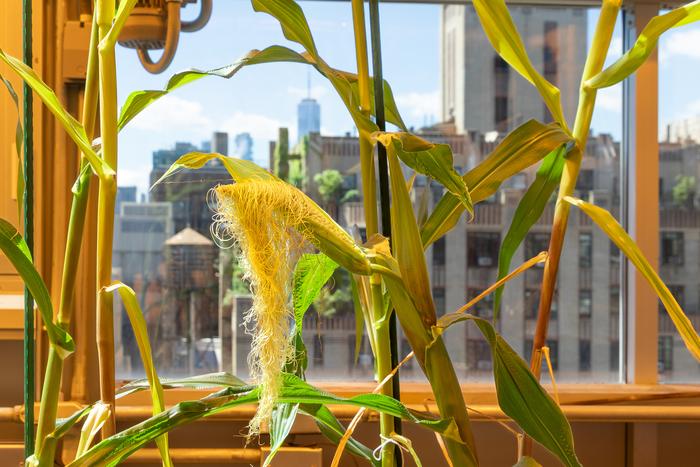
In a groundbreaking advancement at New York University, scientists are pioneering a novel methodology utilizing artificial intelligence (AI) to unravel the complex genetic network that influences nitrogen use efficiency (NUE) in crops, particularly corn. This significant research aims to empower agricultural practices, enabling farmers to enhance crop yields while reducing dependence on nitrogen fertilizers, which have considerable environmental implications. Nitrogen fertilizers have been a staple in modern agriculture, enabling unprecedented crop growth and productivity. However, a staggering reality surfaces when it’s revealed that most crops only utilize approximately 55% of the nitrogen provided yields, with the remainder unfathomably seeping into the environment, necessitating a thorough examination of our current agricultural models.
The challenge lies not only in the economic burden faced by farmers, as they wrestle with the escalating costs of imported nitrogen fertilizers, but also in the wider implications for water quality and climate change. When nitrogen escapes into groundwater, it leads to contamination, resulting in adverse effects such as harmful algae blooms that pose threats to aquatic ecosystems. Furthermore, the residual nitrogen in the soil undergoes microbial transformations into nitrous oxide, a potent greenhouse gas with a warming potential exponentially greater than that of carbon dioxide. Thus, the quest for enhanced nitrogen use efficiency represents a dual opportunity: to bolster agricultural productivity while supporting environmental sustainability.
Leading this charge is Gloria Coruzzi, the Carroll & Milton Petrie Professor in the Department of Biology at NYU. Coruzzi articulates the transformative potential of their research, emphasizing that through pinpointing critical genes responsible for nitrogen utilization, scientists can either select for favorable traits in breeding or even modify the genes themselves. Such advancements could lead to the development of crop varieties that utilize nitrogen more effectively, promising a vast reduction in fertilizer applications and a corresponding decrease in environmental degradation.
The approach taken by Coruzzi’s research team integrates machine learning with insights from plant genetics, a revolutionary perspective that leverages vast datasets to uncover patterns linking genes with traits of interest. Central to their study is the comparative analysis between corn, a staple crop for the U.S. economy, and Arabidopsis, a model organism in plant biology studies. This cross-species examination provides a unique vantage point from which to explore genetic similarities and functional relationships that govern NUE.
Previous research laid the groundwork by identifying conserved nitrogen-responsive genes between corn and Arabidopsis, validating their contributions to nitrogen use. Building on this foundation, the current study dives deeper into the genome, revealing that traits such as nitrogen use efficiency are regulated by groups of genes, known as “regulons.” These regulons are collectively controlled by transcription factors—a class of proteins that regulate gene expression and orchestrate the plant’s response to nitrogen treatment.
The researchers utilized RNA sequencing to analyze how corn and Arabidopsis genes respond when exposed to nitrogen. By harnessing machine learning algorithms, they created models capable of predicting nitrogen use efficiency based on both genotypic and phenotypic data. The evolutionarily conserved genes identified in this study were grouped into NUE regulons and their collective machine learning scores were calculated and ranked. The rigorous methodology employed by the researchers highlights the beauty of machine learning: it reveals complex relationships between multiple genes, rather than attributing physiological traits to singular genetic influencers.
Among the significant findings, two transcription factors were highlighted—ZmMYB34/R3 in corn and AtDIV1 in Arabidopsis. The former regulates 24 nitrogen-related genes in corn, while the latter governs 23 target genes sharing a genetic lineage with corn. This cross-species verification not only strengthens the model but also provides empirical evidence supporting the predicted roles of the identified genes in nitrogen utilization. Furthermore, feeding these validated NUE regulons back into the AI models significantly bolstered predictions for nitrogen use efficiency across various corn varieties grown in field conditions.
The implications of identifying these NUE regulons are profound. By screening corn hybrids at the seedling stage for the expression of identified genes tied to nitrogen use efficiency, farmers can make informed decisions about the varieties they cultivate. Implementing molecular markers at an early growth stage allows for the selection of hybrids most adept at efficiently utilizing nitrogen prior to field planting, ultimately presenting a proactive solution for modern agricultural challenges.
Coruzzi’s vision extends beyond immediate agricultural benefits. The potential to significantly mitigate nitrogen pollution and its cascading environmental effects underlines the importance of this research in the context of global sustainability efforts. Through this innovative intersection of plant genetics and artificial intelligence, the research represents a critical evolution in accurately predicting and managing nitrogen use in crops, echoing the call for environmentally responsible agricultural practices that harmonize productivity with ecological preservation.
The research, listed in a special focus issue of The Plant Cell, emphasizes translational research from model organisms to crop plants, celebrating milestones in plant genomics. New York University has filed a patent covering this pioneering work, suggesting that the implications of these findings could soon shift from academic theory to practical applications in agricultural practice, showcasing the ever-increasing significance of interdisciplinary collaboration in addressing real-world problems.
As this research unfolds, it captures the imagination not only of scientists but of farmers and consumers alike, pointing to tangible pathways toward a more sustainable future in food production. The integration of machine learning within plant genetics promises a new era of precision agriculture, wherein the focus shifts to optimizing resources and achieving ecological balance while continuing to meet the nutritional demands of a growing global population.
Keywords
Cite Scienmag News
Juliet Wilcox. (May 14, 2025). Revolutionizing Agriculture: How AI and Genetics Enable Farmers to Cultivate Corn with Reduced Fertilizer Use. Scienmag. https://scienmag.com/revolutionizing-agriculture-how-ai-and-genetics-enable-farmers-to-cultivate-corn-with-reduced-fertilizer-use/
Juliet Wilcox. "Revolutionizing Agriculture: How AI and Genetics Enable Farmers to Cultivate Corn with Reduced Fertilizer Use." Scienmag, 14 May 2025, https://scienmag.com/revolutionizing-agriculture-how-ai-and-genetics-enable-farmers-to-cultivate-corn-with-reduced-fertilizer-use/. Accessed 3 September 2026.
Juliet Wilcox. "Revolutionizing Agriculture: How AI and Genetics Enable Farmers to Cultivate Corn with Reduced Fertilizer Use." Scienmag. May 14, 2025. https://scienmag.com/revolutionizing-agriculture-how-ai-and-genetics-enable-farmers-to-cultivate-corn-with-reduced-fertilizer-use/


