


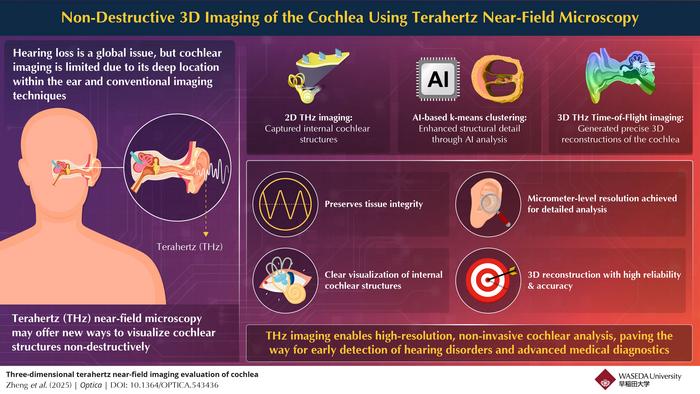
Recent advancements in medical imaging technology have sparked significant interest in addressing hearing disorders, particularly among aging populations. Hearing loss has become a prominent public health concern, as it originates from the cochlea—an essential component of the auditory system. Traditional imaging techniques have struggled to provide the clarity and detail necessary for accurate diagnostics of cochlear structures. This gap in imaging capability has led to ongoing research aimed at developing novel approaches that can visualize the cochlea in exquisite detail.
One such pioneering technique gaining traction is terahertz (THz) imaging, a non-invasive method that employs terahertz radiation for high-resolution visualization of biological tissues. Researchers from Waseda University and affiliated institutions have recently conducted groundbreaking studies demonstrating the potential of THz imaging in the visualization of cochlear architecture. Led by Associate Professor Kazunori Serita, this team has managed to use a micrometer-sized THz point source to investigate the internal structures of the cochlea in mice.
The cochlea is a small, spiral-shaped organ situated in the inner ear, responsible for converting sound waves into neural signals. Thus, understanding its structure is crucial for diagnosing various auditory disorders. The significance of a technique capable of visualizing the cochlea lies in its potential to revolutionize auditory diagnostics. By harnessing THz waves, scientists could achieve deeper tissue penetration and attain unprecedented levels of structural clarity, thereby allowing for accurate assessment and diagnosis of cochlear diseases.
Through innovative methodologies, the research team created micrometer-sized THz point sources utilizing femtosecond lasers, which emit pulses of light at a wavelength of 1.5 μm. This advanced setup not only enabled high-resolution visualization of cochlear structures but also facilitated near-field imaging by positioning the cochlea directly on a GaAs substrate. Such strategic placements optimize the imaging process, gathering comprehensive 2D THz time-domain images across a broad time spectrum, which ultimately results in detailed structural representation at varying depths.
To convert the captured time-domain images into accurate depth scales, the researchers utilized the time-of-flight principle. This crucial application means that every captured THz image corresponds with specific depth, transforming mere images into spatially meaningful data. In addition, the team incorporated k-means clustering, an unsupervised machine-learning method, to identify intricate structural features within the cochlea. The successful deployment of this technique resulted in a 3D reconstruction of the cochlea, culminating in a precise point cloud and surface mesh model that vividly represents the cochlear architecture.
The implications of this groundbreaking research are profound. The study conclusively affirmed the viability of THz imaging as a powerful diagnostic tool for the inner ear, offering detailed insights into cochlear intricacies. The ability to reconstruct 3D models significantly enhances scientific understanding of cochlear structures, a critical advancement for developing targeted treatments for hearing loss.
The potential of terahertz imaging does not merely end with cochlear diagnostics. The researchers speculate that this innovative imaging technique could evolve into miniaturized devices, such as terahertz endoscopes and otoscopes. Such advancements would enable real-time, in vivo imaging for a variety of applications, including dermatology and even early cancer detection. This multifaceted approach could usher in a new era of diagnostics, showcasing how integrating THz technology with existing medical imaging practices could dramatically change the landscape of disease diagnosis.
Moreover, THz technology promises to enhance the efficiency of pathological diagnoses. By significantly reducing the time necessary to conduct tests and receive results, healthcare providers can improve patient outcomes through timely interventions. This capability is particularly crucial in oncology and pathology, where the speed and accuracy of diagnosis correlate directly with treatment efficacy. As researchers continue to explore the possibilities of THz imaging, they recognize its capacity to complement and transform current methods of disease detection.
The collective findings of this study represent a significant milestone within the field of biomedical imaging. They not only reinforce the potential of THz imaging in revealing cochlear structures but also emphasize its adaptability and applicability across various medical disciplines. With its non-invasive, high-resolution capabilities, THz technology stands poised to redefine standards in medical imaging and diagnostics, offering hope for more effective interventions in hearing loss and other related conditions.
These achievements mark a critical advancement in the pursuit of effective diagnosis and treatment for hearing ailments, particularly in aging populations. As researchers continue to refine THz imaging methodologies, the hope is to increase accessibility and integration of this technology within clinical settings. The impact of such innovations on healthcare could substantially improve the quality of life for individuals affected by auditory disorders and further our understanding of the complexities of human biology.
The ongoing research and development of THz imaging technology signal a promising future for non-invasive medical diagnostics. This cutting-edge approach may soon revolutionize our understanding of not only the cochlea but also numerous other biological structures and diseases, opening doors to improved detection, better patient outcomes, and groundbreaking therapeutic options.
As the scientific community continues to explore the vast potential of terahertz imaging, it becomes increasingly clear that this technology is not merely a concept but a tangible tool with the ability to transform medical diagnostics fundamentally. Embracing these advancements will require collaboration, innovation, and a shared vision toward enhancing the future of healthcare.
Through continual research and commitment to advancements in medical imaging, a new paradigm emerges wherein challenges associated with traditional diagnostic methods are efficiently addressed, ensuring that those in need have access to precise and timely interventions.
With the era of THz imaging on the horizon, the medical community stands on the brink of transformative breakthroughs that will undoubtedly reshape our understanding of health and disease, paving the way for a future defined by enhanced diagnostic capabilities and a deeper comprehension of the intricacies of human physiology.
Cite Scienmag News
Nathaniel Bowman. (March 27, 2025). Revolutionary Terahertz Imaging Technology Transforms Non-Invasive Visualization of Cochlea. Scienmag. https://scienmag.com/revolutionary-terahertz-imaging-technology-transforms-non-invasive-visualization-of-cochlea/
Nathaniel Bowman. "Revolutionary Terahertz Imaging Technology Transforms Non-Invasive Visualization of Cochlea." Scienmag, 27 March 2025, https://scienmag.com/revolutionary-terahertz-imaging-technology-transforms-non-invasive-visualization-of-cochlea/. Accessed 3 September 2026.
Nathaniel Bowman. "Revolutionary Terahertz Imaging Technology Transforms Non-Invasive Visualization of Cochlea." Scienmag. March 27, 2025. https://scienmag.com/revolutionary-terahertz-imaging-technology-transforms-non-invasive-visualization-of-cochlea/


