

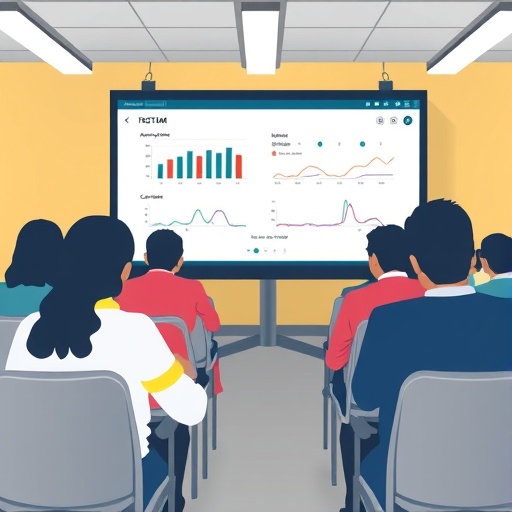
In the contemporary educational landscape, the integration of technology into teaching and assessment methodologies has increasingly become pivotal. A study by Manickam et al. delineates an innovative solution aimed at revolutionizing how formative assessments and attendance monitoring are executed within academic institutions. The integrated system proposed in their research seeks to address significant challenges facing educators today, particularly in the context of real-time evaluation and engagement tracking of students.
Formative assessment has traditionally been characterized by its intermittent and sometimes outdated methods, which do not sufficiently reflect students’ learning progress in real time. The study argues that conventional approaches can lead to gaps in understanding and engagement, which ultimately affect student performance and motivation. By introducing technology into this space, the researchers aim to facilitate a more responsive educational environment that can adapt to students’ needs and provide immediate feedback.
The system proposed by Manickam et al. employs sophisticated algorithms and data analytics tools to enable real-time assessments. This capability allows educators to capture students’ responses and engagement levels instantly, which can be particularly beneficial in large classroom settings where individual attention is often limited. This digital shift not only streamlines the assessment process but also empowers educators to make informed decisions based on instantaneous data, leading to enhanced teaching strategies.
Moreover, the integration of attendance monitoring is a critical aspect of this study. Traditional attendance methods often involve manual tracking and can be prone to inaccuracies, such as misreporting or even ghost attendance. By leveraging technology, the proposed system automates attendance recording through various means, including biometric recognition and digital check-in processes. This offers a dual advantage of heightened accuracy and efficiency, which is essential for both educators and administrative bodies.
In addition to refining formative assessments and attendance monitoring, the research emphasizes the importance of student engagement within the learning process. The integrated system is designed to foster an environment where students are not merely passive recipients of information, but active participants in their educational journeys. This shift could lead to enhanced motivation and ownership of learning outcomes, ultimately resulting in improved academic performance.
An interesting facet of this integrated approach is its potential scalability. The researchers highlight that the system can be adapted to various educational levels, from primary schools to higher education institutions. This adaptability increases the system’s applicability across diverse educational contexts, making it a versatile tool for schools aiming to modernize their assessment and attendance methodologies.
Furthermore, one of the critical outcomes of this study is the potential for increased data-driven decision-making in educational settings. As educators gain access to real-time analytics regarding student performance and attendance, they can tailor their pedagogical approaches to meet students’ individual needs. This personalization aspect is vital, particularly in an era where one-size-fits-all education models are increasingly being scrutinized.
The implications of the research also extend beyond immediate educational advantages. By optimizing formative assessments and attendance processes, institutions can contribute to the overall improvement of educational standards in their respective regions. The ability to effectively track and enhance student engagement can have long-term benefits on graduation rates and overall educational success, making this research not just relevant but crucial for future academic infrastructure.
Additionally, the study encourages a multidisciplinary approach to educational innovation, suggesting that collaboration among educators, technologists, and policymakers is essential. By fostering an ecosystem where these stakeholders can work together, the development and implementation of such integrated systems can become more robust, ultimately leading to a more effective educational landscape.
As they delve further into the technological applications of their proposed system, Manickam et al. underline the importance of user experience and accessibility. It is essential that the tools developed within this framework are user-friendly and accessible to both educators and students. This ensures broad adoption and maximizes the system’s effectiveness, highlighting the need to consider various user demographics during the development phase.
In conclusion, the integrated system for just-in-time formative assessment and attendance monitoring as proposed by Manickam et al. marks a significant stride toward transforming educational practices. By leveraging real-time data and technology, this innovative approach seeks not only to improve the efficiency of assessments but also to enhance the overall educational experience for students and educators alike.
As educational institutions face growing pressures to adapt to modern challenges, research such as this provides a roadmap toward a more effective, data-informed, and student-centered educational model. With continued advancements in technology, the potential for such integrated systems to evolve and further revolutionize the educational landscape seems boundless, ultimately paving the way for a future where education is more inclusive, responsive, and effective.
Subject of Research: Integrated System for Just-in-Time Formative Assessment and Attendance Monitoring
Article Title: An integrated system for just- in-time formative assessment and attendance monitoring.
Article References:
Manickam, S., Al Ismaili, M., Sivamani, R.C. et al. An integrated system for just- in-time formative assessment and attendance monitoring.
Discov Educ 4, 483 (2025). https://doi.org/10.1007/s44217-025-00960-2
Image Credits: AI Generated
DOI: https://doi.org/10.1007/s44217-025-00960-2
Keywords: Formative assessment, attendance monitoring, educational technology, student engagement, data analytics, real-time assessment, adaptive learning, educational innovation.


