


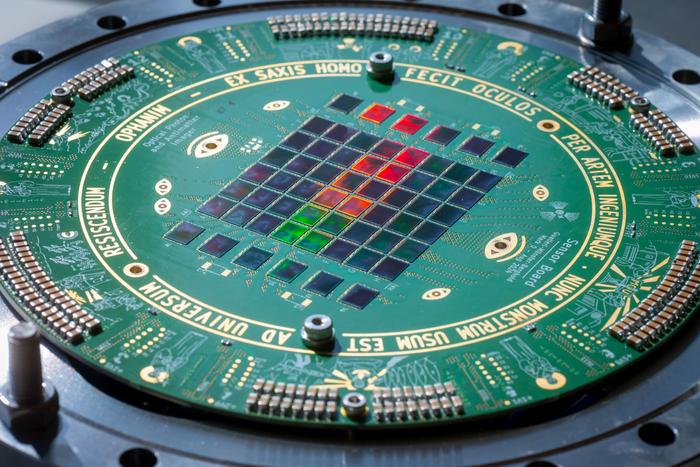
In a groundbreaking development in the field of particle physics, researchers working on the AEgIS experiment at CERN’s Antimatter Factory have unveiled an unprecedented optical anti-matter imager. This revolutionary imaging technology, which utilizes 60 photo sensors scavenged from commercial smartphone cameras, is expected to dramatically enhance our ability to observe and analyze antimatter interactions, particularly focusing on the behavior of antihydrogen in gravitational fields. By achieving spatial resolutions lower than 1 micrometer, the device promises to unveil the minute effects of gravity on antihydrogen, offering insights into longstanding mysteries in physics.
The mission of the AEgIS team is to measure the free-fall of antihydrogen under Earth’s gravity, employing a unique horizontal beam approach. Previous studies in this domain had yielded intriguing theoretical predictions, yet the technical challenges of realizing such experiments had hindered substantial progress. The AEgIS collaboration, comprising a diverse array of researchers and facilities, has now established a novel method to directly track antihydrogen’s responses to gravitational forces through advanced detector technology.
Francesco Guatieri, a key figure from the Technical University of Munich (TUM) and Principal Investigator for the project, has expressed his enthusiasm about the advancements made possible with this technology. “The Optical Photon and Antimatter Imager (OPHANIM) is a significant leap forward in our capabilities. By integrating 60 mobile phone sensors into a single unit, we’ve achieved an impressive pixel count of 3840 million, surpassing traditional photographic plate resolutions," he states. This innovative detector not only brings real-time capabilities to the table but also outstrips previous solutions in terms of particle detection efficiency and resolution.
Historically, the reliance on photographic plates in experiments has been a significant limitation. While these plates provided decent resolution, their inability to deliver real-time data collection rendered them inadequate for modern experimental needs. The development of OPHANIM marks a turning point, bringing together the benefits of photographic plate resolution and the immediacy and self-calibration features of electronic detectors. As Guatieri emphasizes, this technology aligns with the demanding requirements of modern physics experiments, particularly those dealing with rapid and unpredictable antimatter behaviors.
One of the noteworthy aspects of the device’s functionality is its capacity to analyze low-energy positrons—subatomic particles with the same mass as electrons but with a positive charge. Researchers previously revealed that optical image sensors could successfully image these particles in real time. Despite the high complexity involved in adapting smartphone technology for scientific endeavors, including stripping away protective layers designed for consumer electronics, the team succeeded through meticulous engineering efforts.
This endeavor involved significant contributions from master’s students at TUM’s School of Engineering and Design, notably Michael Berghold and Markus Münster, who played pivotal roles in refining the technology. Their work underscored the critical nature of hands-on experimentation and innovation in advancing scientific research, particularly in an era where interdisciplinary collaborations between engineering and physics are essential to break new ground in our understanding of the universe.
The ramifications of the OPHANIM technology extend beyond the immediate goals of measuring antihydrogen and could revolutionize various areas of experimental physics. Dr. Ruggero Caravita, AEgIS spokesperson, has highlighted the technology’s transformative potential, stating that the extraordinary resolution achieved allows for the distinction between different annihilation fragments. This represents a significant advancement in our understanding of low-energy antiparticle annihilation, opening up new avenues for research and discovery.
The implications of such advancements are not solely confined to the realm of antimatter; many scientific investigations could benefit from improved position resolution and real-time diagnostic capabilities. In particular, experiments necessitating meticulous tracking of particles could leverage this technology, expediting the discovery processes across a multitude of fields in particle physics and beyond.
As these experiments progress, the research team hopes to unveil more about the fundamental behavior of matter and antimatter under various circumstances, including the influence of gravity. By examining how antihydrogen interacts with gravitational fields, scientists aim to address profound questions regarding the symmetry between matter and antimatter, an inquiry that has perplexed physicists since the inception of modern physics.
The journey of translating mobile technology into a robust experimental tool speaks volumes about innovation’s role in modern scientific inquiry. As researchers continue to refine this hybrid technology, the hope is that it will not only yield groundbreaking findings in the context of antihydrogen but also inspire further explorations into the quantum realm where gravity’s effects on antimatter could illuminate pathways toward understanding the cosmos better.
In conclusion, the development of the Optical Photon and Antimatter Imager represents a milestone in our quest to unveil the mysteries of antimatter. As researchers persevere in unraveling the intricacies of antihydrogen free-fall, the OPHANIM technology stands poised to potentially reshape our understanding of fundamental forces in nature and catalyze a new era of discovery in particle physics.
Keywords
Antimatter, AEgIS, antihydrogen, optical imaging, particle physics, smartphone sensors, CERN, gravity.
Cite Scienmag News
Katie Riggs. (April 2, 2025). Revolutionary Smartphone Photo Sensors Repurposed as High-Resolution Antimatter Camera. Scienmag. https://scienmag.com/revolutionary-smartphone-photo-sensors-repurposed-as-high-resolution-antimatter-camera/
Katie Riggs. "Revolutionary Smartphone Photo Sensors Repurposed as High-Resolution Antimatter Camera." Scienmag, 2 April 2025, https://scienmag.com/revolutionary-smartphone-photo-sensors-repurposed-as-high-resolution-antimatter-camera/. Accessed 6 September 2026.
Katie Riggs. "Revolutionary Smartphone Photo Sensors Repurposed as High-Resolution Antimatter Camera." Scienmag. April 2, 2025. https://scienmag.com/revolutionary-smartphone-photo-sensors-repurposed-as-high-resolution-antimatter-camera/


