


Certainly! Here is the rewritten article based on the provided details:
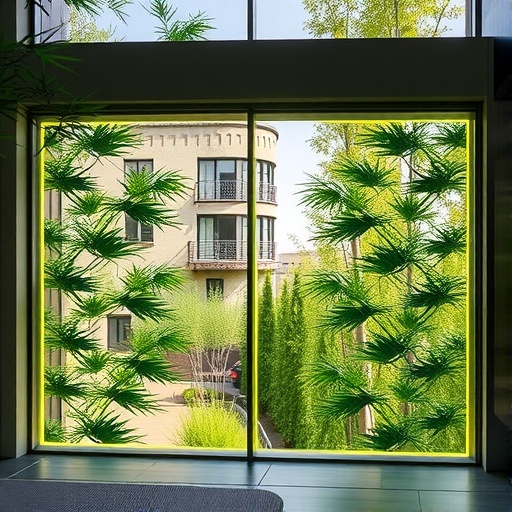
In a remarkable stride toward sustainable architecture, researchers have unveiled a groundbreaking innovation in window technology that harnesses the inherent properties of bamboo, one of nature’s fastest-growing plants. This new window material, which incorporates tungsten–vanadium oxide (W-VO2), presents a vivid alternative to conventional glass. The research indicates that these bamboo-based windows can dynamically adapt to environmental conditions, thereby aligning with modern demands for energy efficiency and sustainable living.
Windows are notorious for being the weakest thermal link in buildings, significantly impacting energy consumption. Roughly 40 percent of global energy use can be attributed to buildings, with windows contributing considerably to heat loss in winter and overheating in summer. Traditional glass, while widely used, invites glare and thermal inefficiencies that lead to increased reliance on heating and cooling technologies. The pursuit of alternatives has led to the development of a biodegradable window that not only addresses these inefficiencies but also offers a myriad of additional benefits.
The methodology employed by the research team is both novel and efficient. The process begins with bamboo boards that are treated with peroxyacetic acid at controlled temperatures to remove lignin, an organic polymer that contributes to the wood’s coloration. By omitting lignin while preserving the structural integrity of cellulose and hemicellulose, the team successfully enhances the material’s properties. The subsequent compression of the delignified bamboo mat ensures a significant reduction in thickness while maintaining the unique alignment of its nanofibrils. The results yield a composite material that boasts a remarkable tensile strength of 870 megapascals, far exceeding that of untreated bamboo and comparative to advanced transparent biomass materials.
In terms of physical properties, the newly engineered bamboo window exhibits a density greater than that of untreated bamboo. The combined strength properties include an impressive resistance to bending and substantial impact toughness. This strength means the material can withstand forces that would typically shatter glass, providing enhanced safety for building occupants. Early tests revealed that the material maintains light transmittance levels of 78%, accompanied by an 86% haze, which effectively diffuses glare and promotes better indoor illumination.
As the material development progressed, a thermochromic coating was added, incorporating W-VO2 particles in a polylactic acid matrix. This cutting-edge feature brings “intelligence” to the material, enabling the window to adapt to temperature fluctuations. At lower temperatures, the window allows a substantial amount of visible light and near-infrared light transmission. However, as temperatures rise, the W-VO2 transitions to a metallic state, drastically reducing solar heat absorption without obstructing light flow, ultimately improving indoor comfort levels and reducing reliance on air conditioning systems.
Energy modeling simulations performed under various climatic conditions provide promising insights into the energy savings potential of this innovation. By incorporating smart bamboo windows into the design of new buildings, or retrofitting existing structures, significant reductions in heating, ventilation, and air conditioning (HVAC) energy consumption are achievable. The models suggest annual energy savings of approximately 5.58% in hot climates like Guangzhou, with varied but significant savings across other regions, solidifying the bamboo window’s role in addressing climate-specific energy demands.
In addition to energy efficiency, a cradle-to-gate life-cycle assessment reveals that these bamboo/W-VO2 composites reduce greenhouse gas emissions, including a 35% reduction in global warming potential and a 46% decrease in particulate matter emissions compared to conventional glass. These metrics stamp the ecological credentials of this bamboo innovation as it highlights a path toward sustainable building materials that benefit both the environment and energy consumers.
Responsible material disposal is another critical component of this initiative. End-of-life biodegradation processes have been carefully considered, allowing for the recovery of W-VO2 particles. This solution promotes a circular economy where waste is minimized, and materials can be recycled or composted rather than sent to landfills. The innovation thus champions not merely energy savings but also a sustainable lifecycle for its materials, setting a new standard for future construction projects.
In terms of scalability, the research indicates that existing bamboo-panel production lines and roll-to-roll coating technologies could be adapted for commercial scale. The cost-effective production of large panes measuring 2 meters by 1 meter appears viable, especially as output exceeds 10,000 square meters per year. This aspect promises to render the technology economically competitive with current low-emissivity glass products, paving the way for broader market adoption.
Despite the many advantages, the researchers note that challenges regarding long-term ultraviolet stability and fire safety compliance with building codes remain. There is ongoing optimism that the intrinsic flame-retardant properties of cellulose could suffice in addressing fire performance concerns. If this technology gains traction, it has the potential to revolutionize windows not just in China but across global markets.
In conclusion, the collaboration of materials scientists and engineers signals a bold step forward in sustainable construction practices. Should this bamboo window technology become commonplace, the environmental impact could be transformative. Its integration into China’s urban environments alone could result in the conservation of approximately 150 terawatt-hours of electricity annually, a figure comparable to the energy output of the Three Gorges Dam. This initiative exemplifies the fusion of nature-inspired design with cutting-edge technology, offering a blueprint for future sustainable living.
Keywords
Bamboo, Sustainability, Sustainable energy, Sustainable development, Environmental impact assessments, Building construction, Architecture
Cite Scienmag News
Denise Maddox. (November 13, 2025). Revolutionary Smart Bamboo Glass Slashes Energy Costs and Reduces Carbon Footprint. Scienmag. https://scienmag.com/revolutionary-smart-bamboo-glass-slashes-energy-costs-and-reduces-carbon-footprint/
Denise Maddox. "Revolutionary Smart Bamboo Glass Slashes Energy Costs and Reduces Carbon Footprint." Scienmag, 13 November 2025, https://scienmag.com/revolutionary-smart-bamboo-glass-slashes-energy-costs-and-reduces-carbon-footprint/. Accessed 3 September 2026.
Denise Maddox. "Revolutionary Smart Bamboo Glass Slashes Energy Costs and Reduces Carbon Footprint." Scienmag. November 13, 2025. https://scienmag.com/revolutionary-smart-bamboo-glass-slashes-energy-costs-and-reduces-carbon-footprint/


