


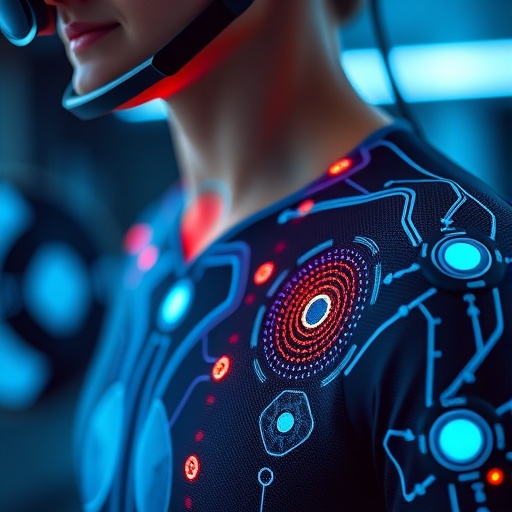
Researchers at Carnegie Mellon University have embarked on a groundbreaking project aimed at enhancing human sensory experiences through innovative wearable technology. The Soft Machines Lab, under the leadership of Professor Carmel Majidi, has introduced a flexible, skin-mounted haptic interface designed to provide rich tactile feedback without the cognitive load often associated with advanced technologies. This device, which is roughly the size of a thimble, accomplishes impressive feats including enabling users to experience sensations while interacting with virtual objects.
The haptic interface is powered by a unique shape memory alloy (SMA) actuator, allowing it to produce eleven distinct multi-directional movements. This capability is significant because it consolidates what traditionally would require multiple actuators into a single structure, minimizing the complexity and potential failure points in the hardware design. Through a delicate epoxy probe, the device safeguards the user’s skin from any heat generated, ensuring comfort during use.
In an era where virtual and augmented reality applications are rapidly transforming industries such as gaming, healthcare, and manufacturing, the fusion of reality and digital worlds becomes increasingly significant. By seamlessly melding these experiences, the haptic interface not only augments the realism of virtual interactions but also encourages more natural user engagement. For instance, in one application, a user wearing this wearable technology was able to feel the physical sensations associated with manipulating virtual objects while using a VR headset, marking a significant step in immersive multi-sensory experiences.
The device has been subjected to various tests demonstrating its versatility across different contexts. One of the most compelling scenarios involved synchronizing the haptic device with a camera to assist in daily activities. In this instance, a user was guided in placing a painting at a desired location on a wall, receiving discreet, differential tapping feedback to direct their movements. This highlights the potential of the technology to transcend mere entertainment applications and extend its utility into practical, everyday life situations.
Perhaps the most revolutionary application showcased the wearable’s ability to assist individuals with visual impairments. By providing directional cues, the device enabled a blindfolded user to locate specific objects on a table, such as fruit and utensils, suggesting a transformative potential for enhancing autonomy and navigation capabilities for people with disabilities. This application not only illustrates the technology’s functionality but also its profound implications for accessibility, offering a tangible solution to alleviate some of the challenges faced by visually impaired individuals.
The collective goal of the Soft Machines Lab is to democratize technology that is inherently intuitive and unobtrusive, allowing users to immerse themselves fully without distractions. “We are building imperceptible technology that requires minimal cognitive effort,” said Professor Majidi, emphasizing the importance of user experience in design. The team believes that as the device progresses, it may facilitate novel interactions between humans and machines, potentially leading to advancements in fields like robotics and human-computer interfaces.
The implications for educational applications are also significant. Suppose this technology can be scaled and integrated effectively into educational settings. In that case, it may provide unprecedented methods of teaching delicate skills, such as playing musical instruments or performing precise surgical procedures, by allowing learners to receive instantaneous feedback during practice.
Safety considerations have been paramount in the development of the haptic interface. The carefully designed components mitigate risks associated with overheating, while the lightweight and flexible nature of the device ensures comfort during extended use. These aspects are crucial in fostering user trust and encouraging broader adoption in various environments, including medical and educational fields.
Looking ahead, the team at Carnegie Mellon is committed to ongoing research and development, aspiring to explore additional applications that can leverage the haptic interface’s capabilities. As they experiment with various configurations and use cases, they remain optimistic about the potential for this technology to reshape the sensory experiences associated with both virtual and real-world engagements.
The research results have been published in the prestigious journal Nature Electronics, further validating the significance of the findings and enhancing the laboratory’s profile within the global research community. By emphasizing a collaborative approach with interdisciplinary partners, the possibilities for innovation in this space are practically limitless.
Overall, the strides made by the Soft Machines Lab exemplify the convergence of engineering, design, and accessibility, culminating in a device that encourages interaction without barriers. As technology evolves, the vision of seamlessly integrating digital and physical worlds while augmenting human capabilities appears ever closer to reality.
Researchers anticipate that future advancements in the area of wearables will not only provide tactile feedback but will also broaden to include various forms of sensory input, such as auditory or visual signals. With a mission to create universally accessible solutions, the potential social impact of this work is immense, indicating a future where technology can enhance daily living for everyone, including those with disabilities.
This work exemplifies the exciting frontier of wearable technology, rooted in academic research yet poised for practical applications that can transform everyday tasks into engaging and interactive experiences. As these innovations continue to develop and integrate into our lives, they promise a future where technology fosters inclusion and enriches human interactions.
Keywords
Wearable devices, Haptic feedback, Robotics, Soft robotics, Tactile sensors, Bioelectronics, Human-machine interfaces, Virtual reality, Engineering, Electronics.
Cite Scienmag News
Denise Maddox. (September 2, 2025). Revolutionary Skin-Mounted Haptic Interface Effortlessly Connects Virtual and Real-World Experiences. Scienmag. https://scienmag.com/revolutionary-skin-mounted-haptic-interface-effortlessly-connects-virtual-and-real-world-experiences/
Denise Maddox. "Revolutionary Skin-Mounted Haptic Interface Effortlessly Connects Virtual and Real-World Experiences." Scienmag, 2 September 2025, https://scienmag.com/revolutionary-skin-mounted-haptic-interface-effortlessly-connects-virtual-and-real-world-experiences/. Accessed 6 September 2026.
Denise Maddox. "Revolutionary Skin-Mounted Haptic Interface Effortlessly Connects Virtual and Real-World Experiences." Scienmag. September 2, 2025. https://scienmag.com/revolutionary-skin-mounted-haptic-interface-effortlessly-connects-virtual-and-real-world-experiences/


