


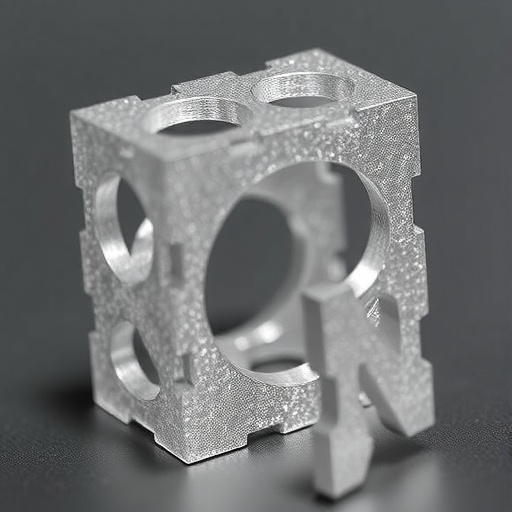
In recent advancements in the field of additive manufacturing, researchers have unveiled a significant breakthrough in enhancing the mechanical properties of 3D-printed metals. This innovation, published in the esteemed International Journal of Extreme Manufacturing, focuses on a dual post-processing technique that successfully increases both strength and ductility—two characteristics that have long been considered mutually exclusive in the world of metallurgy. The study highlights a synergistic approach combining deep cryogenic treatment and laser shock peening, aimed at transforming the microstructural attributes of additively manufactured metals.
The prominent issue plaguing metal 3D printing processes, particularly Laser Powder Bed Fusion (LPBF), is the internal stresses and irregular microstructures that arise from the rapid heating and cooling cycles associated with high-energy laser operation. Each layer of metal, formed at incredible speeds, retains these stresses, leading to vulnerability in the final product. Prof. Xudong Ren, the study’s lead researcher, articulated the inherent dangers posed by these residual stresses, which act like invisible cracks poised to propagate and compromise the integrity of the metal at critical moments.
Conventional heat treatments have traditionally been employed to alleviate these stresses but often diminish the overall strength of the material in the process. Thus, the challenge arose for researchers to devise a method that would simultaneously bolster strength and maintain ductility—attributes essential for the development of reliable components in high-stakes industries such as aerospace, automotive, energy, and defense. Through rigorous experiments and innovative techniques, the research team aims to bridge this long-standing gap, delivering promising results.
At the heart of this study is the metastable high-entropy alloy (Fe₅₀Mn₃₀Co₁₀Cr₁₀), a complex amalgamation of various elements known for its mechanical resilience and corrosion resistance. Rather than altering its chemical composition, the researchers concentrated their efforts on optimizing post-processing methodologies. They began with deep cryogenic treatment, which involved immersing the fabricated alloy in liquid nitrogen at an extreme temperature of -196 °C. This aggressive cooling process served a dual purpose: it mitigated global thermal stresses and refined the alloy’s microstructure to enhance performance.
Following the cryogenic treatment, laser shock peening was employed, a technique that applies high-energy laser pulses to the material’s surface to induce dynamic shock waves. These shock waves plastically compress the metal, effectively altering its internal architecture and providing a considerable boost to its strength. As Dr. Zhaopeng Tong, the primary author of the paper, explained, the combined treatments rearranged the alloy’s internal framework, resulting in a remarkable gradient of densely packed nanocrystals while converting harmful tensile stresses into beneficial compressive ones.
The implications of these transformations are impressive. The treated alloy exhibited a shift to compressive surface stress, observable peak stress levels reaching -289 MPa, and an enhanced surface hardness measuring 380.8 HV. Most importantly, the integration of these processes allowed the researchers to achieve the elusive balance of increased strength alongside enhanced ductility—an essential requirement for parts that must endure significant stresses during use.
This groundbreaking research holds particular promise not only due to its innovative techniques but also because of its practicality. Both deep cryogenic treatment and laser shock peening are already established processes within the industrial landscape. By sequencing these techniques, the research team provided a feasible solution that can be assimilated into existing manufacturing infrastructures, potentially leading to significant advancements in the production of high-performance metal components.
Moreover, this novel integrated strategy allows for fine-tuning both the surface properties and the metallurgical attributes of 3D-printed metals. Overcoming the traditional trade-off between strength and ductility stands as a critical milestone in material design, primarily when considering the pressing demands of structural materials in advanced manufacturing. The team’s future aspirations include extending their findings to other metal systems and alloys, thereby broadening the applicability of their methodologies across various manufacturing domains.
From engines in aircraft to components in medical implants, the need for materials capable of withstanding rigorously high stresses while maintaining safety is paramount. The researchers have placed themselves at the forefront of a paradigm shift toward a future brimming with possibilities for stronger, safer, and more sustainable metal manufacturing practices. Their work not only advances the frontiers of material science but also paves the way for innovations that could eventually revolutionize how we conceive of and fabricate metal components in demanding applications.
As the fields of additive manufacturing and material science continue to evolve, this study heralds a new chapter where the once-disparate goals of strength and ductility in metal 3D printing may finally converge into a harmonious balance, facilitating the development of the next generation of resilient, high-performance materials.
Through rigorous exploration of the mechanical properties of advanced alloys and the deployment of innovative post-processing techniques, the research community is inching closer to breaking the barriers that have long hindered progress in additive manufacturing. In the coming years, it is anticipated that these findings will not only inspire further research but will also lead to widespread adoption and transformation within the industry, ultimately enhancing the safety and reliability of critical components used across various sectors.
The impact of this breakthrough could resound throughout the engineering landscape, prompting manufacturers to rethink their approaches and embrace new methodologies. The journey towards optimizing the properties of additively manufactured metals is far from over, but with the groundwork laid by this research, the possibilities seem virtually limitless.
Strong and ductile materials will serve as the backbone for future innovations, influencing the design and manufacture of everything from intricate aerospace components to vital medical devices. Researchers eagerly look toward a future where advanced manufacturing technologies can deliver unprecedented material capabilities, setting new benchmarks for performance and safety in a rapidly evolving technological landscape.
Keywords
Additive Manufacturing, Strength, Ductility, High-Entropy Alloys, Deep Cryogenic Treatment, Laser Shock Peening, Metal 3D Printing, Aerospace Engineering, Mechanical Properties, Post-Processing Techniques, Material Science.
Cite Scienmag News
Denise Maddox. (October 22, 2025). Revolutionary Post-Processing Technique Enhances Tensile Strength and Ductility in 3D-Printed Alloys. Scienmag. https://scienmag.com/revolutionary-post-processing-technique-enhances-tensile-strength-and-ductility-in-3d-printed-alloys/
Denise Maddox. "Revolutionary Post-Processing Technique Enhances Tensile Strength and Ductility in 3D-Printed Alloys." Scienmag, 22 October 2025, https://scienmag.com/revolutionary-post-processing-technique-enhances-tensile-strength-and-ductility-in-3d-printed-alloys/. Accessed 3 September 2026.
Denise Maddox. "Revolutionary Post-Processing Technique Enhances Tensile Strength and Ductility in 3D-Printed Alloys." Scienmag. October 22, 2025. https://scienmag.com/revolutionary-post-processing-technique-enhances-tensile-strength-and-ductility-in-3d-printed-alloys/


