


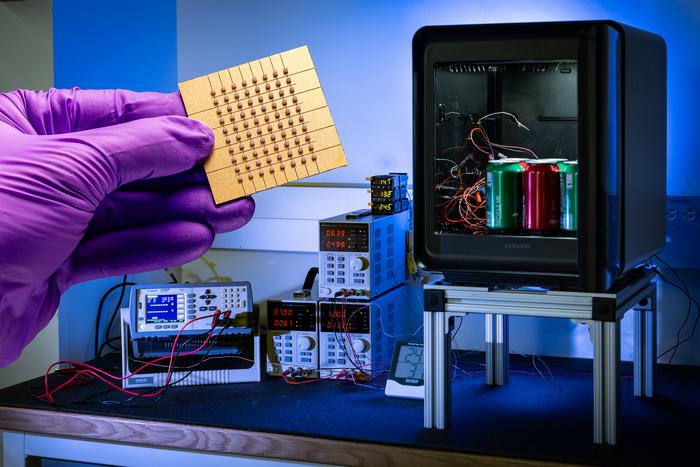
Researchers at the Johns Hopkins Applied Physics Laboratory (APL) have made a groundbreaking advancement in the realm of thermoelectric materials and refrigeration technology, with the introduction of a new class of materials known as controlled hierarchically engineered superlattice structures (CHESS). This novel approach has the potential to revolutionize the efficiency and effectiveness of solid-state cooling devices, providing a sustainable alternative to traditional compressor-based refrigeration systems that dominate today’s market. The study produced by APL researchers and engineers from Samsung Electronics not only illustrates the remarkable performance of these new materials but also provides a blueprint for future advancements in the field.
Solid-state thermoelectric refrigeration has long been regarded as a potentially game-changing technology due to its ability to operate without moving parts, reducing energy consumption and minimizing noise. Historically, however, commercially available thermoelectric materials have faced performance limitations, hindering their broader application in high-efficiency systems. APL’s CHESS materials, developed over a decade of research, address these challenges head-on, achieving nearly double the efficiency of conventional thermoelectric materials at room temperature. This significant leap forward in material performance opens doors to a wide variety of applications in industries that demand compact and efficient cooling solutions.
In a recent publication in Nature Communications, APL’s collaborative research team conducted rigorous tests comparing refrigeration modules built using traditional bulk thermoelectric materials to those crafted with CHESS thin-film materials. The findings were nothing short of revolutionary. They discovered that the new CHESS materials demonstrated nearly 100% improvement in thermal efficiency when confronted with standard cooling demands of everyday refrigerator systems. This efficiency improvement translates to a substantial upgrade in the performance metrics of refrigeration technologies, enabling these systems to deliver better cooling while consuming less energy.
The CHESS mechanism capitalizes on nano-engineered features that elevate heat-pumping capacity, which is crucial for the performance of any refrigeration system. By implementing advanced engineering techniques, the researchers were able to create thin films that excel in moving heat through specialized semiconductor materials. This innovative technology not only heralds a new era for thermoelectric devices but sets a new benchmark in energy efficiency that is critically needed in our increasingly technology-driven world. The need for reliable cooling solutions continues to grow as global temperatures rise and urban populations expand, creating mounting pressure on existing cooling technologies.
One of the most compelling aspects of the CHESS technology is its scalability. Unlike traditional systems that rely heavily on bulky components and chemical refrigerants, CHESS materials can be integrated into smaller, more efficient devices without compromising performance. This means that as the technology matures, it could easily transition from small-scale applications—such as portable refrigerators—to large systems capable of cooling entire buildings. This adaptability emphasizes not only the flexibility of the technology but also its importance in addressing environmental concerns associated with conventional cooling methods, which often involve harmful substances and energy-inefficient operations.
The research team leveraged advanced manufacturing techniques to fabricate these materials, employing metal-organic chemical vapor deposition (MOCVD). This established method is widely used in the production of high-efficiency solar cells, demonstrating its capacity for large-scale manufacturing. The employment of MOCVD means that the CHESS materials can be produced in bulk, leading to reduced production costs and accelerated market entrance. This financial viability is essential for ensuring that new technologies can compete with and eventually supplant older, less environmentally-friendly systems.
The CHESS materials come in incredibly small quantities, requiring merely 0.003 cubic centimeters per refrigeration unit—approximately the size of a grain of sand. This efficiency in material usage underscores not only the innovative nature of the CHESS technology but also its potential impact on the supply chain of cooling products. This drastic reduction in required materials can facilitate production scalability while driving down costs, thus enhancing accessibility across various market segments.
Looking ahead, the implications of the research extend beyond mere refrigeration solutions. The ability of CHESS materials to convert temperature differences, such as human body heat, into usable power introduces exciting possibilities. This feature could support a range of applications, particularly in wearable technology where efficient energy conversion is essential. The integration of such materials could unlock new ways to power devices, allowing for self-sustained systems that capitalize on ambient energy—broadening the horizons of energy harvesting technologies.
Continuing research in this field will not only focus on increasing the efficiency of thermoelectric materials to challenge traditional mechanical cooling systems but will also explore the integration of artificial intelligence to optimize cooling systems further. By employing smart technologies, it may be possible to enhance energy efficiency dramatically, catering to compartmentalized cooling needs within modern HVAC systems. This integration represents a proactive approach to evolving existing technologies to meet consumer demands while adhering to environmental sustainability.
The success of this collaborative project between the APL researchers and industry experts from Samsung Electronics signals a transformative shift in cooling technology. It emphasizes that high-efficiency solid-state refrigeration is not just a scientific curiosity but a commercially viable solution that can be manufactured at scale. As this technology continues to develop, it stands poised to make a substantial impact on sectors yearning for energy-efficient and sustainable cooling solutions amid rising global temperatures.
In conclusion, the advancements achieved through the development of CHESS materials mark a significant step forward, not only in terms of thermoelectric cooling devices but also regarding broader applications in energy harvesting and electronics. With ongoing efforts to refine and commercialize these innovations, APL and its partners aim to establish a new era in thermoelectric technology, one that is capable of addressing modern challenges while paving the way for sustainable solutions in the energy landscape.
Keywords
Thermoelectric materials, solid-state cooling, refrigeration technology, nanotechnology, energy efficiency, environmental sustainability.
Cite Scienmag News
Denise Maddox. (May 21, 2025). Revolutionary Nano-Engineered Thermoelectrics Pave the Way for Scalable, Compressor-Free Cooling Solutions. Scienmag. https://scienmag.com/revolutionary-nano-engineered-thermoelectrics-pave-the-way-for-scalable-compressor-free-cooling-solutions/
Denise Maddox. "Revolutionary Nano-Engineered Thermoelectrics Pave the Way for Scalable, Compressor-Free Cooling Solutions." Scienmag, 21 May 2025, https://scienmag.com/revolutionary-nano-engineered-thermoelectrics-pave-the-way-for-scalable-compressor-free-cooling-solutions/. Accessed 7 September 2026.
Denise Maddox. "Revolutionary Nano-Engineered Thermoelectrics Pave the Way for Scalable, Compressor-Free Cooling Solutions." Scienmag. May 21, 2025. https://scienmag.com/revolutionary-nano-engineered-thermoelectrics-pave-the-way-for-scalable-compressor-free-cooling-solutions/


