


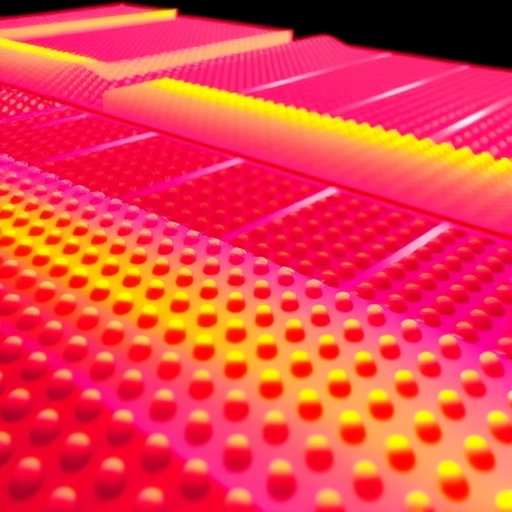
In a breakthrough that could reshape how engineers manipulate light at the nanoscale, an international research team has demonstrated a quantum-well metasurface capable of dramatically enhancing nonlinear polarization through free-space optical access. The work, published in Nature Nanotechnology, shows that a carefully engineered semiconductor metasurface can transform the way light interacts with matter at its most fundamental level, opening doors to more efficient lasers, ultrafast optical switches, and quantum photonic technologies that were previously limited by the weak intrinsic response of natural materials.
Nonlinear optics — the branch of physics governing how intense light changes the properties of the medium it travels through — underpins technologies ranging from frequency-doubled green laser pointers to the wavelength converters used in fiber-optic telecommunications. Yet the underlying physical effects, such as second-harmonic generation and optical rectification, are extraordinarily weak in conventional bulk crystals. Photon conversion efficiencies are often limited to fractions of a percent unless the light traverses centimeters of material or is trapped in a resonant cavity for extended periods. This bottleneck has long frustrated scientists seeking compact, chip-scale nonlinear optical devices. The new study tackles this limitation head-on by combining two powerful concepts: quantum wells, which confine electrons in semiconductor layers just a few nanometers thick, and metasurfaces, the planar arrays of subwavelength structures that can sculpt light with almost arbitrary precision.
A metasurface is essentially an optical component constructed from arrays of tiny “meta-atoms” — structures smaller than the wavelength of light — each designed to impose a specific phase, amplitude, or polarization shift on incoming waves. By arranging these building blocks across a flat surface, researchers can replicate the functions of bulky lenses, wave plates, and holographic elements in a layer thinner than a micron. Metasurfaces have already revolutionized linear optics, enabling flat lenses and compact spectrometers. But harnessing them for strong nonlinear interactions has proven much harder, because the nonlinear polarization generated inside the material depends not only on the local field enhancement but also on the intrinsic nonlinear susceptibility of the constituent material — a quantity fixed by nature for any given substance.
The research team’s innovation was to embed multiple semiconductor quantum wells directly within the resonant meta-atoms of the metasurface. A quantum well is a sandwich of semiconductor materials with different band gaps — typically gallium arsenide bounded by aluminum gallium arsenide — that traps electrons and holes in a thin potential well. This confinement forces the electronic states to become discrete and quantized, and it allows excitons, the bound electron-hole pairs that dominate optical transitions in these structures, to exhibit extraordinarily large oscillator strengths. More importantly for nonlinear applications, the quantum confinement breaks the inversion symmetry of the electronic wavefunctions and amplifies the second-order susceptibility, the material parameter that governs second-harmonic generation and related processes.
Crucially, the coupling between the quantum wells and the metasurface resonances works in both directions. The resonant structures concentrate the incident free-space light into intense local fields that drive the quantum wells hard, while the enhanced nonlinear polarization radiating back from the quantum wells couples efficiently out into free space. This bidirectional matching — often described in the literature as impedance matching between the microscopic nonlinear source and the radiating optical mode — is the key to overcoming the historic trade-off between field confinement and radiation efficiency. In previous designs, researchers could either trap light to boost the interaction or let it escape efficiently, but rarely both. The new quantum-well metasurface achieves simultaneous access from free space and enhanced nonlinear emission, a combination that many in the field considered the holy grail of nonlinear metasurface engineering.
The experimental demonstration involved fabricating arrays of resonant structures patterned into the semiconductor heterostructure containing the quantum wells. Using high-resolution electron-beam lithography and etching techniques standard in semiconductor fabrication, the team sculpted the metasurface with nanometer precision. When they illuminated the device with femtosecond near-infrared laser pulses, the surface emitted second-harmonic light — photons at exactly twice the frequency of the input — at intensities orders of magnitude greater than what the bare quantum-well material could produce without the metasurface architecture. The enhancement arises because each resonant meta-atom acts as a tiny optical antenna and cavity simultaneously, recycling photons through the quantum-well region multiple times before they escape, giving the weak nonlinear process many more chances to occur.
What distinguishes this work from earlier demonstrations of nonlinear metasurfaces, which typically relied on dielectric nanoparticles or plasmonic metals, is the direct integration of quantum-confined electronic states into the resonator itself. Plasmonic structures can concentrate light intensely but suffer from absorption losses that generate heat and limit efficiency. Dielectric metasurfaces avoid these losses but are stuck with the modest nonlinear susceptibilities of bulk semiconductors. Quantum wells, by contrast, offer engineered nonlinearities: by adjusting the well width, the number of wells, and the material composition, designers can tune both the magnitude and the spectral dependence of the second-order response. The metasurface resonance then selects and amplifies exactly those engineered transitions, creating a system in which the material nonlinearity and the optical geometry are optimized together rather than independently.
The implications extend well beyond simple frequency doubling. Enhanced nonlinear polarization at a free-space-accessible surface could enable entangled photon-pair sources for quantum communication that are far more compact and efficient than today’s crystal-based systems. It could power all-optical switching elements that modulate light with light, eliminating the need for electronic conversion in data centers and telecom networks. Researchers in spectroscopy see potential for chip-scale sources of mid-infrared and terahertz radiation, frequency ranges that are difficult to reach with conventional lasers but rich in molecular fingerprints relevant to medical diagnostics, security screening, and environmental monitoring. Because the entire device is planar and fabricated with standard semiconductor processing, integration with existing photonic and electronic circuits appears feasible — a critical requirement for any technology hoping to leave the laboratory.
There are also fundamental physics questions that the platform makes newly accessible. Quantum wells support excitonic resonances whose nonlinear response can be studied with a precision impossible in bulk crystals, and coupling them to collective metasurface modes creates hybrid light-matter states in which the nonlinear dynamics become genuinely quantum mechanical. The authors suggest that such regimes could host giant optical nonlinearities at the level of single photons, where the presence of one photon measurably alters the behavior of the next — the operating principle behind photonic quantum gates. While such applications remain on the horizon, the demonstration of a robust, efficient, free-space-coupled nonlinear metasurface removes one of the central engineering obstacles on the path toward them.
The study also highlights a broader trend in photonics: the convergence of quantum materials engineering with nanophotonic design. For decades, nonlinear optics advanced by discovering new crystals — lithium niobate, beta barium borate, potassium titanyl phosphate — each with slightly better properties. The new work represents a different philosophy, in which the material’s electronic structure is engineered at the quantum level and the photonic architecture is engineered at the wavelength level, with the two designed in concert. This co-design approach, the researchers argue, is not limited to the gallium arsenide system they demonstrated. Similar principles could be applied to other quantum-confined systems, including transition metal dichalcogenide monolayers, quantum dots, and even emerging superlattice materials, each offering its own tunable nonlinear responses.
As nonlinear optics migrates from centimeter-thick crystals to surfaces thinner than a wavelength of light, the technology landscape of photonics may shift dramatically. Compact frequency converters could one day sit on every photonic chip, entangled photon sources could become as routine as laser diodes, and optical computing architectures may gain the nonlinear switching elements they have long lacked. For now, the quantum-well metasurface stands as a striking proof of concept: that by thinking about light-matter interaction at both the quantum and the wave levels simultaneously, engineers can coax far more performance out of materials than nature alone intended. The research, detailed in Nature Nanotechnology, marks a significant step toward a future in which the nonlinear manipulation of light is not a specialized laboratory art but a routine building block of everyday photonic technology.
Cite Scienmag News
Katie Riggs. (September 7, 2026). Metasurface boosts nonlinear polarization with free-space quantum-well design. Scienmag. https://scienmag.com/metasurface-boosts-nonlinear-polarization-with-free-space-quantum-well-design/
Katie Riggs. "Metasurface boosts nonlinear polarization with free-space quantum-well design." Scienmag, 7 September 2026, https://scienmag.com/metasurface-boosts-nonlinear-polarization-with-free-space-quantum-well-design/. Accessed 7 September 2026.
Katie Riggs. "Metasurface boosts nonlinear polarization with free-space quantum-well design." Scienmag. September 7, 2026. https://scienmag.com/metasurface-boosts-nonlinear-polarization-with-free-space-quantum-well-design/


