


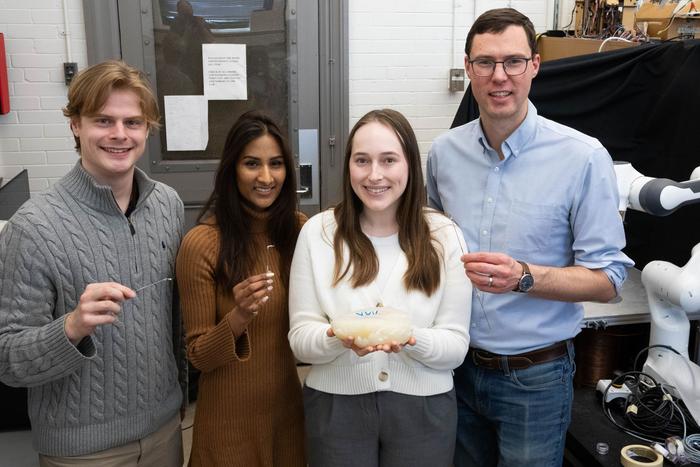
A revolutionary new advancement in surgical robotics has emerged from a collaboration between researchers at the University of Toronto’s Faculty of Applied Science & Engineering and the Wilfred and Joyce Posluns Centre for Image Guided Innovation and Therapeutic Intervention at The Hospital for Sick Children (SickKids). This innovative team has developed a groundbreaking set of micro-robotic tools designed for performing minimally invasive brain surgeries. These tools, measured at approximately three millimeters in diameter, promise to redefine surgical techniques, enabling procedures that were previously inconceivable due to spatial constraints inside the human brain.
The emergence of these tiny robotic instruments marks a significant evolution in the realm of surgical technology, particularly in the field of neurosurgery, where precision and the ability to operate within the confines of delicate brain structures are critical. Published in the esteemed journal Science Robotics, the research team showcased how these innovative instruments can effectively grip, pull, and cut tissue—a process integral to complex surgical procedures. Unlike conventional robotic tools that utilize motors for operation, these new instruments are uniquely powered by external magnetic fields, which enhances their dexterity while minimizing the invasive impact on the patient.
The concept behind these magnetic micro-tools is both intriguing and sophisticated. Traditional robotic surgical instruments often function through cable systems, much like how human fingers grasp and manipulate objects via tendons linked to muscles. On a larger scale, this design is effective; however, as the size of surgical instruments diminishes, the mechanisms that govern their operation can become less reliable. Professor Eric Diller, a leading researcher in this project, illustrated that as the scale of robotic tools decreases, the tension required on cables increases, leading to problems such as friction and reduced operational reliability. Thus, the need for a novel approach drove the development of these magnetically actuated tools.
At the heart of this invention is a dual-component system where the first aspect comprises the tiny tools themselves: a specialized gripper, a finely crafted scalpel, and a set of forceps. These instruments are engineered with magnetically responsive materials that react to external electromagnetic fields generated by a coil table—an innovative surgical table embedded with several electromagnetic coils. This design allows surgeons to control tool movements with exceptional precision, as varying levels of electricity supplied to the coils manipulate the magnetic fields influencing the instruments’ operation.
The testing of these new robotic tools involved collaboration with clinicians and researchers at SickKids, illustrating a commendable partnership between engineering and medical expertise. They crafted a phantom brain, a lifelike model constructed from silicone rubber that mimicked the anatomical features of a real brain, thus providing a realistic environment for testing. In a bid to simulate the mechanical properties relevant to surgical procedures, the team utilized small pieces of tofu and strawberries—representative of brain tissue—allowing them to evaluate the efficacy of the surgical tools.
Evaluating the effectiveness of the magnetically actuated instruments yielded promising findings. When it came to utilizing the magnetic scalpel, the research team observed that it produced cuts that were notably narrow and consistent, with widths averaging between 0.3 and 0.4 millimeters. This level of precision not only surpassed that of conventional hand-held surgical tools, which varied between 0.6 and 2.1 millimeters but also underlines the potential of this technology to enhance surgical accuracy and improve outcomes for patients undergoing neurological interventions.
Furthermore, the gripping capabilities of the magnetic tools were tested against standard surgical instruments, revealing an impressive success rate of 76% in effectively grasping target materials. Testing was also extended to animal models, wherein the tools demonstrated comparable performance, further bolstering the team’s confidence in the practical applications of their robotic innovations. Such consistent results suggest a significant step forward in the realm of neurosurgery, opening up avenues for surgical methods that enhance patient safety and recovery times.
Despite the substantial achievements made thus far, Professor Diller reiterated the challenges that lie ahead before these therapeutic tools find their way into clinical practice. The development timeline associated with medical devices, particularly surgical robotics, is often extensive, ranging from a few years to several decades. Factors such as ensuring compatibility with existing imaging systems, like fluoroscopy, which employs X-ray technologies, remain paramount considerations in their ongoing development.
As these researchers forge ahead with their groundbreaking work, the excitement surrounding the implications of this technology is palpable. The potential for these micro-robots to transform neurosurgical practices is immense, offering capabilities that extend well beyond current methodologies. This innovative work not only addresses the challenges posed by traditional tools but also represents a pioneering step towards integrating advanced robotics with medical procedures, ultimately aiming to improve surgical outcomes for patients worldwide.
The magic of this groundbreaking research lies not just in its technical prowess, but also in the collaborative spirit that brought it to existence—a testament to the synergy between engineering and medicine. As new frontiers in minimally invasive surgery become increasingly viable, the pioneering spirit of this research team at the University of Toronto stands to significantly influence the future of surgical interventions, making brain surgery safer and more efficient.
Emphasizing the transformative nature of such technological advancements, this initiative is not merely a leap in surgical tools, but also a step towards a future where surgical precision is achievable at scales previously thought impossible. In the coming years, as these innovations are further refined and integrated into surgical practice, they hold the promise of being a cornerstone of modern medical intervention, saving lives and optimizing patient recovery through unprecedented precision in neurosciences.
As the path forward unfurls, one cannot help but envision a future where the impact of such innovations cascades throughout the field of medicine, propelling us into a new era of surgical technology. In a world where medical challenges continue to evolve, advancements like these remind us of the potential held in human ingenuity, collaboration, and the relentless pursuit of knowledge.
Keywords
Surgical robots, Human brain, Magnetic fields, Robotics, Medical technology.
Cite Scienmag News
Cassandra Pierce. (March 28, 2025). Revolutionary Microscopic Robots Powered by Magnetic Fields: A Breakthrough in Minimally Invasive Brain Surgery. Scienmag. https://scienmag.com/revolutionary-microscopic-robots-powered-by-magnetic-fields-a-breakthrough-in-minimally-invasive-brain-surgery/
Cassandra Pierce. "Revolutionary Microscopic Robots Powered by Magnetic Fields: A Breakthrough in Minimally Invasive Brain Surgery." Scienmag, 28 March 2025, https://scienmag.com/revolutionary-microscopic-robots-powered-by-magnetic-fields-a-breakthrough-in-minimally-invasive-brain-surgery/. Accessed 3 September 2026.
Cassandra Pierce. "Revolutionary Microscopic Robots Powered by Magnetic Fields: A Breakthrough in Minimally Invasive Brain Surgery." Scienmag. March 28, 2025. https://scienmag.com/revolutionary-microscopic-robots-powered-by-magnetic-fields-a-breakthrough-in-minimally-invasive-brain-surgery/


