


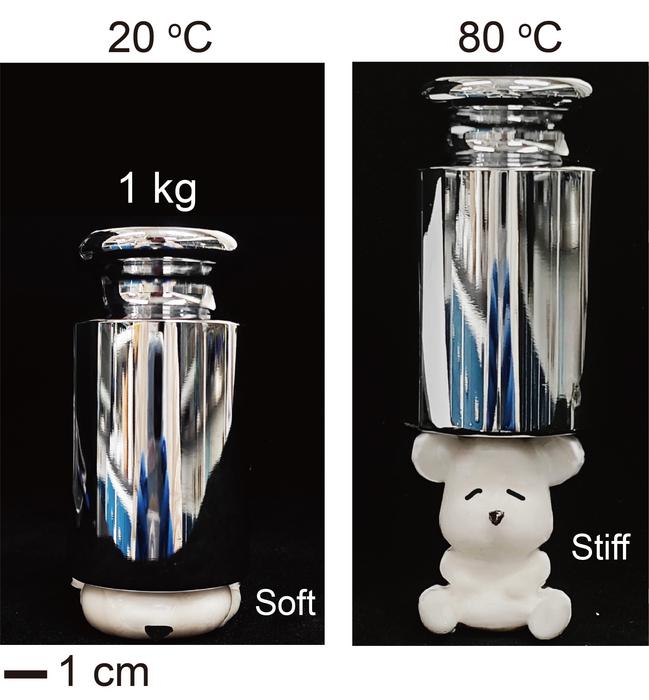
A remarkable breakthrough in material science has been achieved by a research team at Donghua University, culminating in an innovative hydrogel that exhibits rapid transformations between soft and rigid states. This newly developed “high-entropy” hydrogel is effectively tailored to respond to temperature changes, transitioning from a rubbery softness to a hard armor-like rigidity in a matter of seconds when heated, and reverting back to its flexible form almost instantaneously upon cooling. These developments, recently published in a leading journal, the National Science Review, address critical limitations long faced by thermal-responsive materials, particularly regarding their sluggish recovery times after deformation.
The significance of this research cannot be understated, as traditional thermal-stiffening hydrogels have typically suffered from extended recovery periods—in some cases exceeding 30 minutes—post-thermal exposure. This protracted timeline starkly limits their applicability in dynamic or real-time scenarios, which are essential for technologies such as impact-resistant wearables or soft robotics, where performance speed is crucial. The newly developed hydrogel introduces a solution to this ongoing challenge, boasting a remarkable recovery time slashed to just 28 seconds while showcasing a staggering 760-fold increase in stiffness at elevated temperatures of 80°C.
The foundation of this exceptional performance is rooted in an innovative design strategy that employs high-entropy phase-separation. By incorporating hydrophilic acrylamide (AAm) units within a calcium acrylate polymer network, the researchers effectively disrupt the formation of dense clusters of calcium-crosslinked chains. This strategic modification creates an intricate, disordered porous structure that facilitates rapid water diffusion, thus expediting the cooling process during which the hydrogel recovers its original, flexible state. This design approach transforms the hydrogel’s physical properties, enabling it to efficiently "melt" back into its softer condition, akin to loosening compacted structures to allow ease of movement.
Co-author of the study, Shengtong Sun, offered a vivid analogy to describe the functionality of their high-entropy design, likening it to loosening tightly packed Lego blocks separated by marbles. This disordered topology not only reduces energy barriers but also promotes an efficient mechanism that allows for near-instantaneous transitions between the glassy and rubbery states of the hydrogel. With its unprecedented combination of rapid recovery and significant stiffness improvement, this hydrogel holds immense potential for various advanced applications.
The hydrogel’s performance highlights are impressive and underscore its versatility. At a cooler temperature of 20°C, the material can stretch over 20 times its original length and flawlessly conform to the human hand. Conversely, when subjected to 80°C, it can support a weight of up to 1 kg and withstand impacts with a remarkable resistance at 474 J/m. Such outstanding characteristics signify not only an advancement in hydrogel technology but also an opening of new avenues in soft robotics and protective materials where fast responsiveness to thermal stimuli is paramount.
The implications of this technology extend into numerous practical applications, marking a transformative step forward for industries requiring adaptable materials. In the realm of adaptive armor, this hydrogel provides essential functionality by hardening upon impact and subsequently softening for enhanced comfort. This capability ensures that users experience protection without compromising mobility or ease of wear. Likewise, in the field of soft robotics, the material facilitates precise shape changes triggered by heat, opening doors to developments in robotics that necessitate adaptability to diverse tasks and environments.
Moreover, the integration of this high-entropy hydrogel into smart fabrics represents another cutting-edge application. This pioneering material can adjust its stiffness dynamically based on the body temperature of the wearer, providing a unique solution to create garments that not only respond to environmental conditions but also enhance personal comfort and wearability. Such innovations illustrate a burgeoning intersection of materials science with everyday life, highlighting potential future advancements that could redefine how we interact with our environments.
As this research pushes the boundaries of current knowledge in material science, its experimental underpinnings promise to inspire further exploration into high-entropy materials and other non-traditional approaches to polymer design. The combination of innovative thinking and rigorous methodology has led to unparalleled advancements that not only address existing challenges but also set the stage for future discoveries. The impact of these findings could resonate across multiple domains, fostering a new wave of research that embraces the potential offered by智能 materials in various spheres of technology.
Ultimately, the newly developed hydrogel stands as a testament to human ingenuity in addressing longstanding scientific challenges. By leveraging the principles of high-entropy design, researchers are not simply refining existing materials; they are laying the groundwork for a revolution in how materials can behave and respond under various conditions. The promise that this hydrogel holds suggests that we may be on the cusp of significant advancements in protective wear and responsive robotics, ushering in a new era of smart materials that could fundamentally change our interactions with technology and the world around us.
With each new discovery, scientists inch ever closer to unlocking the true potential of smart materials. As this hydrogel demonstrates, the future of material science is bright, teeming with possibilities that merge functionality and innovation in ways previously thought impossible. As research unfolds, we can eagerly anticipate new applications that will harness these breakthroughs, shaping the landscape of technology in exciting new directions.
Keywords
Smart materials, hydrogels, thermal responsiveness, polymer science, adaptive materials, soft robotics, material innovation, temperature-induced transformation, high-entropy design.
Cite Scienmag News
Bethany Barker. (March 28, 2025). Revolutionary High-Entropy Design Enables Instant Armor Hydrogels to Soften Within Seconds. Scienmag. https://scienmag.com/revolutionary-high-entropy-design-enables-instant-armor-hydrogels-to-soften-within-seconds/
Bethany Barker. "Revolutionary High-Entropy Design Enables Instant Armor Hydrogels to Soften Within Seconds." Scienmag, 28 March 2025, https://scienmag.com/revolutionary-high-entropy-design-enables-instant-armor-hydrogels-to-soften-within-seconds/. Accessed 6 September 2026.
Bethany Barker. "Revolutionary High-Entropy Design Enables Instant Armor Hydrogels to Soften Within Seconds." Scienmag. March 28, 2025. https://scienmag.com/revolutionary-high-entropy-design-enables-instant-armor-hydrogels-to-soften-within-seconds/


