


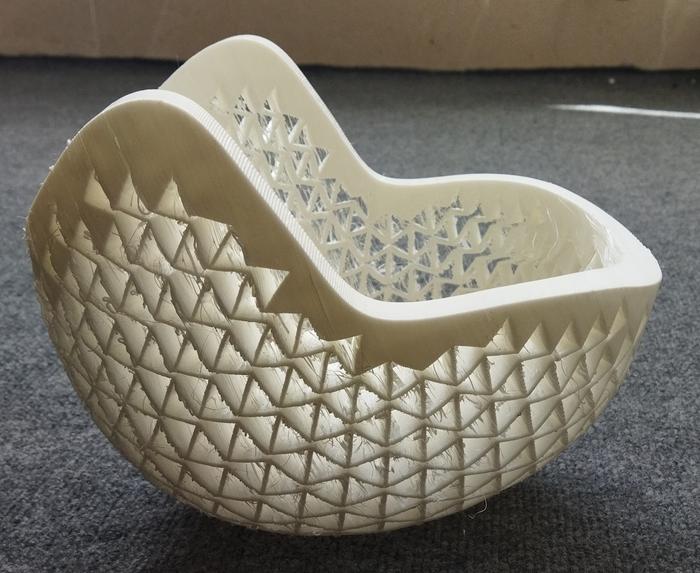
Researchers at the University of Gothenburg in Sweden and the University of Isfahan in Iran have unveiled a revolutionary design for bicycle helmets that aims to enhance safety for cyclists. At the core of this innovation lies a newly developed shock-absorbing material engineered with unique geometric features that greatly improve its efficacy in absorbing impact from crashes. The heart of this research focuses on the application of auxetic metastructures, which behave in ways that conventional helmet materials, such as simple foams, cannot.
Past designs of bicycle helmets have consistently faced challenges in terms of impact resistance and comfort while ensuring a proper fit for cyclists. Traditional foam liners have been the standard for many years; however, they often fail to provide optimal protection during accidents. The revolutionary technique developed by these researchers harnesses the intriguing properties of auxetic materials, which are known for their ability to expand laterally when stretched and contract upon the absorption of energy. This allows the newly designed helmet to react more effectively during the dynamic forces of a collision, thereby reducing the overall risk of head injuries.
In an enlightening statement, Mohsen Mirkhalaf, an Associate Professor involved in the study, articulates that, “When exposed to energy from an impact, the liner material contracts, which significantly improves the absorption of impact energy. This translates to lower risks of injuries sustained by cyclists during accidents.” This developed technology could represent a substantial leap forward in the design of safety equipment, offering notable improvements over existing options.
The crux of the research, which is detailed in the International Journal of Solids and Structures, merges the principles of auxetic metastructures with advanced computational simulations and design optimization methods. This complex interplay of geometry and material science laid the foundation for the innovation of a safer helmet. In layman’s terms, the geometry of the helmet’s internal structure has been meticulously optimized to minimize forces during potential collisions, making it a critical aspect of the innovation.
Furthermore, the helmet’s protective layer underwent rigorous testing, which included being manufactured via a sophisticated 3D printing technology. The material chosen for the liner is a hyperelastic polymer capable of undergoing considerable deformations while maintaining the ability to revert to its original form. These attributes were pivotal during testing, as they showcased enhanced performance across varying impact scenarios compared to traditional helmet designs. The dual-layer approach in material design allows for an adaptive response during application, granting cyclists better safety assurance.
The customizability aspect of this innovation cannot be overstated. With a growing emphasis on personalization within consumer products, this helmet leverages 3D printing technology to accommodate individual head shapes, which is particularly beneficial for professional athletes and those who struggle to find a helmet that meets comfort requirements. By individually tailoring the fit and performance characteristics of the helmet, users can significantly enhance their protective gear’s functionality during cycling.
Historic advancements in 3D printing have opened new avenues for the development of such advanced materials. Mohsen Mirkhalaf notes that while the concept of auxetic metastructures has been around for approximately four decades, it is the recent breakthroughs in fabrication processes, particularly additive manufacturing, that have facilitated the rapid proliferation of diverse metastructural designs across various fields of application.
Such technology will not only enhance bicycle safety but may pave the way for smarter protective equipment in multiple domains, including sports, automotive safety, and even construction. The potential applications of auxetic metastructures could see widespread improvements in equipment designed for helmet usage, impact protection gear, and beyond.
As the research continues to gain momentum, the implications of these advances suggest an exciting future for safety gear. If these developments lead to further improvements in helmet design and manufacturing, there is strong potential for a new generation of bicycle helmets that surpass current safety standards, prioritizing comfort and personalized fit as part of the offering.
While the initial investment in 3D printing technology remains high compared to mass-produced alternatives, market trends indicate that costs will steadily decline as widespread adoption occurs. The concept of personalized helmets printed on demand could one day transform the way cyclists approach safety gear, ensuring each individual is equipped to the highest standard of protective innovation.
The journey to safer cycling practices is ongoing, and the insights gained from this research provide a hopeful glimpse into the advancements of protective technologies in sports. As society continues to prioritize cyclist safety, implementing these cutting-edge designs will be instrumental in reshaping public perceptions and standards about what it means to be adequately protected while enjoying the ride.
The collaboration between the University of Gothenburg and the University of Isfahan illustrates the profound impact of cross-institutional research and the importance of innovation in public safety. The implications of this study underscore the necessity for constant evolution in protective gear, as the risks associated with cycling continue to challenge those dedicated to ensuring safety on the roads. The research team’s commitment to enhancing the well-being of cyclists exemplifies a forward-thinking approach to engineering and public health and sets a precedent for future advancements in the field of protective sports gear.
As safety technology progresses, one can only watch closely as new breakthroughs unfold in the landscape of protective equipment, paving the way toward safer environments for the burgeoning community of cycling enthusiasts worldwide.
Keywords
Bicycle helmets, auxetic metastructures, shock absorption, 3D printing, cyclist safety, impact protection, material science, personalized fit, innovative design.
Cite Scienmag News
Bethany Barker. (March 25, 2025). Revolutionary Geometric Design Enhances Safety Features of Bicycle Helmets. Scienmag. https://scienmag.com/revolutionary-geometric-design-enhances-safety-features-of-bicycle-helmets/
Bethany Barker. "Revolutionary Geometric Design Enhances Safety Features of Bicycle Helmets." Scienmag, 25 March 2025, https://scienmag.com/revolutionary-geometric-design-enhances-safety-features-of-bicycle-helmets/. Accessed 4 September 2026.
Bethany Barker. "Revolutionary Geometric Design Enhances Safety Features of Bicycle Helmets." Scienmag. March 25, 2025. https://scienmag.com/revolutionary-geometric-design-enhances-safety-features-of-bicycle-helmets/


