


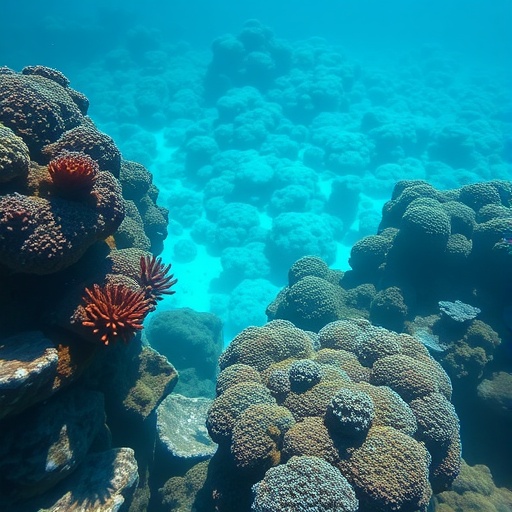
Scientists at the University of Miami Rosenstiel School have made a significant advancement in predicting coral bleaching risks due to marine heat stress. Utilizing a revolutionary AI model, this research empowers conservationists and marine scientists to foresee heat stress conditions at various locations along Florida’s Coral Reef. The model can now predict moderate heat stress events up to six weeks in advance, providing invaluable time for local reef management and emergency responses. With increasing threats to coral ecosystems—particularly highlighted by the record-breaking marine heatwave of 2023—this predictive tool emerges as a beacon of hope.
At the heart of this groundbreaking research lies an intricately designed machine-learning framework. Researchers have honed this model to be site-specific and explainable, which greatly enhances its utility for coral scientists and marine resource managers. The significance of this model extends beyond simple predictions; it also clarifies the environmental conditions and variables that drive these predictions, offering a comprehensive understanding of local reef dynamics.
As lead author Marybeth Arcodia explains, the AI model serves as an early warning system for coral scientists and managers, anticipating the potential onset of heat stress during critical seasons. This foresight allows for proactive measures, enabling resource managers to enact emergency protocols right when they are needed the most. By identifying the precise week when heat stress is expected to initiate, this tool allows stakeholders to prioritize their monitoring efforts and allocate resources efficiently.
The model employs data collected from various environmental factors including accumulated heat-stress metrics, sea-surface temperature anomalies, and air temperature measurements, among others. This holistic approach integrates aspects of atmospheric science, coral ecology, and data science to formulate predictions tailored specifically for Florida’s unique coral reef ecosystem. Researchers successfully utilized an XGBoost machine-learning model for these predictions, demonstrating its exceptional ability to forecast the onset of heat stress.
Numerous historical datasets spanning from 1985 to 2024 were processed to optimize the accuracy of these predictions. The study incorporates essential indicators, such as wind patterns and solar radiation, alongside nuances like the Loop Current and El Niño conditions, which significantly impact local marine environments. In practice, the model showed impressive accuracy, with predictions often precise to within a week of actual heat stress events, positioning it as a remarkably reliable tool for marine scientists.
Moreover, the research team compared their new predictive method with standard approaches, such as multiple logistic regression models and frequency-based methods. The model consistently outperformed these benchmarks, demonstrating not only its predictive power but its ability to dissect the timing of heat stress occurrences, thus allowing for more effective management strategies. For coral reefs struggling under the pressures of climate change, such advancements are crucial.
A game-changing aspect of this research is the application of explainable AI techniques using SHAP. This method elucidates which environmental factors have the most significant influence on predictions for each reef site. Insights gleaned from these analyses indicate that surface air temperature frequently emerges as a priority predictor, with other environmental variables fluctuating based on site-specific characteristics and forecast timing. This localized knowledge empowers conservation efforts by pinpointing exactly where and when intervention may be most effective.
The implications of these findings stretch far beyond academic interest; they are vital for the proactive conservation of Florida and Caribbean reefs. As marine ecosystems confront increasingly frequent and severe heat-stress events, the necessity for advanced early-warning systems becomes even more pronounced. This AI framework does not aim to supplant existing operational systems, such as NOAA Coral Reef Watch; instead, it serves as a complementary resource, enhancing the existing frameworks with localized data that offer a season-wise understanding of heat stress onset.
By delivering predictions on actionable timescales, the research underscores the urgency of prioritizing management actions. These forecasts facilitate timely monitoring and can inform when and where emergency measures should be initiated. At a time when coral reefs are under threat, these robust, localized predictions are undeniably a step toward ensuring the survival of these vital ecosystems.
Furthermore, the study represents a collaborative effort that synthesizes expertise from various disciplines, showcasing the power of interdisciplinary research. With contributions from atmospheric science, data science, and marine ecology, the researchers have created not merely a predictive tool but a comprehensive support system empowering local reef management and impactful conservation strategies.
Driven by funding from several prestigious organizations, including the U.S. Department of Energy and NOAA Coral Reef Conservation Program, this research exemplifies the increasing recognition of the urgent need for innovative solutions in the face of climate change. The commitment to preserving coral ecosystems represents a growing initiative among scientists and policymakers alike, fostering a future where proactive measures lead to better outcomes for marine biodiversity.
In closing, the development of this AI-driven prediction model signifies a pivotal advancement in marine conservation efforts. By equipping scientists and resource managers with precise, timely information on heat stress conditions, we stand on the threshold of new opportunities to protect and restore coral ecosystems. This model not only provides crucial data but also embodies a commitment to harnessing technology in the service of environmental stewardship, crucial for navigating the uncertain challenges posed by global climate change.
Keywords
Coral bleaching, Artificial intelligence, Computer simulation.
Cite Scienmag News
Denise Maddox. (February 2, 2026). Revolutionary AI Model Enhances Early Detection of Coral Bleaching Risks. Scienmag. https://scienmag.com/revolutionary-ai-model-enhances-early-detection-of-coral-bleaching-risks/
Denise Maddox. "Revolutionary AI Model Enhances Early Detection of Coral Bleaching Risks." Scienmag, 2 February 2026, https://scienmag.com/revolutionary-ai-model-enhances-early-detection-of-coral-bleaching-risks/. Accessed 3 September 2026.
Denise Maddox. "Revolutionary AI Model Enhances Early Detection of Coral Bleaching Risks." Scienmag. February 2, 2026. https://scienmag.com/revolutionary-ai-model-enhances-early-detection-of-coral-bleaching-risks/


