

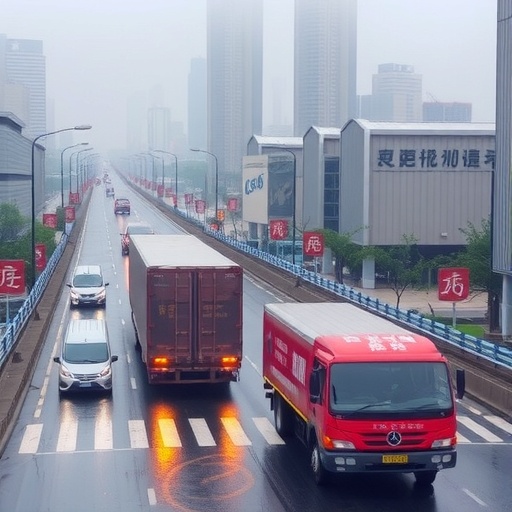
In a groundbreaking exploration of sustainable transport solutions, researchers have sought to understand the determinants of carbon dioxide (CO₂) emissions in China’s transport sector. This critical investigation was propelled by the increasing necessity to mitigate climate change impacts, particularly in rapidly urbanizing regions where transportation emissions continue to soar. The work undertaken by Wang and Wang employed advanced methodologies, particularly the bio-inspired extreme learning machine (ELM), to pinpoint key factors influencing emissions and predict peak pollution levels. However, the research has recently faced controversy, leading to a formal retraction note being published.
At the core of the study was the goal to not merely analyze existing data but to utilize sophisticated computational techniques to provide accurate predictions of CO₂ emissions. ELM, which mimics the neural learning processes found in biological systems, offers remarkable efficiency and speed in processing vast amounts of data. This methodology promises to unlock new pathways in environmental research, allowing for rapid and reliable forecasts that can influence public policy and corporate practices alike.
As the world grapples with the urgent need to lower greenhouse gas emissions, understanding the role of transportation—one of the largest contributors—is paramount. In the case of China, a nation experiencing unprecedented levels of vehicular growth, the implications of high emissions from this sector cannot be overstated. Energy consumption driven by transportation is intrinsically linked to economic growth, yet it poses significant risks to air quality and public health. The research aimed to delve into this duality of progress versus pollution, providing a clear picture of the keys to reducing emissions.
Central to the research’s findings was the identification of various determinants that affect CO₂ emissions in the transport sector. These included factors such as vehicle types, traffic conditions, fuel consumption patterns, and governmental policies. Each factor was meticulously examined through the lens of complex data analytics to reveal underlying relationships and driving trends. By integrating these components into an advanced predictive model, the researchers hoped to pave the way for more informed decision-making among stakeholders in urban planning and policy formulation.
The extreme learning machine framework used in this study stands out for its unique approach to training models through a single-layer feedforward neural network. This technique allows for rapid training and robust performance, especially suited for handling large datasets that characterize environmental studies. Through simulations, the model demonstrated its capability to accurately forecast emissions under various scenarios, offering valuable insights that could ultimately help reduce CO₂ outputs in transportation.
Among the notable discoveries highlighted in the study was the significant impact of governmental initiatives aimed at reducing emissions. The researchers demonstrated through their analyses that policies promoting electric vehicles or public transit usage can lead to considerable decreases in CO₂ emissions. Furthermore, they underscored the importance of real-time data monitoring, emphasizing how data transparency can empower citizens and governing bodies to collectively work towards sustainable transportation solutions.
The implications of this research extend far beyond mere academic interest; they rise to the level of critical public discourse as countries around the globe seek actionable solutions in mitigating climate change. By understanding the factors at play in emissions generation, cities can tailor their strategies to encourage more sustainable practices among their populations. This research could serve as a benchmark for similar studies in other regions and foster a wave of environmentally-conscious policymaking.
In light of recent developments, however, the research conducted by Wang and Wang has been formally retracted. While specific details regarding the retraction’s causes remain unclear, the implications for ongoing research in this critical area are significant. It raises questions about the oversight in academic publishing and the pressures researchers face to produce impactful results in increasingly competitive fields like climate science.
Despite the retraction, the methodologies and findings proposed in the original study could inform future research endeavors. The enduring crisis of CO₂ emissions demands innovative approaches and fresh perspectives, signaling that the pursuit of knowledge must continue even in the face of setback. Scholars must refine their techniques and uphold the integrity of scientific research as they contribute to solutions addressing global environmental challenges.
The intersection of technology, policy, and science forms a dynamic nexus in the quest for sustainable transportation. For researchers and policymakers alike, the study represents a vital reminder that understanding emissions is a multi-faceted challenge—one that necessitates collaboration across disciplines. The commitment to utilizing advanced computational methods like ELM can yield enlightening perspectives on how to achieve cleaner transportation options while supporting economic growth.
In closing, the groundbreaking nature of this research—coupled with its recent retraction—provides a comprehensive lesson in the ongoing discourse surrounding environmental studies. It emphasizes the vital need for accuracy, transparency, and accountability in scientific endeavor, reinforcing that while advances are essential for our future, their integrity must never be compromised. As our world stands at a crossroads in climate action, proactive, research-driven insights will play a key role in steering us towards more sustainable futures, particularly in the transport sector.
The complexities of vehicle emissions represent a critical area for ongoing exploration. Still, the lessons learned through the trajectory of this work can guide future inquiries and innovative approaches to foster meaningful change. Enhanced understanding of these dynamics will undoubtedly shape the dialogue surrounding environmental conservation in an era increasingly defined by climate urgency.
With pointed focus on critical areas such as policy impact, consumer behavior, and technological advancements, the future of transportation emissions research remains bright. The ecological stakes are too high for researchers to retreat in the face of challenges or setbacks, for their work carries the potential to illuminate pathways toward a sustainable future for all.
Ultimately, the implications of the findings discussed extend beyond academic relevance; they bridge into a shared responsibility to protect the planet. As researchers look to harness the power of advanced computational techniques to combat climate change, fostering a culture of openness and rigor in research will be paramount—ensuring that every effort contributes meaningfully to the discourse on sustainability.
The call to action is clear—innovative approaches like those harnessed in the ambit of machine learning can truly revolutionize our understanding of CO₂ emissions in transportation and beyond—yet, this quest for knowledge must be underpinned by unwavering ethical standards and a commitment to truth.
Engaging with the complexities of air pollution and environmental degradation offers a transformative perspective on what is at stake. Together, society must navigate challenges as collaborations deepen in the shared pursuit for a greener tomorrow.
Subject of Research: Determinants and peak prediction of CO2 emissions in China’s transport sector utilizing a bio-inspired extreme learning machine.
Article Title: Retraction Note: Determinants investigation and peak prediction of CO2 emissions in China’s transport sector utilizing bio-inspired extreme learning machine.
Article References:
Wang, W., Wang, J. Retraction Note: Determinants investigation and peak prediction of CO2 emissions in China’s transport sector utilizing bio-inspired extreme learning machine.
Environ Sci Pollut Res (2025). https://doi.org/10.1007/s11356-025-37316-0
Image Credits: AI Generated
DOI:
Keywords: CO₂ emissions, transport sector, extreme learning machine, environmental science, sustainability, China.


