


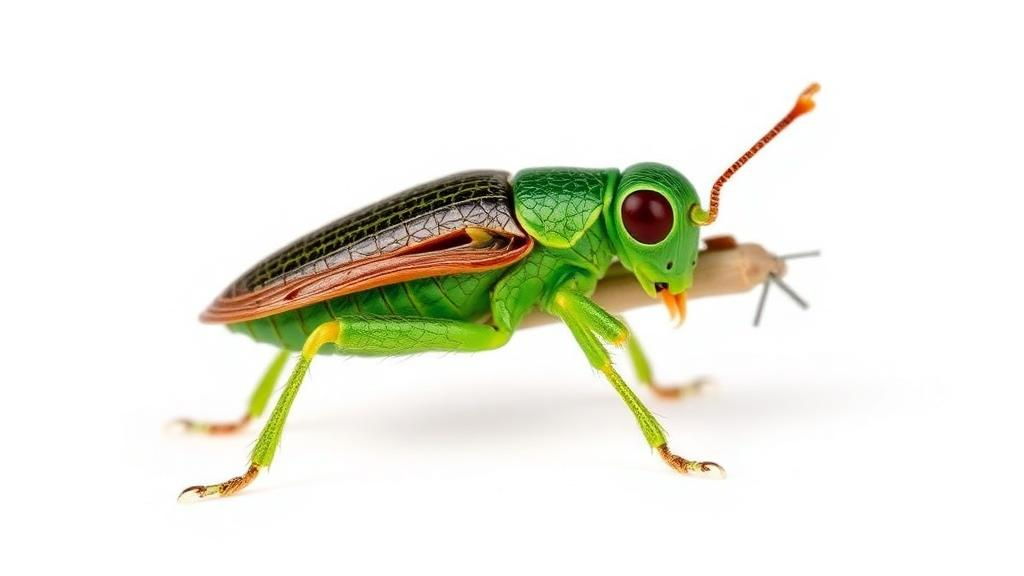
A taxonomic revision of the South African leafhopper genus Hadroca has expanded the genus from one known species to six, describing five new species and redescribing Hadroca ramosa. The study examined more than 1,000 specimens and found extensive variation in body size, coloration, wing form and male genital structures among the insects. Despite these striking differences, the researchers identified a consistent combination of features in the male aedeagus and style that distinguishes Hadroca from closely related leafhoppers.
Hadroca belongs to the deltocephaline tribe Bonaspeiini within the family Cicadellidae. Its only previously recognized species, H. ramosa, was established by Theron in 1974 from a specimen originally described as Euscelis ramosa. That earlier assessment was based on a subbrachypterous specimen and captured only a narrow expression of the species. Re-examination of museum material and additional specimens revealed brachypterous, submacropterous and macropterous forms, multiple color patterns, considerable variation in the shape of the female sternite VII and up to three forms of the apex of the aedeagal shaft.
The five species added by the revision are Hadroca hapsistylis, H. bualacauda, H. alavittata, H. alacaudella and H. treichroa. They differ markedly in size and appearance. H. hapsistylis was the smallest known member of the genus, with males measuring 1.95–2.45 mm from the apex of the crown to the apex of the tegmina and females measuring 2.26–2.80 mm. H. bualacauda was the largest, with corresponding male and female lengths of 5.02–5.95 mm and 5.51–6.49 mm. H. alavittata bears a conspicuous dark brown, V-shaped band across its tegmina, whereas H. treichroa combines light brown, dark brown and whitish areas.
Two of the new species, H. alacaudella and H. bualacauda, possess narrow, pointed extensions of the posterior margins of their tegmina. The extensions give both species a tail-like appearance, but the former is distinctly smaller and more slender. Males of H. alacaudella measured 4.02–4.23 mm from the crown apex to the tegminal apex and had head widths of 1.10–1.15 mm, compared with 5.02–5.95 mm and 1.67–1.81 mm for H. bualacauda. Their aedeagi also differed: H. alacaudella had a more widely curved shaft that was wider distally than medially, while H. bualacauda had a narrowly curved shaft that narrowed distally.
Male terminalia supplied the most consistent basis for recognizing the genus and separating its species. The aedeagus of Hadroca is C-shaped and uniformly sclerotized, with a short, narrow, transverse dorsal apodeme and a reduced preatrium. Its shaft may be strongly or weakly curved, but its overall configuration remains recognizable. The style generally has a short apophysis that curves ventrally, although H. hapsistylis has an unusually long, strongly arched apophysis and H. alavittata has the least pronounced ventral curvature. The researchers noted that the previously proposed diagnostic value of an elongated connective stem no longer holds: the connective is longer than wide in four species but wider than long in H. hapsistylis.
The revision therefore was not based on a single conspicuous trait. Color was used as one element of species recognition, alongside tegmina shape, body dimensions, female terminalia and the structure of the male genital capsule. H. ramosa alone occurs in three wing forms, with brachypterous individuals exposing three to five abdominal segments, submacropterous forms exposing three or four segments and fully winged forms extending beyond the abdomen. Its coloration ranges from ochraceous or stramineous with brown reticulations to light green or yellow-green, sometimes nearly unmarked. The female sternite VII also varies, appearing ligulate, truncate or narrowly notched, and can differ between the wing forms.
More than 400 specimens of H. ramosa were examined, including 353 submacropters, 94 brachypters and 19 macropters. A few individuals also showed a narrow, desclerotized anterior process near the apex of the aedeagal shaft. Among 70 aedeagi examined in anterior or dorsal view, 46 had a broad apex, 18 had a narrow apex and six were parallel-sided. The researchers treated much of this variation as continuous rather than discrete, noting that shaft curvature and shape, especially in brachypterous specimens, did not support separate forms. The style was also sensitive to viewing angle: lateral views usually showed the ventral curvature clearly, whereas dorsal views could make the preapical lobe appear different or even absent when directed downward.
Comparisons with other Bonaspeiini illustrated both the distinctive status of Hadroca and the difficulty of separating superficially similar genera. Bloemia hieroglyphica resembles Hadroca in size, shape and the curvature of its aedeagal shaft, but its aedeagus has weak lateral sclerotization, a strongly sclerotized base and desclerotized regions along the anterior, posterior, medial, apical and subapical portions. Brachyterous H. ramosa can resemble species of Tzitzikamaia, whose aedeagal shafts bear paired apical processes. Basutoia brachyptera has a much longer dorsal apodeme, while Goniagnathus brachypterus has a thicker, tapered aedeagus and a broad, serrated style apophysis. These comparisons were based on examined specimens and the authors’ observations of terminalia.
Distribution analysis combined geographic records with 19 bioclimatic variables from WorldClim, using the 10th-percentile training presence setting in MaxEnt and mapping outputs in DIVA GIS. Most Hadroca species appear concentrated in South Africa’s Western Cape province, often in the Fynbos Biome, whereas H. hapsistylis was recorded in the Western Cape, Eastern Cape and Northern Cape. The models represent potential natural distributions rather than direct observations of occupancy, and the authors emphasized the uneven ecological information in the collections. Asteraceae were recorded in 55 records and 41 plant taxa, while 18 other families and 27 plant species appeared in 33 records.
Host associations remain uncertain because fewer than half of the more than 200 examined records included an associated plant, and few collections contained nymphs or repeated sampling. H. alavittata appeared to be associated with wild asparagus based on limited records and specimens, while H. bualacauda was collected on several Asteraceae and other plant families. For H. treichroa, the known material came from three nearby localities in the Cedarberg Mountains, where all examined insects shared a distinctive three-color tegminal pattern. H. hapsistylis occurred on multiple plant families without an evident correlation among color, locality, subgenital-plate structure and associated plant. These gaps mean that the revision resolves species identity more securely than it defines the genus’s ecological relationships or life history.
Subject of Research: Taxonomic revision of six species in the South African leafhopper genus Hadroca
Article Title: Revision of the South African leafhopper genus Hadroca Theron ( Hemiptera , Auchenorrhyncha , Cicadellidae , Bonaspeiini )
Article References: Stiller, M. (2023). Revision of the South African leafhopper genus Hadroca Theron (Hemiptera, Auchenorrhyncha, Cicadellidae, Bonaspeiini). Deutsche Entomologische Zeitschrift, 70(1), 13-54. https://doi.org/10.3897/dez.70.90851
Image Credits: AI Generated
DOI: 10.3897/dez.70.90851
Keywords: Hadroca, leafhoppers, Cicadellidae, Bonaspeiini, taxonomy, species description, South Africa, insect morphology, aedeagus, wing polymorphism, Revision, South
Cite Scienmag News
Drew Townsend. (October 20, 2026). Revision reveals five new species in South African leafhopper genus. Scienmag. https://scienmag.com/revision-reveals-five-new-species-in-south-african-leafhopper-genus/
Drew Townsend. "Revision reveals five new species in South African leafhopper genus." Scienmag, 20 October 2026, https://scienmag.com/revision-reveals-five-new-species-in-south-african-leafhopper-genus/. Accessed 20 October 2026.
Drew Townsend. "Revision reveals five new species in South African leafhopper genus." Scienmag. October 20, 2026. https://scienmag.com/revision-reveals-five-new-species-in-south-african-leafhopper-genus/


