


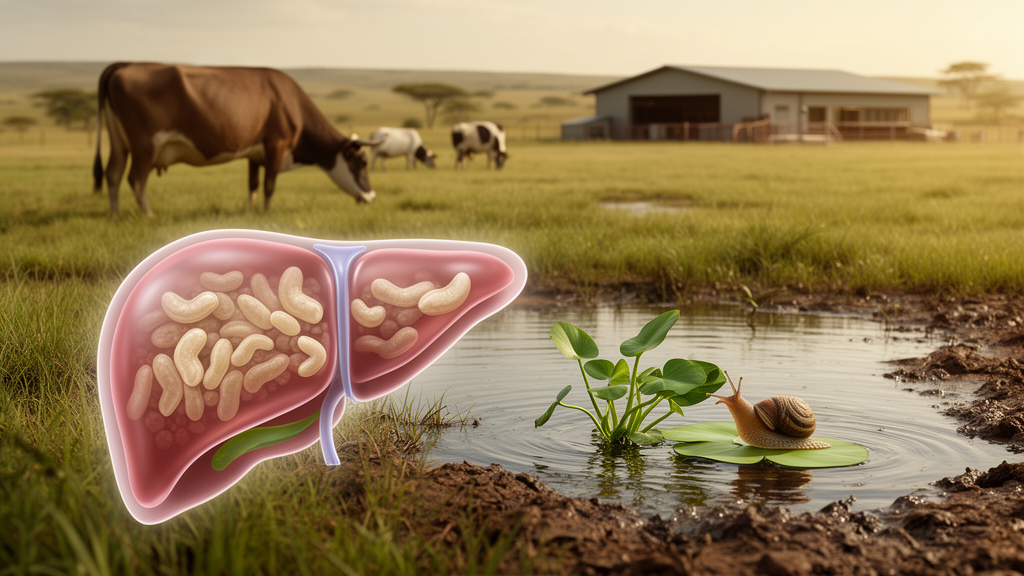
Fascioliasis, a zoonotic parasitic disease caused by liver flukes of the genus Fasciola, remains a substantial yet poorly documented problem in Kenya, according to a structured narrative review published in Frontiers in Veterinary Science. The World Health Organization classifies the disease as a Neglected Tropical Disease and ranks it among the four major foodborne trematodiasis infections, alongside paragonimiasis, clonorchiasis and opisthorchiasis. Two fluke species dominate globally: Fasciola hepatica, which prevails in temperate zones, and Fasciola gigantica, which is primarily tropical. In Kenya, the review concludes that F. gigantica is the most predominant causative parasite, with F. hepatica recorded less frequently, mainly in high-altitude zones. Domestic ruminants serve as the primary definitive hosts, within which the parasites migrate to the bile duct and gallbladder, severely damaging these organs, while humans are infected only accidentally.
The review’s authors, Victor O. Magero and Gabriel O. Dida, aggregated evidence from searches of PubMed/MEDLINE, Web of Science, Scopus and Google Scholar together with WHO and other sources, which identified 28,057 records. After removal of 21,848 duplicates and extensive screening, 72 studies were included, spanning publication dates from 1960 to 2025. The first scholarly article on fascioliasis in Kenya, published in 1960 by G. Froyd, documented the incidence of F. gigantica in Kenyan cattle. Most of the included evidence consists of abattoir and field surveys in cattle, with 28 studies involving cattle, 23 sheep, 16 goats, 15 snails, 5 wildlife, 2 pigs and only 2 humans. Quality appraisal with the Joanna Briggs Institute critical appraisal tools judged 70 studies to have low concern about risk of bias, and the SANRA guidelines were used to improve the review’s transparency. Because most studies predate Kenya’s 2010 Constitution, the review retains the former provincial and district administrative names.
The parasite’s life cycle depends on mud snails of the genera Radix and Galba, which thrive in wet environments. Radix natalensis, which prefers more permanent aquatic habitats such as irrigation schemes, stagnant freshwater and swamps, acts as the principal intermediate host for the tropical fluke F. gigantica, whereas amphibious Galba snails, most notably Galba truncatula, favour mud-laden or temporary wetlands and transmit F. hepatica. Humans and animals acquire infection by ingesting water, food or vegetation contaminated with metacercariae, the infective encysted larvae shed by the snails. Globally, an estimated 180 million people in 75 countries are at risk, with over 2.4 million currently infected. Human disease runs through an acute migratory phase, marked by fever, abdominal pain and high eosinophil counts as juvenile flukes tunnel through the liver, and a chronic biliary phase, marked by biliary colic and inflammation or blockage of the bile ducts and gallbladder once adult flukes settle in place.
The review identified poverty and rural residence as the two major socio-economic factors associated with fascioliasis in Kenya, with the disease disproportionately affecting impoverished communities that have limited access to clean water and healthcare. Rural households often rely on untreated water contaminated with livestock or human faeces, and lower household incomes leave them unable to treat drinking and cooking water. Water development projects also shape transmission: dams and irrigation schemes alter local ecosystems and create ideal breeding grounds for the intermediate snail hosts, as shown at the Ahero and Perkerra irrigation schemes. In Trans-Nzoia West, farmers attested to grazing animals in swampy areas, a major risk factor, yet 80.0% of them did not know the underlying cause of the disease, underscoring a critical awareness gap.
Economically, the condemnation of Fasciola-infected livers at slaughter represents the most severe documented drain, with regional estimates scaling up to over £7 million in annual losses across Kenya. A ten-year retrospective study of abattoir data from Dagoretti slaughterhouses by Kithuka and colleagues estimated losses of approximately US$2.6 million during the 1990s, tracking a downward economic trend driven by routine liver condemnation. In Taveta division abattoirs, condemned livers due to F. gigantica infections caused losses of Kshs 3.505 million between 1989 and 2004, while slaughterhouse records from Kinango Sub-County, Kwale, showed direct losses of roughly US$20,571 during the study period. Beyond condemnation, the disease inflates agricultural operating costs through anthelmintic drug expenses, veterinary fees for managing severe outbreaks, and increased labour from isolation, dosing schedules and extra animal care. Chronic infection further erodes productivity, causing slow growth, reduced milk and meat yields, abortions, infertility, reduced birth weights, predisposition to other infections and high mortalities in calves and ruminants.
Geographically, the former Western province emerged as the highest-risk area, with an average bovine prevalence above 15% in most studies. The Dagoretti analysis established the highest prevalence in cattle from Western province at 16%, followed in descending order by Eastern at 11%, Nyanza at 9%, Rift Valley at 8%, Central at 6%, Nairobi at 4% and Coast at 3.5%, despite most cows originating from Rift Valley. The review attributes Western province’s burden to high rainfall of approximately 1,200–2,200 mm and the abundance of Radix natalensis under favourable climatic conditions. Local studies reveal wide variation: an early survey at the Athi River abattoir found 30.7% of cattle livers infected with F. gigantica, dairy farms in Kiambu district recorded 34% F. gigantica infection with older cattle more affected, and about 50% of faecal samples from cattle, sheep and goats in Trans-Mara Division tested positive. Irrigation schemes proved particularly dangerous, with recent bovine studies establishing prevalences of 35.1% at Ahero, 27.0% in the Mara river basin and 38.0% at Perkera. Coast province recorded the lowest nationwide figures, likely because its relatively low rainfall does not favour abundant snail habitation.
Among wildlife, only elephants, African buffaloes and camels have been reported infected in Kenya. Elephant populations in Tsavo East National Park and the Laikipia-Samburu Ecosystem recorded trematode infection prevalences of 39.4% and 25.7% respectively, with F. hepatica demonstrated as the parasite that mostly infects Kenyan elephants rather than F. gigantica. The review explains this apparent paradox through ecological zoning: F. hepatica is adapted to cooler highland zones, and key elephant populations range through montane ecosystems such as Mt. Kenya, the Aberdares and Mt. Elgon, where amphibious Galba snails thrive in mud and cool water bodies. Notably, Fasciola jacksoni, a fluke unique to elephants that critically threatens Asian elephants in countries like Sri Lanka and India, has not yet been reported in Kenya. African buffaloes are highly infected with F. gigantica, with flukes found in the bile ducts or gallbladders of approximately 50% of buffaloes in certain ecosystems, while faecal examination of 255 camels in Samburu District confirmed infections there as well.
Diagnosis in Kenya relies primarily on coprological sedimentation techniques to detect Fasciola eggs in faeces, supported by veterinary abattoir inspections and clinical evaluations for regional surveillance, with little use of immunological or molecular methods. Coprological analysis provides important information on the number of infected individuals releasing eggs, but it has low analytical sensitivity, misses low-burden infections and fails to detect pre-patent and sub-patent infections before eggs are actively shed. Coproantigen tests, which detect parasite-specific proteins directly in faecal samples, could overcome this sensitivity gap, yet the review found a dearth of published literature on their use in Kenya, suggesting systemic and infrastructural barriers to wider adoption. The authors caution that because the evidence base is dominated by abattoir and field surveys in cattle, many conducted before 2010 with varied diagnostic methods, prevalence figures should be read as indicative rather than directly comparable estimates.
Control efforts documented in Kenya combine improved animal husbandry with snail targeting. Transitioning toward zero-grazing prevents livestock from roaming into contaminated wetlands, feeding clean sun-dried pasture eliminates viable metacercariae, and home watering through clean troughs removes direct contact with stagnant water. Snail control has employed synthetic molluscicides such as N-tritylmorpholine and copper sulphate; a study in a Nandi estate used N-tritylmorpholine to eliminate snails including Radix natalensis in nearby dams, with consequential improvements in livestock weight gain and completely clean livers. However, synthetic molluscicides persist in the environment, resist rapid degradation, kill non-target organisms and face resistance development. Plant molluscicides, including Glinus lotoides extracts with strong snail-killing and larvae-killing properties, are being embraced as biodegradable, locally sourced alternatives, though they generally fall short of the rapid potency of synthetic compounds. Biological control through competitor snails such as Marisa cornuarietis, which completely eliminated Radix natalensis from local freshwater habitats in Tanzania, remains undemonstrated in Kenya, and the review warns that wholesale snail elimination would disrupt aquatic food webs and trigger algal blooms.
Treatment centres on triclabendazole, the WHO-recommended drug administered orally at 10 mg/kg, effective against both immature and mature fluke stages. Kenyan studies suggest treatments should be given during dry seasons, as rainy-season dosing is likely to be ineffective, and triclabendazole has been shown to improve fertility, birth weights and meat and milk production in sheep. Strategic combined treatments targeting Fasciola with triclabendazole and gastrointestinal nematodes with levamisole at the beginning of the wet season yielded the highest birth weights and weight gains in highland sheep. Yet the drug’s high cost and limited accessibility hinder large-scale programs, constant re-infection pressure from marshy habitats complicates control, and resistance to triclabendazole is a growing global concern. Plant anthelmintics including Annona squamosa, Ananas comosus, Albizia anthelmintica, Myrsine africana, Allium sativum and Allium cepa are being experimentally explored for efficacy, toxicity and optimum dosage. With no official data on human fascioliasis in Kenya and the disease spanning public health, veterinary and wildlife domains, the review recommends an integrated One Health approach coordinating public health officials and veterinarians.
Subject of Research: Fascioliasis in Kenya: a review
Article Title: Fascioliasis in Kenya: a review
Article References: Magero, V. O., & Dida, G. O. (2026). Fascioliasis in Kenya: a review. Frontiers in Veterinary Science, 13, 1998426. https://doi.org/10.3389/fvets.2026.1998426
Image Credits: AI Generated
DOI: 10.3389/fvets.2026.1998426
Keywords: Fascioliasis, Kenya, review, scientific research, peer-reviewed research, research findings
Cite Scienmag News
Kristina Jarvis. (October 26, 2026). Review maps Kenya’s liver fluke burden, from snails to slaughterhouses. Scienmag. https://scienmag.com/review-maps-kenyas-liver-fluke-burden-from-snails-to-slaughterhouses/
Kristina Jarvis. "Review maps Kenya’s liver fluke burden, from snails to slaughterhouses." Scienmag, 26 October 2026, https://scienmag.com/review-maps-kenyas-liver-fluke-burden-from-snails-to-slaughterhouses/. Accessed 26 October 2026.
Kristina Jarvis. "Review maps Kenya’s liver fluke burden, from snails to slaughterhouses." Scienmag. October 26, 2026. https://scienmag.com/review-maps-kenyas-liver-fluke-burden-from-snails-to-slaughterhouses/


