


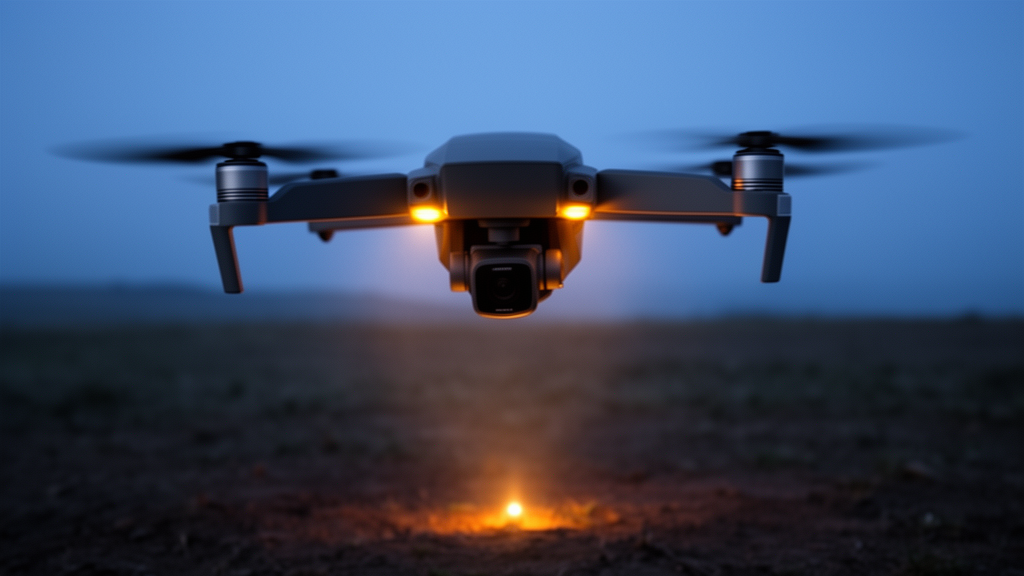
Detecting small objects such as people, vehicles, and drones in infrared imagery captured from unmanned aerial vehicles is a persistent challenge for nighttime surveillance, search and rescue, and reconnaissance missions. Thermal images often show targets as just a few faint pixels against cluttered backgrounds, and multi-class detection from UAV platforms must solve several intertwined problems at once. A newly published open-access study in Complex & Intelligent Systems addresses this joint problem with a detection framework that organizes infrared domain knowledge around two physical cues: temperature gradients and radiation intensity.
The researchers argue that existing prompting methods have improved either infrared modality adaptation or mask-level segmentation of small targets, but horizontal-box detection of multiple object classes from UAVs still requires simultaneous progress on three fronts. These are fine-grained semantic ambiguity in thermal imagery, the loss of weak small-target evidence as features pass through multi-scale network stages, and scale-dependent localization errors that must be corrected within a practical deployment budget of computation and memory.
To tackle semantic ambiguity, the team introduces Thermal-aware Dual-branch Semantic Alignment, or TDSA. This module maps temperature-gradient and radiation-intensity information into dual thermal prompts and aligns them with visual features, injecting infrared-specific physical knowledge directly into the learning process. The design is problem-oriented rather than claiming to be the first infrared prompting method, a distinction the authors state explicitly in their abstract.
Preserving weak evidence during feature propagation is handled by a Three-path Thermal-aware Scale-adaptive Hybrid Feature Fusion Block, abbreviated TS-HFFB. It combines three pathways so that fragile local cues from small targets survive alongside global context and cross-level information drawn from different depths of the network. A complementary module, Scale-adaptive Target-Aware Reweighting, or STAR, emphasizes difficult small-target localization during training, giving underperforming cases more influence on the learning signal.
The framework also employs a training-only shape supervision mechanism that regularizes target boundaries without altering the deployed task, which remains standard box detection. Because the shape constraint is applied only during training, inference speed and architecture are unaffected at deployment time.
Controlled experiments reported in the paper show that the dual thermal prompt mapping outperforms class-name prompts, random prompts, and single-projection alternatives, supporting the claim that the two physical cues carry complementary information. Shape supervision improves AP50 by 0.98 points and mAP@[.5:.95] by 1.75 points, indicating gains in both loose and strict localization accuracy.
On the main benchmarks, the method achieves 86.8 percent mAP50 on HIT-UAV and 84.6 percent mAP50 on DroneVehicle, two widely used UAV infrared datasets. The model runs at 152 frames per second with 10.8 million parameters, a footprint the authors position as compatible with practical deployment budgets rather than laboratory-only conditions.
The study, published as an open-access article with authors including Lin Yu, Liujie Hua, Yaqi Kang, Jinzhou Fu, Xiyu Tan, Haitao Yang, and Long Ni, appeared online on 26 October 2026 in a version shared early for faster access to peer-reviewed, accepted research. The publisher notes that this early version is citable, carries a permanent DOI, and will be replaced automatically by the final Version of Record after further edits.
For the surveillance and robotics communities, the work illustrates a broader trend: rather than treating infrared imagery as a generic image modality, encoding physical knowledge such as how temperature gradients and radiation intensity behave in thermal scenes can measurably improve detection of weak, small, and ambiguous targets. The reported results support a problem-oriented thermal detection framework, and the ablation evidence ties each architectural component to a specific failure mode of small-target detection from aerial platforms.
Subject of Research: Thermal-aware deep learning framework for multi-class infrared small target detection from UAVs
Article Title: Thermal-aware UAV infrared small target detection integrating infrared domain knowledge
Article References: Yu, L., Hua, L., Kang, Y., Fu, J., Tan, X., Yang, H., & Ni, L. (2026). Thermal-aware UAV infrared small target detection integrating infrared domain knowledge. Complex & Intelligent Systems. https://doi.org/10.1007/s40747-026-02551-6
Image Credits: AI Generated
DOI: 10.1007/s40747-026-02551-6
Keywords: Thermal-aware, infrared, small, target, detection, integrating, domain, knowledge, scientific research
Cite Scienmag News
Denise Maddox. (October 26, 2026). Thermal-aware AI sharpens UAV infrared small target detection. Scienmag. https://scienmag.com/thermal-aware-ai-sharpens-uav-infrared-small-target-detection/
Denise Maddox. "Thermal-aware AI sharpens UAV infrared small target detection." Scienmag, 26 October 2026, https://scienmag.com/thermal-aware-ai-sharpens-uav-infrared-small-target-detection/. Accessed 21 November 2026.
Denise Maddox. "Thermal-aware AI sharpens UAV infrared small target detection." Scienmag. October 26, 2026. https://scienmag.com/thermal-aware-ai-sharpens-uav-infrared-small-target-detection/




