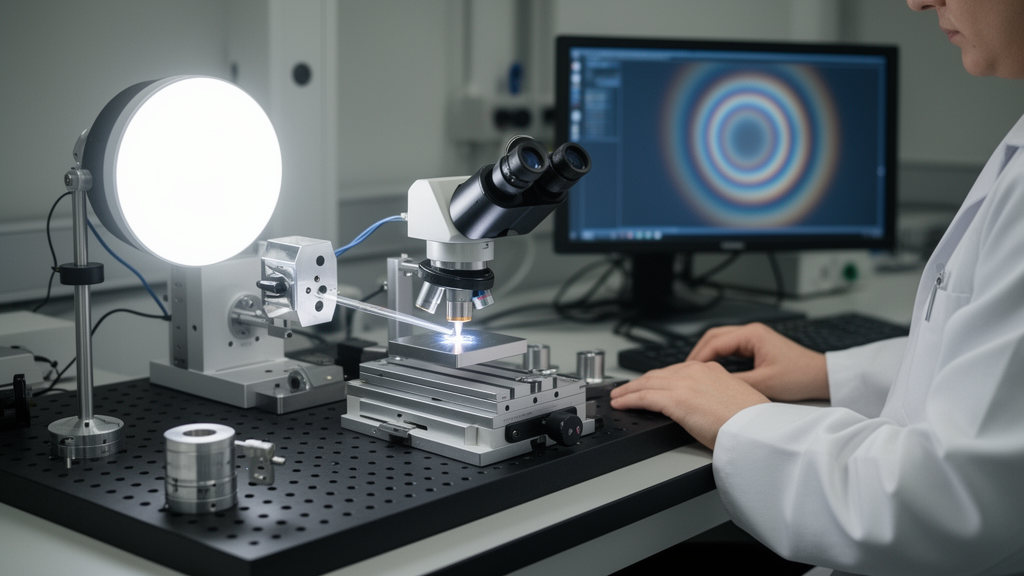
White-light interferometry has become one of the most trusted tools for measuring the microscopic hills and valleys of manufactured surfaces, but a new comprehensive review argues that the technique’s accuracy is constantly under siege from a surprising range of error sources, from laboratory vibrations to the quirks of the samples themselves. The review, published in Frontiers in Physics by researchers at Hebei University of Technology in China and the University of Auckland in New Zealand, systematically catalogs the physical mechanisms behind these errors and summarizes two decades of compensation strategies developed to fight them.
The technique, also known as coherence scanning interferometry or scanning white-light interferometry, works by exploiting the low-coherence nature of broadband light sources such as white-light LEDs or halogen lamps. Unlike laser-based phase-shifting interferometry, which suffers from an inherent 2π phase ambiguity, white-light interferometry produces pronounced fringe contrast only when the optical path difference between the test beam and the reference beam approaches zero. This spatially confined fringe visibility allows the zero optical path difference position to be located unambiguously, giving the method a large unambiguous measurement range and vertical resolution comparable to that of scanning probe microscopy. Those qualities have made it a standard technique for surface roughness measurement across industries ranging from precision engineering to micro-electromechanical systems and biomedical applications.
The review’s authors explain that the ideal mathematical model underlying the technique assumes a Gaussian spectral distribution for the light source, a stable measurement environment, and an ideally reflective sample surface. In practice, all three assumptions break down. The authors classify the major error sources into environmental vibration, errors induced by the measured sample’s surface characteristics, the batwing effect, algorithmic processing errors, and a collection of additional factors including actuator nonlinearity, optical aberrations, non-ideal spectra, and temperature and air disturbances. Crucially, they emphasize that these errors rarely act alone; when multiple sources are present simultaneously, their effects are not simply linearly superimposed but interact in complex ways through the measurement system and the reconstruction algorithms.
Environmental vibration emerges as one of the most persistent threats. The review models vibration as a random process and shows how it introduces additional phase terms into the interference signal, causing the entire fringe envelope to drift. Low-frequency vibrations are singled out as particularly damaging because their amplitudes tend to be larger; when fringe displacement exceeds one fringe period, fringe contrast collapses and accurate measurement becomes impossible. To combat this, the authors distinguish active suppression methods, which use closed-loop feedback to correct a piezoelectric transducer in real time, from passive approaches such as vibration isolation platforms, shortened acquisition times, and algorithmic reconstruction of distorted signals. One highlighted example rearranged interferograms based on displacement measurements from an auxiliary distance sensor and then applied interpolation, transforming a profile completely obscured by oscillations into a clearly resolved periodic step structure.
The samples themselves are another major culprit. For transparent or semi-transparent materials such as thin films, reflected signals from the upper and lower surfaces interfere both with the reference wave and with each other, producing interference envelopes with multiple peaks rather than a single peak. This makes localizing the zero optical path difference far more difficult and can cause algorithms to lock onto the wrong interface, producing thickness jumps in transparent and multilayer films. Geometric complexity compounds the problem: steep slopes, deep grooves, and abrupt steps redirect reflected light outside the objective’s numerical aperture, attenuating the signal and distorting the envelope into asymmetric, broadened, or multi-peaked shapes. Compensation strategies reviewed here include polarization phase-shifting system designs, dispersion-compensated thin-film measurement models, and even cross-disciplinary imports such as tomographic analysis and focus-metric-based three-dimensional recovery.
Perhaps the most vividly named artifact is the batwing effect, in which wing-shaped overshoots and undershoots appear in reconstructed profiles near abrupt height transitions. The review traces its origin to diffraction: at steep edges, incident light diffracts toward both the top and bottom of the step and interferes alongside the reference and reflected components, so the signal at the imaging plane becomes a superposition of multiple envelope components. Studies cited in the review found that the effect’s severity depends strongly on the height-to-wavelength ratio and on numerical aperture, with smaller apertures widening the batwing and larger depth errors. Suppression approaches range from achromatic phase shifters, which add hardware complexity, to algorithmic fixes combining mean filtering with surface fitting, and to multi-scale decompositions such as wavelet transforms and improved complete ensemble empirical mode decomposition, which separate high-frequency edge distortions from low-frequency background components. One hybrid method combining edge-guided CEEMDAN with wavelet correction produced smooth transitions across step edges where conventional Fourier and frequency-domain methods showed obvious protrusions.
Algorithmic errors form the fourth pillar of the review. Because reconstruction depends heavily on signal models and parameter settings, mismatches between algorithmic assumptions and real signals introduce peak localization deviations and reconstruction errors. The authors compare the noise robustness of mainstream algorithms, reporting that the centroid method showed the highest height variance and weakest interference resistance, the Hilbert transform method performed moderately, and correlogram correlation-based approaches fared better. Three recurring failure modes are identified: envelope peak localization errors driven by noise and envelope asymmetry, phase calculation and unwrapping errors that accumulate under low signal-to-noise conditions, and filtering errors from fixed thresholds and insufficient sampling rates. Recent remedies include moving sinusoidal average filtering, multi-sub-envelope zero-order phase bias compensation, correlation-based signal selection criteria, and variational mode decomposition paired with improved wavelet thresholding, which one study showed recovered a trapezoidal grating’s standard 1.75 micrometer height with a deviation below 0.02 micrometers and a relative error of 1.14 percent.
Beyond these individual categories, the review highlights joint suppression of multiple error sources as an emerging frontier. One strand of work targets phase noise directly, through monochromatic reference interferometers sharing the optical path, frequency-domain decomposition denoising, and phase noise self-correction algorithms; one such method kept surface deviation within ±2 nanometers. The other, more speculative strand applies deep learning, with envelope deep residual shrinkage networks extracting stable envelopes from undersampled signals and end-to-end networks reconstructing topography directly from simulated interferograms. Yet the authors issue a pointed caution: purely data-driven models treat the mapping from interferograms to height as a black box, learn only statistical correlations within their training distribution, and can hallucinate false steps, spurious fringes, and edge artifacts with high confidence when faced with low-reflectivity surfaces or multiple reflections. They advocate physics-informed neural networks and uncertainty quantification, which would let instruments flag unreliable pixels and distinguish measurement noise from model ignorance.
Looking forward, the review identifies four development directions: new light sources such as supercontinuum lasers, whose broad, flat spectra could improve envelope morphology and reduce sidelobes, though cost, size, and the lack of error-propagation evaluation methods remain hurdles; active anti-vibration technology, which brings its own sensor noise, control delay, and stability challenges; real-time measurement enabled by GPU and FPGA acceleration, which raises new questions about numerical precision and the absence of unified evaluation standards; and intelligent reconstruction that fuses physical priors with data-driven learning. For a technique the authors describe as mature yet still constrained by its imaging model and inversion algorithms, the message is clear: the next gains in nanometer-scale surface metrology will come not from any single fix, but from understanding how vibration, sample physics, diffraction, and computation conspire together, and from compensation strategies designed with those couplings in mind.
Subject of Research: Error mechanisms and compensation methods in white-light interferometric surface topography measurement
Article Title: A review of error analysis and compensation methods in white-light interferometric surface topography measurement
Article References: Lian, Y., Shan, Y., Xie, L., Wang, X., Wang, Y., & Lu, Z. (2026). A review of error analysis and compensation methods in white-light interferometric surface topography measurement. Frontiers in Physics, 14, Article 1974701. https://doi.org/10.3389/fphy.2026.1974701
Image Credits: AI Generated
DOI: 10.3389/fphy.2026.1974701
Keywords: white-light interferometry, surface topography, metrology, interference microscopy, error compensation, batwing effect, environmental vibration, reconstruction algorithms, deep learning, thin films, coherence scanning interferometry, precision manufacturing
Cite Scienmag News
Blake Davidson. (October 28, 2026). Review Maps How Errors Distort White-Light Interferometry and How to Fix Them. Scienmag. https://scienmag.com/review-maps-how-errors-distort-white-light-interferometry-and-how-to-fix-them/
Blake Davidson. "Review Maps How Errors Distort White-Light Interferometry and How to Fix Them." Scienmag, 28 October 2026, https://scienmag.com/review-maps-how-errors-distort-white-light-interferometry-and-how-to-fix-them/. Accessed 2 November 2026.
Blake Davidson. "Review Maps How Errors Distort White-Light Interferometry and How to Fix Them." Scienmag. October 28, 2026. https://scienmag.com/review-maps-how-errors-distort-white-light-interferometry-and-how-to-fix-them/