


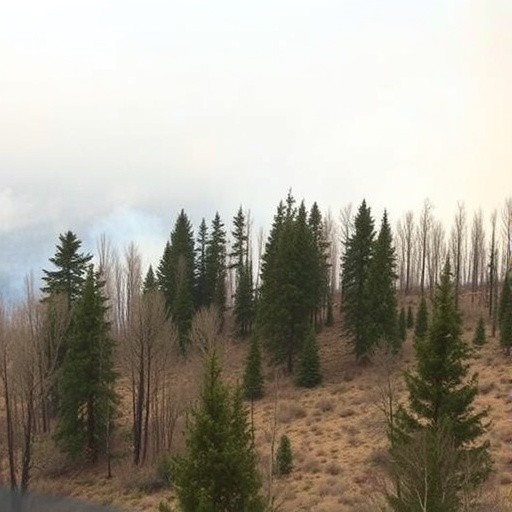
As wildfires surge with increasing frequency and ferocity across landscapes such as the western United States, the effects of smoke exposure are becoming a persistent public health concern. Yet, despite the widespread acknowledgment of these risks, the biological mechanisms underlying the health consequences of wildfire smoke remain deeply elusive. This knowledge gap challenges the development of precise interventions and guidelines aimed at protecting vulnerable populations from the adverse outcomes linked to inhalation of wildfire particulate matter.
A recent comprehensive review published in Frontiers in Public Health brings to light this critical oversight. Authored by Veronica L. Penuelas and David D. Lo from the University of California, Riverside, the paper outlines the urgent need for a fundamental shift in wildfire smoke research priorities. The authors emphasize that much of the existing literature relies heavily on epidemiological correlations, linking community-level exposures to health outcomes without dissecting the biomedical pathways that translate inhaled pollutants into physiological damage.
Professor David Lo, a distinguished figure in biomedical sciences and director of the BREATHE (Bridging Regional Ecology, Aerosolized Toxins, and Health Effects) Lab at UCR, points out that these statistical associations, while suggestive, fail to capture the intricacies of cellular and molecular harm induced by wildfire smoke. “Most studies are based on inferred exposures rather than direct evidence delineating how smoke constituents injure respiratory tissues, provoke inflammation, or disrupt immune responses,” he notes. This lack of mechanistic understanding hampers the formulation of targeted therapeutic strategies or public health advisories that could mitigate the impact of smoke exposure in real time.
Delving deeper into the complexity of wildfire smoke, the review underscores that this pollutant is far from being a monolithic entity. Instead, wildfire emissions undergo dynamic chemical transformations as they traverse the atmosphere, evolving into what researchers term “aged” smoke. This aged smoke carries a distinct composition, with particles that have reacted with atmospheric constituents, potentially increasing their toxicity. Penuelas, a doctoral researcher contributing to the study, elaborates: “The chemical evolution of wildfire smoke over time means that exposures experienced by downwind populations can differ greatly in composition and biological effect from fresh emissions near the fire front.”
This revelation challenges conventional approaches that treat wildfire smoke exposure as uniform and static. Understanding the precise chemical and physical transformations that smoke undergoes is paramount to unraveling its varied respiratory health outcomes. Such knowledge could illuminate why certain populations, based on geographic or temporal factors, experience exacerbated health risks, including heightened incidences of asthma, chronic obstructive pulmonary disease (COPD), and other pulmonary inflammation-driven conditions.
The review’s critical analysis also accentuates the limited scope of traditional air quality monitoring systems, which often quantify particulate matter mass concentration but fall short in capturing the nuanced chemical makeup of smoke at different stages of atmospheric aging. Without integrating detailed aerosol characterization and biological assays, the health risk assessments derived from such monitoring remain rudimentary and potentially misleading.
To bridge these scientific divides, the authors advocate for an integrative research paradigm that synergizes atmospheric chemistry, toxicology, and clinical biomedical sciences. This approach would involve deploying cutting-edge technologies such as high-resolution mass spectrometry to track the chemical evolution of wildfire aerosols, alongside in vitro and in vivo models that simulate human respiratory tract exposure. These methodologies could pinpoint specific molecular pathways activated by different smoke constituents, leading to cellular injury, oxidative stress, or immune dysregulation.
Moreover, understanding the interface between environmental exposure and underlying biological mechanisms holds promise for identifying biomarkers predictive of susceptibility or early disease onset. Such biomarkers could revolutionize public health responses by enabling personalized risk assessments and timely medical interventions during wildfire events, which increasingly coincide with heatwaves and urban expansion into fire-prone landscapes—a zone termed the wildland–urban interface.
The authors caution that until research efforts move beyond correlations toward elucidating causative pathways, the full magnitude of wildfire smoke’s impact on respiratory health will remain obscured. This stagnation in knowledge not only impedes the development of effective clinical treatments but also undermines policy decisions aimed at reducing population-level exposure and improving community resilience.
In light of these insights, funding bodies and scientific institutions are urged to recalibrate their research agendas to prioritize mechanistic studies that dissect the chemical and biological complexity of wildfire smoke. The escalating threat posed by climate change-driven wildfire regimes demands that the scientific community harness multidisciplinary expertise to safeguard public health against this insidious pollutant.
UC Riverside, as a hub for pioneering environmental health research, exemplifies the transformative potential of such integrated approaches. The BREATHE Lab’s focus on bridging ecological aerosol science with biomedical perspectives positions it uniquely to spearhead advances in this emerging field. By charting the journey from combustion emissions to physiological consequences, researchers aim to generate actionable knowledge that transcends academic boundaries and translates into tangible public health benefits.
As wildfire smoke continues to darken skies and challenge air quality worldwide, this call to action echoes loudly: a deeper, mechanistically grounded understanding of how smoke transforms and impacts the human respiratory system is essential. Only through such an accelerated scientific revolution can society hope to devise interventions that truly protect millions vulnerable to the insidious health effects of this increasingly common environmental hazard.
News Publication Date:
15-Mar-2026
Web References:
Frontiers in Public Health Article
References:
Penuelas, V.L., & Lo, D.D. (2026). From combustion to consequence: respiratory health concerns from primary and aged smoke at the wildland–urban interface. Frontiers in Public Health. DOI: 10.3389/fpubh.2026.1763671
Keywords
Wildfire smoke, respiratory health, aged smoke, atmospheric chemistry, pulmonary inflammation, biomedical research, particulate matter, wildland–urban interface, toxicology, exposure assessment, inflammation mechanisms, environmental health
Cite Scienmag News
Russell Cooper. (May 7, 2026). Review Highlights Overlooked Health Risks of Wildfire Smoke. Scienmag. https://scienmag.com/review-highlights-overlooked-health-risks-of-wildfire-smoke/
Russell Cooper. "Review Highlights Overlooked Health Risks of Wildfire Smoke." Scienmag, 7 May 2026, https://scienmag.com/review-highlights-overlooked-health-risks-of-wildfire-smoke/. Accessed 3 September 2026.
Russell Cooper. "Review Highlights Overlooked Health Risks of Wildfire Smoke." Scienmag. May 7, 2026. https://scienmag.com/review-highlights-overlooked-health-risks-of-wildfire-smoke/


