


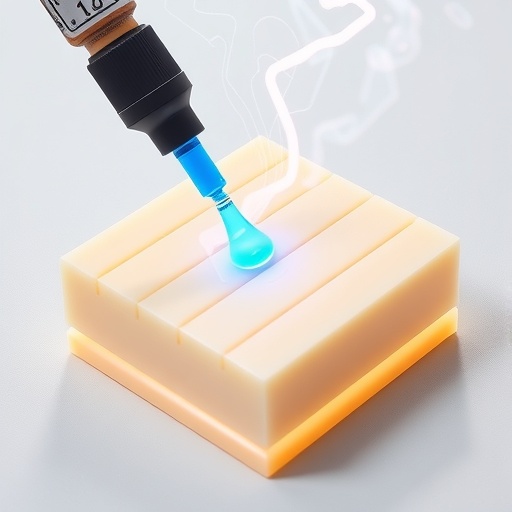
In a groundbreaking fusion of electrical and chemical engineering, researchers at Newcastle University have unveiled an electrically conductive, water-based reversible adhesive poised to revolutionize electronic waste recycling. This novel technology addresses a critical environmental challenge by enabling the easy disassembly and recovery of electronics, unlike traditional permanent adhesives and soldering methods. The development offers a sustainable pathway for tackling the mounting volumes of electronic waste worldwide, estimated at a staggering 62 billion kilograms annually.
This cutting-edge adhesive transcends the limitations of current bonding technologies used in electronics manufacturing. Unlike conventional solder, which forms permanent conductive joints difficult to reverse without damaging components, this innovative glue maintains electrical conductivity while allowing components to be separated through environmentally friendly solvents. Simply washing with acetone or an alkaline solution detaches the electronics parts safely, facilitating reuse and reducing the need for mining scarce and geopolitically sensitive minerals.
What sets this glue apart is its formulation — a “one-pot,” water-based system that sidesteps the toxic volatile organic compounds commonly emitted by many commercial adhesives. Unlike typical waterborne glues that suffer bond degradation in humid conditions, this adhesive exhibits exceptional stability without requiring additional hardeners or curing steps. The water-based nature not only enhances environmental compatibility but also supports straightforward industrial scalability, given its similarity to paint manufacturing processes.
The underlying chemistry integrates silver particles into the adhesive matrix, conferring the necessary electrical conductivity essential for electronic assembly tasks. While silver-enhanced conductive adhesives have existed, they traditionally offer no convenient means to reverse the bond. Newcastle’s team innovatively engineered a chemically reversible microstructure, enabling the silver components to be efficiently reclaimed, which is crucial both to minimize environmental toxicity and to reduce costs associated with silver’s high market price.
E-waste poses one of the largest global sustainability crises today; an overwhelming majority of discarded electronics are not recycled, resulting in massive accumulation of hazardous waste and lost resources. Silver and other critical minerals contained in e-waste are sourced in limited global locations, often under unstable political conditions. By fostering detachable electrical joints, this reversible adhesive significantly promotes circular economy principles, enabling not just recycling, but also straightforward repairs and component reuse.
Scaling this technology seemed feasible from the outset due to its reliance on abundant raw materials and well-established industrial methods. The water-based adhesive system avoids the production complexities and health risks associated with solvent-based glues. Moreover, the adhesive demonstrates robust bonding across diverse substrates, including metals, plastics, and printed circuit boards, making it versatile for a wide array of electronic device assemblies.
From a sustainability perspective, this advancement holds immense promise. Dr. Ama Asiedu-Asante, a researcher contributing to the study, highlighted that embracing water-based reversible adhesives offers the electronics industry opportunities to shift away from permanent joining techniques such as screws and solder, which hinder automated recycling processes. This paradigm shift could drive a future where electronic products are designed with end-of-life disassembly in mind.
Silver’s environmental impact and cost have historically limited the use of conductive adhesives in electronics. Professor Mark Geoghegan emphasized that the reversibility of the new glue allows for effective silver recovery and reuse, presenting a crucial economic and ecological breakthrough. This ability to recover precious metals not only conserves resources but also aligns with global initiatives to reduce e-waste toxicity and resource depletion.
Power Electronics expert Professor Volker Pickert underscored the pressing environmental concerns surrounding lead-based solder, which, while exhibiting excellent electrical conductivity, poses severe health risks. The newly developed glue provides a timely alternative, urging industry stakeholders to reconsider material choices where sustainability and performance must be balanced. This reversible adhesive may thus usher in a new era of environmentally conscious electronic manufacturing.
Adding to the societal impact, the research team filed a patent highlighted alongside their publication, reflecting the broad applications of this technology for creating repairable and reusable electronic systems. Such innovations resonate deeply with current policy shifts toward sustainability and resource optimization, reinforcing Newcastle University’s commitment to leading environmental stewardship in engineering disciplines.
Notably, the development arrives as Newcastle University was ranked 22nd nationally and 64th globally for sustainability by the QS World Rankings in 2026. This achievement underscores the institution’s ongoing dedication to pioneering solutions that integrate environmental foresight with scientific excellence, epitomized by this electrically conductive reversible adhesive.
The collaborative effort behind this adhesive combines rigorous experimental research and practical engineering insights. This multidisciplinary approach ensured the resultant glue meets performance benchmarks expected in commercial electronics, while firmly grounding its benefits in tangible ecological advantages. The work funded by the EPSRC and the Royal Commission for Jubail and Yanbu exemplifies the power of international academic partnerships in addressing global challenges.
In summary, Newcastle University’s electrically conducting water-based reversible adhesive represents a transformative leap toward sustainable electronics. By merging robust electrical performance with green chemistry and recyclability, this technology has the potential to reshape electronic manufacturing and waste management paradigms worldwide, heralding a cleaner and more resource-efficient future.
News Publication Date: 14-May-2026
Web References: DOI: 10.1002/aelm.202500617
References:
B. A.Aljohani, A. B.Asiedu-Asante, A.Sierra-Romero, K.Novakovic, V.Pickert, and M.Geoghegan, “An Electrically Conducting Water-based Reversible Adhesive.” Advanced Electronic Materials (2026): e00617.
Keywords
Adhesives, Recycling, Waste disposal, Electrical engineering, Chemical engineering
Cite Scienmag News
Denise Maddox. (May 15, 2026). Reversible Glue Technology Powers Up with Electric Activation. Scienmag. https://scienmag.com/reversible-glue-technology-powers-up-with-electric-activation/
Denise Maddox. "Reversible Glue Technology Powers Up with Electric Activation." Scienmag, 15 May 2026, https://scienmag.com/reversible-glue-technology-powers-up-with-electric-activation/. Accessed 3 September 2026.
Denise Maddox. "Reversible Glue Technology Powers Up with Electric Activation." Scienmag. May 15, 2026. https://scienmag.com/reversible-glue-technology-powers-up-with-electric-activation/


