

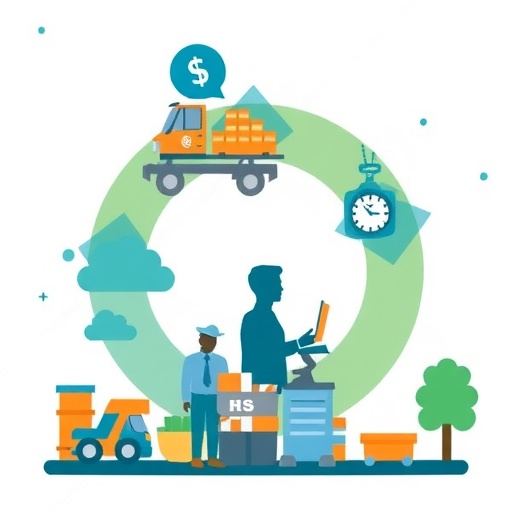
In an era where sustainable development has become more crucial than ever, the concept of a circular economy presents an innovative approach to managing resources. In their ground-breaking study, “Unveiling the impact of revenue and inventory on circular economy using profitability and competition as moderators in Indian automobile firms,” researchers Kanoujiya, Agarwal, and Rastogi delve into the intricate interplay between revenue generation, inventory management, and the underlying principles of a circular economy, particularly focusing on the context of the Indian automobile sector. Their work promises to shine a light on how these economic factors can shape the landscape of sustainable practices, transforming conventional business models into ones that prioritize environmental stewardship.
The Indian automobile industry represents a substantial chunk of the nation’s economy and has been undergoing significant transformation in recent years, particularly as consumer demands shift towards more sustainable practices. Amidst rising awareness regarding climate change and resource depletion, firms in this sector face dual pressures: maintaining profitability while also conforming to emerging circular economy frameworks. The authors of the study propose an interesting thesis – that revenue and inventory are not merely operational metrics but are pivotal in assessing the transition towards a circular economy.
In their research, the authors develop a comprehensive framework to analyze how revenue and inventory can serve as moderators in this transition. By examining the relationships among these variables, they provide critical insights into how automobile firms can leverage profitability and competition to foster a more circular approach to their operations. This nuanced understanding could help policymakers and business leaders alike navigate the complexities posed by traditional economic models, potentially leading to more sustainable organizational practices.
A major focal point of the study is the analysis of revenue generation mechanisms within companies that contribute to the circular economy. The authors argue that revenue, traditionally viewed as a measure of business success, must also be evaluated through the lens of sustainability. This reframing encourages firms to innovate their revenue models to incorporate value retention strategies, such as repair, refurbishment, and recycling. By doing so, companies not only enhance their financial performance but also minimize waste and resource consumption – pivotal goals within a circular economy framework.
Equally important in this investigation is inventory management. The researchers highlight that effective inventory control can significantly influence both the financial viability and the sustainability efforts of firms. Excessive inventory leads to higher holding costs and increased waste, which directly contravenes circular economy principles. Consequently, by fine-tuning their inventory practices, companies can reduce waste while increasing efficiency, presenting a compelling business case for reassessing conventional inventory strategies.
As competition intensifies within the global market, the study notes that companies cannot afford to ignore the benefits of embracing sustainability. The findings suggest that firms that actively engage in circular economy practices may not only witness improved financial outcomes but can also gain competitive advantages. This competitive edge arises from enhanced brand image and consumer loyalty, as a growing segment of consumers prefers products and services that demonstrate environmental responsibility. Thus, a win-win scenario is presented where sustainability is not merely a regulatory burden but a pathway to enhanced market performance.
Leveraging the insights from this research could significantly alter how automobile firms approach their broader business strategies. The implications extend to supply chain management as well, wherein stakeholders at all levels can benefit from adopting circular economy principles. For instance, suppliers can forge closer collaborations with manufacturers, focusing on shared sustainability goals that drive mutual success and environmental stewardship.
The study’s findings also reinforce the necessity for ongoing policy support in promoting circular economy initiatives. Both industry leaders and governments have a role to play in creating a conducive environment for businesses to thrive while adhering to sustainable practices. This support can come in various forms, from financial incentives such as grants and subsidies, to regulatory frameworks that encourage sustainable resource management and production practices.
While the research predominantly focuses on the Indian automobile sector, its implications resonate globally. The challenges and opportunities associated with transitioning to a circular economy are universal, and insights derived from this study can guide firms outside India as well. Consequently, the work not only adds to the existing body of literature on circular economies but also serves as a practical guide for businesses aiming to innovate and adapt.
The authors conclude by emphasizing that the journey towards a circular economy is ongoing and requires a collective effort from all stakeholders involved, including businesses, consumers, and regulatory bodies. For automobile firms, the intersection of revenue management, inventory control, profitability, and competition encapsulates the essence of this journey. By adopting a holistic approach, companies can create models that are not only economically viable but are also socially responsible and environmentally sustainable.
As the discourse surrounding sustainability becomes increasingly relevant, the insights presented by Kanoujiya, Agarwal, and Rastogi will likely spur further research and dialogue in this critical area. In unveiling the impact of revenue and inventory on circular economy principles, the authors have laid the groundwork for future studies and innovations that could redefine the operational landscape for the automobile industry and beyond.
In conclusion, the study not only sheds light on the intricate dynamics within the Indian automobile sector but also serves as a clarion call for a more sustainable business paradigm. Firms that acknowledge the power of integrating sustainable practices into their core operations stand to gain not only in terms of profitability but also in fostering a healthier planet for future generations. The era of circular economy is upon us, and the findings from this research could play a pivotal role in shaping its trajectory in the years to come.
Subject of Research: The impact of revenue and inventory on circular economy principles in the Indian automobile sector.
Article Title: Unveiling the impact of revenue and inventory on circular economy using profitability and competition as moderators in Indian automobile firms.
Article References:
Kanoujiya, J., Agarwal, B., Rastogi, S. et al. Unveiling the impact of revenue and inventory on circular economy using profitability and competition as moderators in Indian automobile firms.
Discov Sustain (2025). https://doi.org/10.1007/s43621-025-02322-2
Image Credits: AI Generated
DOI:
Keywords: Circular economy, revenue, inventory management, sustainability, Indian automobile industry, profitability, competition, business strategy.


