

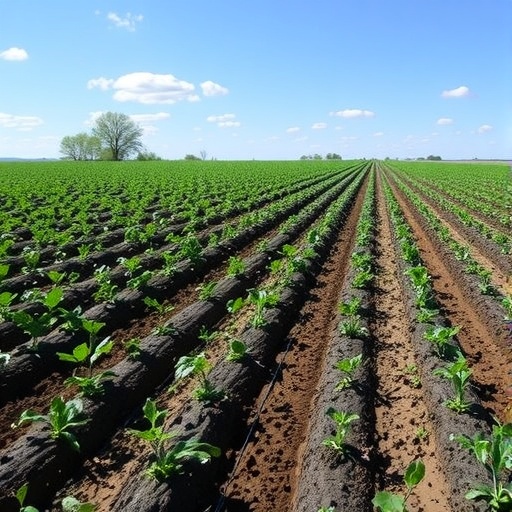
In a groundbreaking review that challenges longstanding assumptions about soil remediation, scientists are turning their focus to the biovolatilization and turnover methods that promise effective management of arsenic-contaminated agricultural lands. Arsenic contamination has long posed significant health and environmental hazards, particularly in regions where groundwater sources deliver naturally arsenic-enriched water to crop fields. Now, innovative microbial approaches and soil management techniques are emerging that could transform the way we approach arsenic detoxification in critical food-producing areas.
Central to these advances is the process known as biovolatilization, which exploits the natural ability of microorganisms expressing the arsenite S-adenosylmethionine methyltransferase gene (arsM) to convert inorganic arsenic species into volatile methylated forms like dimethylarsinic acid (DMA) and monomethylarsonic acid (MMA). While this microbial function occurs naturally in both terrestrial and marine ecosystems, its inherent activity is limited, thus requiring human intervention to amplify its effectiveness. Enhanced biovolatilization could provide a sustainable and natural pathway to reduce arsenic levels in contaminated soils while mitigating environmental risks.
Recent field investigations measuring biovolatilization fluxes provide essential insights into the magnitude of this process in real-world settings. Notably, research conducted in Bangladesh indicated that arsenic volatilization rates from rice paddies irrigated with arsenic-laden groundwater hovered around 240 milligrams per hectare annually, which translates to approximately 0.07 micrograms per square meter per day. Meanwhile, studies in southern China’s Guangdong Province demonstrated much higher volatilization rates reaching 54 micrograms per square meter per day in paddy soils irrigated using hydrogen peroxide-rich rainwater. These findings suggest that the composition of irrigation water can have a profound impact on arsenic volatilization dynamics.
Beyond leveraging natural microbial activity, an innovative genetic enhancement approach is now under exploration, involving the transfer of the arsM gene through synergistic interactions between lysogenic bacteriophages and their bacterial hosts. This novel gene transfer mechanism could dramatically scale up the microbial capacity for arsenic methylation, potentially increasing biovolatilization rates to a level where approximately 8% of the total arsenic burden in soils could be volatilized annually. Such a leap in efficiency would not only lessen arsenic accumulation in crops but could also contribute to safer agricultural ecosystems on a global scale.
However, as volatile arsenic species are released into the atmosphere, their ultimate fate becomes a critical consideration. Atmospheric biovolatilized arsenic typically associates with fine particulate matter ranging from 0.2 to 2.0 micrometers in diameter. Geographic and climatic conditions heavily influence its deposition patterns, with measured dry deposition rates varying widely between 0.78 and 82 micrograms per square meter per month, and wet deposition rates even higher, spanning 1.8 to 247 micrograms per square meter per month. Precipitation events notably increase arsenic deposition, highlighting the interconnectedness of biovolatilization with regional weather and biogeochemical cycles.
Despite the movement of biovolatilized arsenic through atmospheric pathways, there remains a significant knowledge gap regarding its redeposition specifically onto agricultural soils. Existing estimates posit that such redeposition contributes less than 0.05% of the total arsenic load in affected environments. Effectively, biovolatilization redistributes arsenic over wider spatial scales, resulting in a more homogeneous but lower-concentration contamination landscape. While this broader dispersal might reduce localized exposure risks, the broader environmental consequences and interactions with other elemental cycles, such as those of iron, sulfur, and nitrogen, necessitate deeper multidisciplinary research.
Complementary to biovolatilization, the soil turnover and attenuation (T&A) process offers a physical method to reduce arsenic concentration within the root zone. This approach involves mixing contaminated topsoil with arsenic-poor soil sourced from deeper subsoil layers. Such vertical homogenization leads to a dilution effect, with T&A shown to reduce topsoil arsenic levels by approximately 34%. The resulting decrease in arsenic bioavailability in surface soils translates directly into reduced arsenic accumulation in crops—a crucial outcome for food safety in vulnerable agricultural systems.
Nonetheless, this promising reduction comes with trade-offs, as the nutrient composition in deeper soil layers is often poorer, leading to slightly diminished crop yields after T&A intervention. Researchers have found that judicious application of fertilizers post-T&A can effectively ameliorate this decline, restoring productivity while maintaining the crucial benefit of lower arsenic uptake in crops. This balance between contaminant dilution and soil fertility underscores the need for integrated management strategies that account for both toxicant removal and crop health.
Importantly, both biovolatilization and T&A contribute to a more even spatial distribution of arsenic contamination. While biovolatilization promotes lateral smoothing through atmospheric dispersal, T&A achieves a vertical homogenization by blending soil strata. These complementary modalities open fertile ground for combined remediation protocols tailored to site-specific conditions and contamination profiles, optimizing arsenic management with potential for scalability across diverse agroecosystems.
The complexity of arsenic biogeochemistry in soils involving interactions with iron oxides, sulfur compounds, and nitrogen cycles further complicates remediation efforts but also invites innovative approaches that exploit these synergies. Iron minerals, for instance, strongly adsorb arsenic species, influencing mobility and bioavailability, while sulfur and nitrogen transformations can affect microbial community structure and function. Understanding these intertwined pathways is pivotal to enhancing both natural and engineered processes of arsenic attenuation.
Despite the promise, the field of arsenic biovolatilization and soil turnover remains ripe for exploration. The scarcity of extensive field trials, especially on a global scale, leaves many questions unanswered about long-term stability, environmental trade-offs, and potential unintended consequences of increased arsenic volatilization. Linking molecular biological advances such as phage-mediated gene transfer with soil science, atmospheric chemistry, and agronomic practices will be crucial to delivering holistic remediation solutions.
The conceptual innovations presented herein point to a future where arsenic-contaminated soils can be managed more sustainably and effectively, safeguarding crop yields while protecting environmental and human health. As the global population grows and water scarcity intensifies, approaches that simultaneously leverage microbial ecology and engineered soil management could redefine agricultural resilience in arsenic-affected regions.
Building on these findings, future research should prioritize the development of enhanced microbial consortia with optimized arsM expression, field verification of atmospheric arsenic cycling dynamics, and fine-tuning of T&A protocols to preserve soil fertility. Cross-sector collaboration—including microbiologists, soil scientists, agronomists, and atmospheric chemists—will be indispensable to harness the full potential of these innovative remediation pathways.
In conclusion, this new synthesis of arsenic remediation literature highlights the transformative promise of combining biovolatilization and soil turnover strategies. By embracing the complexity of arsenic’s environmental fate and harnessing cutting-edge microbial genetics and soil sciences, we stand on the cusp of revolutionary advances in mitigating a toxic global pollutant while promoting sustainable agriculture and food safety across vulnerable landscapes.
Subject of Research:
Remediation of arsenic-contaminated agricultural soil through biovolatilization and soil turnover and attenuation methods.
Article Title:
Revisiting the remediation of arsenic-contaminated agricultural soil: a review of real-world testing.
Article References:
Wan, X., Zeng, W., Wang, Y. et al. Revisiting the remediation of arsenic-contaminated agricultural soil: a review of real-world testing. npj Sustain. Agric. 4, 4 (2026). https://doi.org/10.1038/s44264-025-00111-y
Image Credits:
AI Generated


