


The early origins of the Israelites are at the centre of a new research project at the University of Oldenburg, Germany. A team of researchers led by Hebrew Bible scholar and archaeologist Prof. Dr Benedikt Hensel will explore over a three-year period how one of the largest “megacities” of the Bronze Age in the eastern Mediterranean was abandoned and then resettled over centuries – and how the narratives about these events influenced the shaping of early Israelite identities.
The Gerda Henkel Foundation is providing around 400,000 euros in funding for the project, titled “Resettlement of Ruins and Memories in the Making – A Case Study on Hazor and the Shaping of Early Israelite Identities during the Iron Age”, as part of its “Lost Cities” programme. The international team of researchers based in Oldenburg will work closely with academics from the Hebrew University of Jerusalem in Israel and the University of Regensburg.
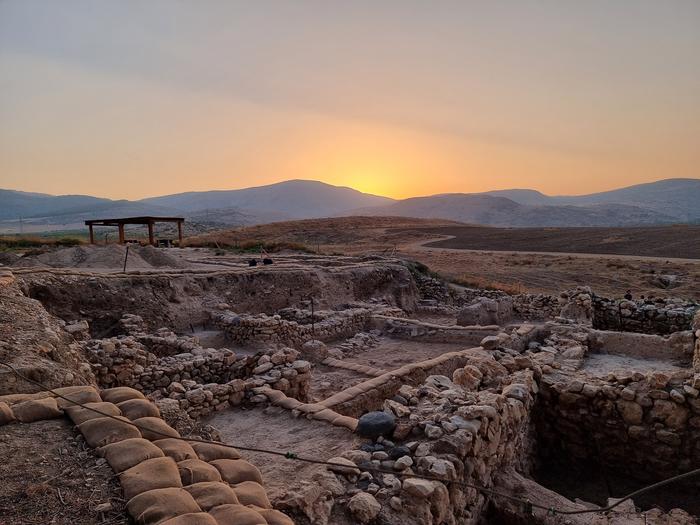
The ruins of the ancient city of Hazor are located in northern Israel, north of the Sea of Galilee. Based on the archaeological findings the site was first settled about 5,000 years ago, in the Early Bronze Age. By the Middle and Late Bronze Age Hazor’s population had grown to between 10,000 and 15,000 people thanks to its strategic location at the crossroads of several trade routes, making it the largest city in the entire region. Various sources from this period, including letters and clay tablets from cities in Syria and Egypt with which the rulers of Hazor conducted trade, testify to the central role Hazor played as a trading hub and cultural melting pot for the entire Near East region.
At the end of the Bronze Age, around 1300 B.C., Hazor was destroyed and temporarily abandoned for unknown reasons. In the subsequent Iron Age, the site was repopulated, albeit on a much smaller scale. “Which culture the inhabitants of Hazor belonged to is something we don’t know for sure,” says Hensel. In addition to the archaeological findings, biblical texts have also served as a key source of information on Hazor. The Book of Joshua from the Old Testament, for instance, describes how the Israelites conquered Hazor, which was inhabited by Canaanites at the time. The historicity of these passages is, however, disputed among researchers, because the texts date from a much later period. “They are probably not directly connected to the resettlement of Hazor,” says Hensel, whose specialty is biblical archaeology.

Credit: Maryam Matta
The early origins of the Israelites are at the centre of a new research project at the University of Oldenburg, Germany. A team of researchers led by Hebrew Bible scholar and archaeologist Prof. Dr Benedikt Hensel will explore over a three-year period how one of the largest “megacities” of the Bronze Age in the eastern Mediterranean was abandoned and then resettled over centuries – and how the narratives about these events influenced the shaping of early Israelite identities.
The Gerda Henkel Foundation is providing around 400,000 euros in funding for the project, titled “Resettlement of Ruins and Memories in the Making – A Case Study on Hazor and the Shaping of Early Israelite Identities during the Iron Age”, as part of its “Lost Cities” programme. The international team of researchers based in Oldenburg will work closely with academics from the Hebrew University of Jerusalem in Israel and the University of Regensburg.
The ruins of the ancient city of Hazor are located in northern Israel, north of the Sea of Galilee. Based on the archaeological findings the site was first settled about 5,000 years ago, in the Early Bronze Age. By the Middle and Late Bronze Age Hazor’s population had grown to between 10,000 and 15,000 people thanks to its strategic location at the crossroads of several trade routes, making it the largest city in the entire region. Various sources from this period, including letters and clay tablets from cities in Syria and Egypt with which the rulers of Hazor conducted trade, testify to the central role Hazor played as a trading hub and cultural melting pot for the entire Near East region.
At the end of the Bronze Age, around 1300 B.C., Hazor was destroyed and temporarily abandoned for unknown reasons. In the subsequent Iron Age, the site was repopulated, albeit on a much smaller scale. “Which culture the inhabitants of Hazor belonged to is something we don’t know for sure,” says Hensel. In addition to the archaeological findings, biblical texts have also served as a key source of information on Hazor. The Book of Joshua from the Old Testament, for instance, describes how the Israelites conquered Hazor, which was inhabited by Canaanites at the time. The historicity of these passages is, however, disputed among researchers, because the texts date from a much later period. “They are probably not directly connected to the resettlement of Hazor,” says Hensel, whose specialty is biblical archaeology.
The interdisciplinary research team is now examining the resettlement period in greater detail. Researchers from the fields of archaeology, social and cultural history, anthropology and Hebrew biblical studies plan to use the results to create a comprehensive overview of the cultural and ethnic transformations that took place in the area between the Euphrates and the Sinai Peninsula known as the Levant during the transition from the Bronze Age to the Iron Age – and of how the identity of the early Israelites developed in the course of these upheavals.
Why did the new settlers avoid certain places in the abandoned city?
One of the project’s key objectives is to investigate the resettlement of the Bronze Age ruins during the Iron Age. The researchers aim to learn more about how the new settlers viewed and treated the remains of the destroyed buildings at the site and gain insights into their cultural and ethnic identity. “The new settlers seem to have deliberately avoided certain places in the city, such as the former temple district in the upper city, which would actually have been an ideal place to settle,” Hensel explains. The team plans to carry out further excavations to locate other sites with a similar history within the city complex.
A second objective of the project is the literary-historical and cultural-historical reconstruction of the accounts of Hazor and the Canaanites within the biblical tradition, and an examination of how these narratives are linked to the biblical imagination of Israel as an early tribal culture. “In the biblical narratives, Hazor is portrayed as the capital of the Canaanites. This image is for the most part artificial, but over the centuries during which the biblical texts were compiled it endured – even long after the settlement had been abandoned,” Hensel explains. “Hazor serves as a counter-image to the Israelites, shaping the identity of biblical Israel through literary means,” he observes. The project team is investigating the potential historical anchor points of these identity-building processes.
Extensive archaeological excavations have been underway in Hazor since the 1990s. They are led by Professor Hensel and by Dr. Igor Kreimermann from the Hebrew University of Jerusalem, who is also involved in the current project. Oldenburg students also took part in the Hazor Excavations Project for the first time last year. The project funds will enable volunteers from Oldenburg to continue to participate in the archaeological work.
Cite Scienmag News
Courtney Benton. (April 17, 2024). Resettlement processes and cultural transformation in an ancient megacity. Scienmag. https://scienmag.com/resettlement-processes-and-cultural-transformation-in-an-ancient-megacity/
Courtney Benton. "Resettlement processes and cultural transformation in an ancient megacity." Scienmag, 17 April 2024, https://scienmag.com/resettlement-processes-and-cultural-transformation-in-an-ancient-megacity/. Accessed 3 September 2026.
Courtney Benton. "Resettlement processes and cultural transformation in an ancient megacity." Scienmag. April 17, 2024. https://scienmag.com/resettlement-processes-and-cultural-transformation-in-an-ancient-megacity/

