


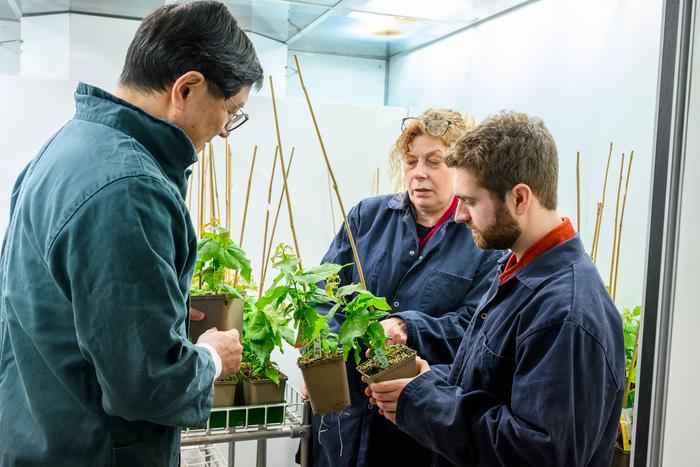
A groundbreaking study emerging from Umeå University unveils the intricate role of the circadian clock in dictating the growth patterns and seasonal timing of trees, shedding light on a critical biological mechanism that aligns tree physiology with environmental cues. Using genetically modified Populus species, including poplar and aspen, researchers have demonstrated how internal biological timers govern not only daily metabolic processes but also phenological events such as leaf emergence and bud set. This pioneering research bridges the gap between controlled-environment plant biology and the notoriously complex, variable conditions experienced in natural forest habitats.
Fundamentally, trees possess an endogenous circadian clock, a molecular timekeeping system that orchestrates biochemical and physiological activities aligned with the 24-hour day-night cycle. While previous investigations have underscored its relevance primarily in greenhouse settings, this new study transcends those limitations by incorporating multi-year field trials where environmental heterogeneity is pronounced. Factors such as temperature fluctuations, photoperiod variability, and biotic stressors like herbivory interact dynamically with the trees’ circadian system, influencing growth and survival outcomes under real-world conditions.
The research team engineered 68 distinct Populus lines, each carrying targeted genetic modifications affecting key circadian clock-associated genes. These genetically tailored populations were subjected to rigorous phenotyping across both controlled greenhouse environments and extensive field plots, enabling a comprehensive analysis of growth trajectories and seasonal development. The parallel use of statistical learning techniques alongside traditional experimental biology allowed for multifactorial data integration, revealing specific gene targets that modulate growth rates and the timing of phenological transitions under diverse environmental pressures.
Lead author Bertold Mariën highlights, “By leveraging statistical models, we unraveled the precise genetic components within the circadian framework that regulate tree growth and seasonal behavior. Our dual-environment approach validates how these clock genes interact with fluctuating external signals, enabling predictive insights that were previously unattainable.” This synthesis of computational and experimental approaches firmly establishes a causal link between circadian modulation and ecological adaptability in trees.
One of the salient findings is the plasticity of the tree circadian clock in responding to photoperiod cues. Certain genetic alterations shifted trees’ perception of daylight length, effectively extending the active growth phase later into the season than what is typical for their native latitudes. This capacity to recalibrate internal biological rhythms holds profound implications for forestry in high-latitude regions, where growing seasons are tightly constrained by short summers and long winters.
Maria E. Eriksson, senior author, explains, “Our findings provide a blueprint for adapting tree populations to new latitudinal zones by genetically tuning their circadian clocks. Such adaptations can lengthen the period available for biomass accumulation, enhancing timber productivity without compromising ecological fitness.” This approach could revolutionize forestry management by tailoring genetic profiles to local environmental conditions, thereby mitigating the impacts of climate change on forest yields.
Moreover, the study observed that specific clock gene modifications conferred enhanced resilience to abiotic stresses prevalent in field environments. These genetic variants demonstrated improved capacity to buffer against temperature extremes and other environmental fluctuations, bolstering tree survival and stable growth. This resilience factor offers promising avenues for future tree breeding programs focused on sustainability and climate adaptation.
The integration of circadian biology into forestry practices heralds a transformative era where biological timing mechanisms complement silvicultural techniques. “By aligning forestry operations with the natural rhythm of trees’ internal clocks,” Eriksson notes, “we can optimize growth cycles and stress responses, ultimately fostering healthier forests equipped to thrive amid unpredictable environmental challenges.” Such synchronicity may also refine silvicultural interventions including planting schedules and harvest timing to maximize yield and ecosystem services.
Beyond the immediate forestry applications, these insights bear significant weight for global vegetation models that underpin climate change predictions. Current models often overlook the nuanced role of circadian systems, potentially underestimating the sensitivity of trees to fluctuating environmental variables. Incorporating circadian regulatory modules can enhance model fidelity, enabling better projections of forest carbon dynamics and phenological shifts on a planetary scale.
This interdisciplinary endeavor exemplifies the power of collaboration between plant science and quantitative analytics. Researchers at Umeå Plant Science Centre, the Department of Mathematics and Mathematical Statistics, and the Integrated Science Lab (IceLab) combined expertise to forge new methodologies that transcend traditional disciplinary boundaries. The fusion of molecular genetics, ecology, and advanced statistical modeling showcases a holistic approach to unraveling complex biological phenomena.
The research was supported by a postdoctoral fellowship jointly funded by Kempestiftelserna and IceLab, enabling the lead author and collaborators to navigate the challenges of linking genotype to phenotype in complex field settings. Their collective work underscores the necessity of experimental rigor paired with computational innovation to unlock biological insights with far-reaching practical impact.
Looking forward, this study paves the way for engineered forestry solutions where circadian biology is an integral component of tree breeding, management, and conservation strategies. As climate variability intensifies, such precision adaptation becomes indispensable for maintaining forest productivity, biodiversity, and the myriad ecosystem services forests provide. The revelation that internal biological clocks can be modulated to extend growing seasons or bolster environmental resilience represents a paradigm shift in our understanding of tree ecology and evolution.
In sum, the Umeå University research delineates a sophisticated biological orchestration wherein the circadian clock acts as both conductor and guardian of tree life cycles, harmonizing growth and phenology with the environment’s temporal tapestry. This work not only advances scientific knowledge but also holds transformative potential to shape sustainable forestry and climate resilience in the decades to come.
News Publication Date: 7-Apr-2025
Web References: 10.1038/s44323-025-00034-4
Cite Scienmag News
Sloane Callahan. (April 15, 2025). Resetting Trees’ Internal Clocks: A New Strategy to Combat Climate Change. Scienmag. https://scienmag.com/resetting-trees-internal-clocks-a-new-strategy-to-combat-climate-change/
Sloane Callahan. "Resetting Trees’ Internal Clocks: A New Strategy to Combat Climate Change." Scienmag, 15 April 2025, https://scienmag.com/resetting-trees-internal-clocks-a-new-strategy-to-combat-climate-change/. Accessed 4 September 2026.
Sloane Callahan. "Resetting Trees’ Internal Clocks: A New Strategy to Combat Climate Change." Scienmag. April 15, 2025. https://scienmag.com/resetting-trees-internal-clocks-a-new-strategy-to-combat-climate-change/


