


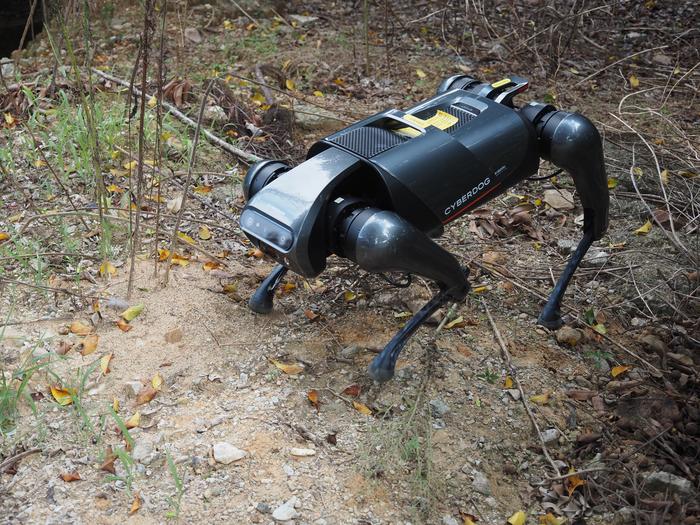
A multidisciplinary research team based across China and Brazil has used a dog-like robot and AI to create a new way to find fire ant nests. Published in the SCI journal Pest Management Science, the study highlights how a ‘CyberDog’ robot integrated with an AI model can automate the identification and control of Red Imported Fire Ants (RIFA), a globally destructive pest.
Field tests carried out by the researchers reveal the robotic system can significantly outperform human inspectors, identifying three times more RIFA nests with greater precision. Eduardo Fox, postdoctoral researcher at State University of Goiás in Brazil, and corresponding author of the study explained the motivation behind this pest management approach.
“Fire ant nests are difficult for untrained personnel to identify and confirm in the field, and searching large areas can be time-consuming and exhausting under the hot sun. A robot could automatically locate the nests without requiring specially trained individuals and operate at various times of the day regardless of temperature conditions.”
Controlling an invasive species
RIFA is one of the most destructive pests worldwide. Accidentally introduced to the United States in the 1930s, they have since spread as an invasive organism across numerous areas including China, Japan and Europe, causing extensive environmental damage and economic losses.
Discussing the importance of detecting RIFA nests, Fox noted, “RIFA proliferate rapidly in established areas, displacing local fauna and flora by outcompeting and eliminating sensitive species. Small vertebrates, such as birds and reptiles, are particularly vulnerable. Additionally, RIFA associates with significant agricultural pests like mealybugs and can damage some plants, exposing them to pathogens.”
Conventional approaches to controlling RIFA populations involve the use of pesticides, at the risk of harming local ecosystems. To implement effective and targeted RIFA control strategies which minimise the harm to native species, extensive monitoring of populations is essential.
Training the dog
The team utilised Xiaomi’s CyberDog robot, integrating it with a machine learning model trained on a comprehensive dataset of over 1,100 RIFA nest images. This approach resulted in a nest detection precision rate of over 90%.
They conducted rigorous field tests to measure the system’s effectiveness. The CyberDog was programmed to press the nest with its front paw: when a fire ant nest mound is disturbed, the workers will rush out from cracks and openings displaying aggressive behaviour. This, the researchers said, is key for diagnosing active mounds from abandoned nests, and to avoid false positives with mounds inhabited by other species.
Hualong Qiu, a researcher at Guangdong Academy of Forestry in China, and corresponding author of the study explained: “A group of students received official standard training for quarantine inspectors and were tasked with locating fire ant nests in an open field. Subsequently, the AI-trained robot was challenged with the same field, and the performances of the students and the robot were compared.”
Challenges and future directions
Despite the promising results, the researchers acknowledge several challenges in scaling up the technology. “The primary limitations to scaling the use of robots are their battery autonomy, which lasts about 30 minutes, and the high cost of acquiring more agile and efficient models”, noted Zheng Yan, a researcher at Lanzhou University in China and corresponding author of the study.
“Currently, it is still more expensive using the robot system than through the traditional approach, but we believe production costs may optimise this with time,” he said.
Improving public awareness with robots
The study’s findings could have a significant impact on pest control policies and public awareness. “In addition to being versatile machines for navigating urban environments, robot dogs attract a lot of public attention. Fire ants pose a serious threat in China, yet most people remain unaware of the dangers of invasive fire ant nests in public areas. Therefore, sightings of robots tracking fire ant nests are likely to captivate the public and raise awareness about the presence of fire ants”, Yan said.

Credit: Dr Hualong Qiu, Guangdong Academy of Forestry
A multidisciplinary research team based across China and Brazil has used a dog-like robot and AI to create a new way to find fire ant nests. Published in the SCI journal Pest Management Science, the study highlights how a ‘CyberDog’ robot integrated with an AI model can automate the identification and control of Red Imported Fire Ants (RIFA), a globally destructive pest.
Field tests carried out by the researchers reveal the robotic system can significantly outperform human inspectors, identifying three times more RIFA nests with greater precision. Eduardo Fox, postdoctoral researcher at State University of Goiás in Brazil, and corresponding author of the study explained the motivation behind this pest management approach.
“Fire ant nests are difficult for untrained personnel to identify and confirm in the field, and searching large areas can be time-consuming and exhausting under the hot sun. A robot could automatically locate the nests without requiring specially trained individuals and operate at various times of the day regardless of temperature conditions.”
Controlling an invasive species
RIFA is one of the most destructive pests worldwide. Accidentally introduced to the United States in the 1930s, they have since spread as an invasive organism across numerous areas including China, Japan and Europe, causing extensive environmental damage and economic losses.
Discussing the importance of detecting RIFA nests, Fox noted, “RIFA proliferate rapidly in established areas, displacing local fauna and flora by outcompeting and eliminating sensitive species. Small vertebrates, such as birds and reptiles, are particularly vulnerable. Additionally, RIFA associates with significant agricultural pests like mealybugs and can damage some plants, exposing them to pathogens.”
Conventional approaches to controlling RIFA populations involve the use of pesticides, at the risk of harming local ecosystems. To implement effective and targeted RIFA control strategies which minimise the harm to native species, extensive monitoring of populations is essential.
Training the dog
The team utilised Xiaomi’s CyberDog robot, integrating it with a machine learning model trained on a comprehensive dataset of over 1,100 RIFA nest images. This approach resulted in a nest detection precision rate of over 90%.
They conducted rigorous field tests to measure the system’s effectiveness. The CyberDog was programmed to press the nest with its front paw: when a fire ant nest mound is disturbed, the workers will rush out from cracks and openings displaying aggressive behaviour. This, the researchers said, is key for diagnosing active mounds from abandoned nests, and to avoid false positives with mounds inhabited by other species.
Hualong Qiu, a researcher at Guangdong Academy of Forestry in China, and corresponding author of the study explained: “A group of students received official standard training for quarantine inspectors and were tasked with locating fire ant nests in an open field. Subsequently, the AI-trained robot was challenged with the same field, and the performances of the students and the robot were compared.”
Challenges and future directions
Despite the promising results, the researchers acknowledge several challenges in scaling up the technology. “The primary limitations to scaling the use of robots are their battery autonomy, which lasts about 30 minutes, and the high cost of acquiring more agile and efficient models”, noted Zheng Yan, a researcher at Lanzhou University in China and corresponding author of the study.
“Currently, it is still more expensive using the robot system than through the traditional approach, but we believe production costs may optimise this with time,” he said.
Improving public awareness with robots
The study’s findings could have a significant impact on pest control policies and public awareness. “In addition to being versatile machines for navigating urban environments, robot dogs attract a lot of public attention. Fire ants pose a serious threat in China, yet most people remain unaware of the dangers of invasive fire ant nests in public areas. Therefore, sightings of robots tracking fire ant nests are likely to captivate the public and raise awareness about the presence of fire ants”, Yan said.
Journal
Pest Management Science
DOI
Article Title
The implementation of robotic dogs in automatic detection and surveillance of red imported fire ant nests
COI Statement
The authors declare that they have no known competing financial interests or personal relationships that could have appeared to influence the work reported in this paper.
Cite Scienmag News
William Thompson. (August 21, 2024). Researchers use AI and robot dog to combat invasive fire ants. Scienmag. https://scienmag.com/researchers-use-ai-and-robot-dog-to-combat-invasive-fire-ants/
William Thompson. "Researchers use AI and robot dog to combat invasive fire ants." Scienmag, 21 August 2024, https://scienmag.com/researchers-use-ai-and-robot-dog-to-combat-invasive-fire-ants/. Accessed 6 September 2026.
William Thompson. "Researchers use AI and robot dog to combat invasive fire ants." Scienmag. August 21, 2024. https://scienmag.com/researchers-use-ai-and-robot-dog-to-combat-invasive-fire-ants/

