


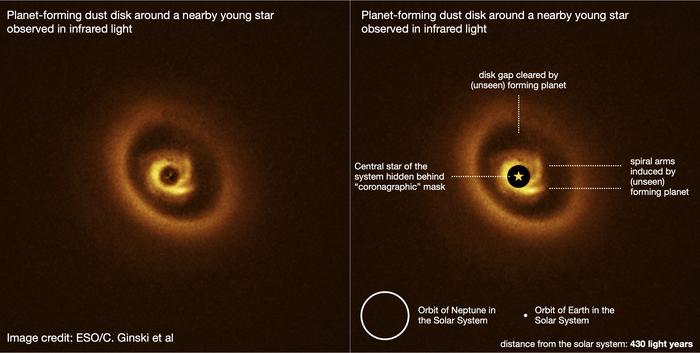
An international team of astronomers, spearheaded by researchers from the University of Galway, has made a groundbreaking discovery that could reshape our understanding of planet formation. On June 9, 2025, these scientists unveiled remarkable observations of a nascent star system known as 2MASS1612 or RIK113, which is located approximately 430 light years away from Earth. Utilizing the advanced capabilities of the European Southern Observatory’s Very Large Telescope (VLT) in Chile, the team captured unprecedented images revealing a structured protoplanetary disk around this distant young star.
The protoplanetary disk is a swirling mass of gas and dust that is fundamental in the process of planet formation. Surrounding the star, this disk spans an astonishing 130 astronomical units. To put this into perspective, one astronomical unit represents the average distance from Earth to the Sun. The disk’s dimensions are significant, as it is larger than our own solar system but, due to the immense distance, appears as diminutive as a pint glass held at arm’s length in Galway.
In the captured images, the disk exhibits clear structural features, including a prominent bright ring followed by a notable gap centered around 50 astronomical units. This intriguing gap and its features suggest that a planet may be in the early stages of formation. The findings provide tantalizing evidence that a gas giant could be evolving within this gap, potentially several times the mass of Jupiter, thereby becoming one of the largest planets in our galaxy.
The intricate formations within the disk resemble systems of spiral arms, indicative of gravitational influences at play during the formation process. While they may seem scarce in the captured imagery, these spiral arms are crucial to understanding the dynamics of material in the disk. The inner radius of this active region is roughly 40 astronomical units, signifying that it is vast enough to include all the planets of our solar system and still have room to spare.
Dr. Christian Ginski, the lead author of the study and a lecturer at the University of Galway’s Centre for Astronomy, expressed his excitement regarding the team’s findings. He noted that while they have previously observed nearly 100 potential planet-forming disks around other stars, the combination of rings and spiral arms seen in 2MASS1612 is exceptionally rare. The observed structure closely aligns with theoretical models predicting how forming planets shape the disks around them. This breakthrough offers a more profound insight into the mechanisms driving planet formation throughout the cosmos and could enhance our understanding of the origins of our own solar system.
The commitment of the research team is noteworthy, particularly the integration of the University of Galway’s postgraduate students into this ambitious project. Many students, including Chloe Lawlor, Jake Byrne, Dan McLachlan, and Matthew Murphy, contributed significantly to the analysis, showcasing the impactful role of emerging scientists in cutting-edge research. Their engagement not only marked a crucial step in their academic journey but also highlighted the collaborative spirit of scientific inquiry, particularly in astrophysics.
While the preliminary observations are remarkable, the study notes key areas requiring further exploration. Amiable atmospheric emissions detected within the disk suggest the presence of a forming planet, although definitive confirmation is necessary through continued investigation. To further their research, Dr. Ginski and his team have secured observation time with the James Webb Space Telescope. This state-of-the-art observatory, launched to deepen our understanding of the universe, has the sensitivity required to capture direct images of the young planet, should it be confirmed.
Ultimately, this discovery positions the 2MASS1612 system as a prime candidate for the study of planet-disk interaction. Understanding this relationship is critical in comprehending how planets evolve and interact with their environments during the formation phase. As scientists gain more knowledge from new observations, our grasp of planet formation may illuminate the past conditions of our solar system and those of distant worlds.
With ongoing studies and technology advancements, the potential to witness the birth of a gas giant within such a dynamic disk represents a unique milestone in astronomy. Each new finding brings the scientific community closer to unraveling the mysteries behind planetary birth and development. Researchers aim to foster a legacy of exploration that will inspire future generations of scientists eager to unlock the secrets of the universe.
The insights gleaned from these observations and the excitement surrounding the research embody the essence of modern astronomy. As telescopes become more sophisticated and collaborative efforts among international teams intensify, the prospects for remarkable discoveries grow. This development is not only prominent for the field of astrophysics but also stands to captivate the imagination of the public, igniting interest in the vast possibilities that await us in the cosmos.
As we look toward the future, the findings regarding the 2MASS1612 system highlight a crucial time in the field of astronomy. The potential discovery of a new gas giant could prompt a reevaluation of existing theories regarding planetary formation and evolution. Researchers advocate for continued exploration of this and similar systems to unveil further insights into how planets emerge in their infancy amidst the intricate dance of cosmic dust and gas.
The story of 2MASS1612 serves as a beacon of hope and inspiration in the quest for knowledge. As we strive to comprehend our place in the universe, each advancement in astronomical research brings us closer to unlocking the enigmas of our existence. The collaboration across institutions and countries fosters a deep commitment among scientists, emphasizing that the pursuit of understanding is a shared human endeavor.
Accomplishments like this underline the importance of education and mentorship in nurturing the next generation of researchers. The aspirations and contributions of students working under experienced mentors underscore the value of hands-on experience in shaping future leaders in science. As we continue to probe the depths of the universe, let us remember that the future of astronomy lies in understanding pathways of collaboration, innovation, and unyielding curiosity.
Therefore, as we await the next chapter in this exciting narrative, the discoveries surrounding the 2MASS1612 system remain a testament to the power of inquiry, perseverance, and the unending quest to unveil the grandeur of the cosmos we inhabit.
Keywords
Planet formation, protoplanetary disk, 2MASS1612 system, gas giant, astronomical units, James Webb Space Telescope, observational study.
Cite Scienmag News
Grant Pearson. (June 9, 2025). Researchers Identify Promising Location for Emerging Planet Formation. Scienmag. https://scienmag.com/researchers-identify-promising-location-for-emerging-planet-formation/
Grant Pearson. "Researchers Identify Promising Location for Emerging Planet Formation." Scienmag, 9 June 2025, https://scienmag.com/researchers-identify-promising-location-for-emerging-planet-formation/. Accessed 4 September 2026.
Grant Pearson. "Researchers Identify Promising Location for Emerging Planet Formation." Scienmag. June 9, 2025. https://scienmag.com/researchers-identify-promising-location-for-emerging-planet-formation/


