

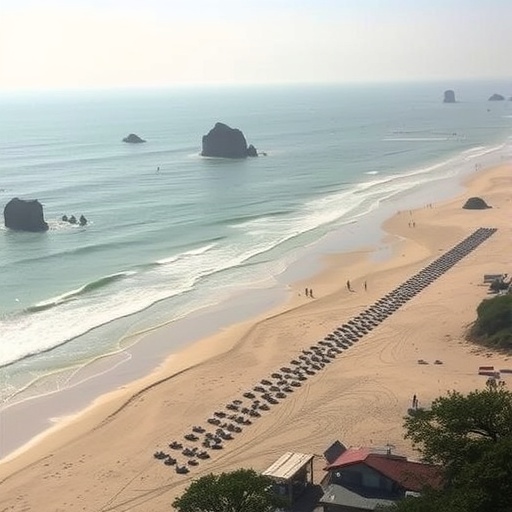
Beaches, the iconic guardians of our coastlines, are facing an unprecedented threat as climate change and urban expansion converge to imperil these vital ecosystems. According to Uruguayan marine scientist Omar Defeo, a professor at the University of the Republic (UdelaR), nearly half of the world’s beaches could vanish by the close of this century. This alarming projection was unveiled at the FAPESP Day Uruguay symposium in Montevideo, signaling a call to action for international cooperation, particularly among Uruguay, Brazil, and Argentina, to mitigate this looming ecological crisis.
The coastal landscape is not merely a stretch of sand; it comprises a complex, dynamic ecosystem divided into three integral zones: the dunes, the beach face, and the submerged foreshore. Dunes serve as natural sand reservoirs, shaped by wind into mounds that act as buffers against storms and sea encroachment. The beach face, exposed during low tide, interacts continuously with the ocean’s ebb and flow. Below this lies the foreshore—submerged, yet critical—as it bears the brunt of wave action and sediment transport. These interconnected zones maintain a delicate sediment exchange, indispensable for maintaining the beach’s structural and ecological integrity.
Wind-driven sand transport is a key mechanism in this system, moving sediments from the dunes to the surf zone and vice versa. Waves contribute by returning sediments to the shoreline, creating a bidirectional sediment flux that sustains the beach environment. This natural cycle is critically disrupted when urbanization eliminates dunes to make way for infrastructure. Without this protective barrier, coastal settlements become increasingly vulnerable to storm surges and coastal erosion, risking not only biodiversity but human livelihoods and infrastructure as well.
Defeo and his team, collaborating with Brazilian researchers under FAPESP funding, conducted extensive biodiversity assessments across 30 beaches along São Paulo’s northern coast. Their research demonstrated that urbanization’s impact permeates beyond visibly altered dry sand areas, significantly diminishing species richness and biomass in submerged habitats. Notably, increased human foot traffic on beaches correlated negatively with the diversity of marine life below the waterline, highlighting the extended reach of anthropogenic stressors.
Mechanical beach cleaning and the presence of constructed buildings further exacerbate the degradation of marine ecosystems. These activities, designed often with aesthetic or recreational motivations, inadvertently sweep away organic matter and vital habitats, stifling the biological productivity of coastal zones. Paradoxically, the study observed an increase in individual abundance due to opportunistic species such as polychaetes thriving on human-derived organic inputs, signaling a shift towards ecological imbalance and reduced ecosystem services.
The complexity of human impacts is underscored by the findings that stressors in the upper beach layers propagate through the sediment continuum, influencing benthic communities in submerged environments. The interdependence inherent in the coastal zone means that damage is rarely localized; degradation in one zone reverberates through the ecosystem, undermining resilience and biodiversity on a broader scale.
Complementing these findings, Defeo’s global study published in Frontiers in Marine Science highlights severe erosion patterns affecting one-fifth of the 315 beaches surveyed worldwide. This work integrates oceanographic variables such as sea level rise, wind dynamics, and wave energy to dissect erosion drivers. The analysis reveals that reflective and intermediate beaches—those with steep slopes causing abrupt energy dissipation and mixed morphologies—are disproportionately impacted by anthropogenic pressures, emphasizing the nuanced vulnerability of different beach types.
The symposium, which situated Defeo’s presentation within a panels of oceanography experts, stresses the interdisciplinary effort required to confront beach erosion. Panelists Marcelo Dottori (USP), Cristiana Seixas (UNICAMP), and Natália Venturini (UdelaR) collectively advocate for integrated coastal management strategies that reconcile ecological preservation with socioeconomic demands. Their discourse reflects a growing acknowledgment of the intricate feedback loops between natural systems and human development.
Urbanization, while a driver of economic growth, poses a formidable threat to coastal systems through habitat fragmentation, alteration of natural sediment fluxes, and increased pollution. The urgent need for transnational scientific collaboration is exemplified by the shared coastal heritage of South America’s Atlantic margins. Joint conservation initiatives, data sharing, and coordinated policymaking could help buffer the compounded effects of climate change and urban expansion.
Climate-driven sea level rise exacerbates these challenges by intensifying erosion and promoting saltwater intrusion into coastal aquifers. Compound events, such as storm surges coinciding with high tides, overwhelm diminished dune systems, accelerating habitat loss. This dynamic fuels a feedback loop wherein deteriorating coastal defenses hasten urban vulnerability, economic disruption, and loss of ecosystem services including fisheries and tourism.
Efforts to preserve beach ecosystems must therefore harmonize ecological principles with sustainable human activity. Protecting dunes as natural buffers, regulating beach usage, minimizing detrimental mechanical cleaning, and establishing marine protected areas are essential strategies to maintain biodiversity and sedimentary processes. Science-based policymaking supported by continuous monitoring is critical to anticipate and adapt to the rapid changes unfolding along global shorelines.
The insights offered by Defeo and colleagues illuminate the dual threats of climate change and urbanization in reshaping the world’s coastal geographies. Without decisive action, the beaches that form the interface between land and sea—harboring unique biodiversity, cultural values, and economic potential—may succumb to disappearance. This stark prognosis underscores the pressing imperative for global and regional initiatives aimed at safeguarding these priceless ecological treasures for future generations.
Subject of Research: Coastal ecosystem dynamics, beach erosion, urbanization impacts, and climate change effects on beaches
Article Title: ‘Almost half of the beaches will disappear by the end of the century,’ warns researcher
News Publication Date: Not specified in the content
Web References:
References:
- FAPESP project numbers 17/17071-9, 18/22036-0, 18/05099-9, 18/19776-2
Image Credits: Karina Toledo/Agência FAPESP
Keywords: Sea level rise, Climate change effects, Urbanization, Oceanography


