


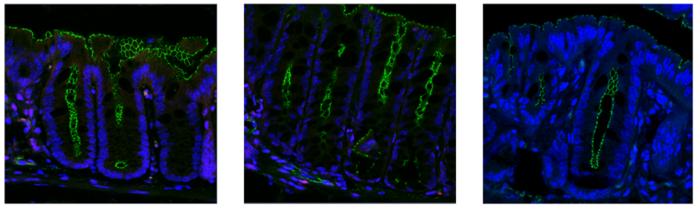
Receptor protein tyrosine phosphatases are cell membrane-localised proteins. They are regulators of cell-cell contacts and are also considered likely to be tumour suppressors but the specifics of how they function are unknown. A member of this family, PTPRK, is implicated as a tumour suppressor in several cancer types, particularly colorectal cancer, and mutations and genetic events inactivating PTPRK are found in human colorectal cancers. PTPRK has also been linked genetically to celiac disease.

Credit: Babraham Institute
Receptor protein tyrosine phosphatases are cell membrane-localised proteins. They are regulators of cell-cell contacts and are also considered likely to be tumour suppressors but the specifics of how they function are unknown. A member of this family, PTPRK, is implicated as a tumour suppressor in several cancer types, particularly colorectal cancer, and mutations and genetic events inactivating PTPRK are found in human colorectal cancers. PTPRK has also been linked genetically to celiac disease.
The Sharpe lab at the Babraham Institute investigated the role and signalling mechanisms of PTPRK in cell adhesion, growth factor signalling and tumour suppression in the mouse colon and also in human colorectal cancer cells. Their findings, published in the Journal of Cell Science, are relevant to better understanding the cellular environments that function to repress tumour development as well as understanding the cell interactions that affect repair after injury and potentially cancer metastasis.
Dr Katie Young, lead author on the paper who undertook this research as a PhD student in the Sharpe lab, said: “Through this work we aimed to investigate the role of PTPRK in the colon, working together several observations in the field and connecting these back to the complex signalling mechanisms behind them. It’s vital that we know more about how receptor protein tyrosine phosphatases sense and transmit signals to ensure the healthy growth of our cells, as well as how errors in these mechanisms cause disease.”
Using human colorectal cancer cell lines, the team found that the deletion of PTPRK altered the appearance of the cells, compared to control cells where PTPRK was functional, and observed that the knockout cells showed impaired wound-healing response, which was likely to be due to the loss of PTPRK affecting coordinated action by cells and their neighbours and defects in cellular polarisation.
Utilising a mouse line where PTPRK had been deleted, the team uncovered a role for PTPRK in colon repair. When inflammation of the colon (colitis) was stimulated, mice lacking PTPRK showed a more severe response, demonstrating either increased susceptibility to damage or decreased repair following inflammation. The knockout mice also developed larger and more invasive tumours in a colorectal cancer model compared to wild-type controls, confirming that PTPRK has a role in suppressing tumour growth and invasion.
Using a catalytic mutant, where the catalytic function of PTPRK was abolished, and a xenograft model where cancer cells were transplanted into mice, the researchers confirmed the function for PTPRK in suppressing tumour growth and demonstrated that this was independent of the protein’s phosphatase activity.
Comparing gene expression profiles between cells with and without PTPRK, the team identified genes that were affected by the loss of PTPRK. These genes are characterised in function as being related to epithelial cell identity (being involved in the epithelial to mesenchymal transition and mesenchymal cell differentiation).
The team hypothesise that PTPRK regulation could be a central factor giving plasticity in epithelial barriers, such as lines the intestines, to facilitate epithelial repair while providing a signal to stop the repair response.
Analysing the xenograft tumour samples, the team quantified tyrosine phosphorylation to determine the signalling mechanisms by which PTPRK suppresses tumour development. Their work suggests that the suppression of epidermal growth factor receptor (EGFR) signalling by PTPRK is a key factor and is mediated separately from its function as a phosphatase.
Dr Hayley Sharpe, group leader in the Signalling research programme at the Institute, said: “The goal of our research was to pull several observations together and begin to fill in the gaps of what we don’t know about PTPRK. It has been assumed that PTPs act as tumour suppressors by countering kinase activity by dephosphorylation on oncogenic phosphotyrosine modifications. Therefore, the non-catalytic role of PTPRK in signalling is really intriguing to us and how it achieves this is an important next question to fully understand its role in tumour suppression.”
Journal
Journal of Cell Science
Method of Research
Experimental study
Subject of Research
Animals
Article Title
The receptor protein tyrosine phosphatase PTPRK promotes intestinal repair and catalysis-independent tumour suppression
Cite Scienmag News
Nathaniel Bowman. (July 24, 2024). Research sheds light on the role of PTPRK in tissue repair and cancer. Scienmag. https://scienmag.com/research-sheds-light-on-the-role-of-ptprk-in-tissue-repair-and-cancer/
Nathaniel Bowman. "Research sheds light on the role of PTPRK in tissue repair and cancer." Scienmag, 24 July 2024, https://scienmag.com/research-sheds-light-on-the-role-of-ptprk-in-tissue-repair-and-cancer/. Accessed 4 September 2026.
Nathaniel Bowman. "Research sheds light on the role of PTPRK in tissue repair and cancer." Scienmag. July 24, 2024. https://scienmag.com/research-sheds-light-on-the-role-of-ptprk-in-tissue-repair-and-cancer/

