


A groundbreaking new study published in the prestigious journal Proceedings of the National Academy of Sciences uncovers how exposure to artificial light at night (LAN) precipitates depression-like behaviors by engaging a previously uncharacterized visual neural pathway in the brain. This discovery, made through innovative experimental techniques, highlights the profound neurobiological consequences of modern light pollution, offering critical insight into how the pervasive glow of urban nighttime illumination might jeopardize mood regulation and mental health.
Researchers focused their investigations on tree shrews, diurnal mammals that share crucial genetic and behavioral characteristics with primates, making them an ideal model for studying human-related neurological phenomena. These animals exhibit a natural pattern of daytime activity akin to humans, yet they possess a neural architecture that permits direct examination of the mechanisms underlying mood and cognitive function. The team’s selection enables a translational understanding potentially relevant to human mental health in increasingly artificial light-saturated environments.
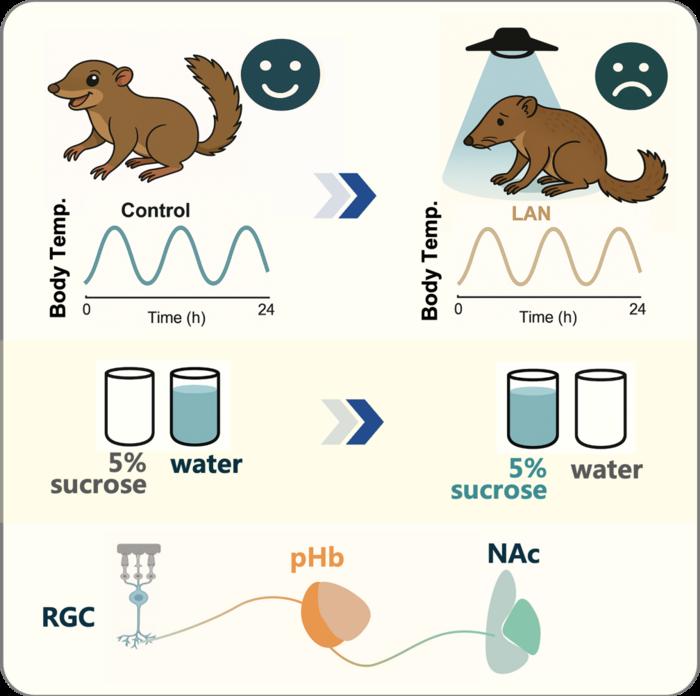
The experimental protocol involved exposing the tree shrews to blue-enriched light — mimicking the intensity and spectrum of bright indoor lighting common in contemporary settings — for two hours every night over a period of three weeks. This chronic light exposure regimen induced profound disruptions in behavior. Notably, the animals displayed diminished sucrose preference, a reliable indicator of anhedonia or loss of pleasure. In addition, the shrews showed significantly reduced exploratory activity and impairments in tests of long-term memory consolidation, indicating broad cognitive and motivational deficits linked to the artificial lighting conditions.
To decode the neural substrates mediating these effects, the researchers employed state-of-the-art neural tracing techniques. They uncovered a specialized population of retinal ganglion cells that relay photic information directly to the perihabenular nucleus (pHb), a subregion of the thalamus that had not previously been implicated in mood regulation. The pHb itself projects extensively to the nucleus accumbens, a central hub within the brain’s reward circuit, well-known for its role in regulating affective states and motivational drives.
Critically, the study demonstrated causality using chemogenetic methods to silence pHb neurons during exposure to LAN. When this neural population was inhibited, the depression-like behaviors in tree shrews were abolished, linking activity within the pHb-nucleus accumbens pathway to the maladaptive behavioral phenotype. This finding is a landmark in identifying a discrete visual-to-reward circuit path through which aberrant environmental light exposure can alter emotional and cognitive processing.
Further molecular analyses through RNA sequencing of the pHb region revealed shifts in gene expression patterns associated with depression. Genes involved in neurotransmitter signaling, synaptic plasticity, and neural excitability showed differential regulation after chronic LAN exposure, suggesting that prolonged light-induced activation of this pathway may induce lasting molecular adaptations potentially underpinning sustained mood disturbances.
This research is particularly salient in the context of modern urbanization, where artificial lighting extends well into nocturnal hours, disrupting natural circadian rhythms and sleep architecture. The elucidation of a direct neural mechanism by which LAN influences mood expands our understanding of light pollution beyond sleep disorders to include profound psychological consequences. It underscores the need to carefully consider lighting environments, especially regarding light intensity, spectrum, and duration of exposure in the design of urban living and working spaces.
Moreover, the findings raise compelling questions about the ubiquitous use of blue light-emitting devices such as smartphones, tablets, and LED lighting, whose spectral properties strongly activate retinal pathways implicated in mood regulation. This study could ignite new lines of research into how everyday technology contributes to the rising incidence of depressive disorders worldwide.
Prof. YAO Yonggang, who co-led this collaborative effort between the University of Science and Technology of China, the Kunming Institute of Zoology of the Chinese Academy of Sciences, and Hefei University, emphasized the dual implications of the findings: "The same illumination that augments our nighttime productivity harbors the potential to subtly rewire brain circuits underlying emotional stability. Identifying the precise nodes within this pathway opens avenues for targeted interventions."
Indeed, these discoveries pave the way for novel therapeutic strategies aiming to mitigate the deleterious psychological effects of artificial light without compromising its societal benefits. Potential approaches could include pharmacologically modulating the pHb or its downstream circuits, developing lighting solutions that minimize activation of deleterious pathways, or designing behavioral interventions to reduce exposure during sensitive periods.
This study exemplifies a synthesis of behavioral neuroscience, neuroanatomy, and molecular genetics, advancing the neurobiological framework linking sensory input to complex affective outcomes. By dissecting the cellular and circuit-level foundations of light-induced mood disorders, it catalyzes a paradigm shift in how we conceptualize mental health in the Anthropocene era, where anthropogenic environmental factors like light pollution are now recognized as significant modulators of brain function and behavior.
As urban populations continue to surge globally, the implications of this work resonate beyond basic science, touching on public policy, urban planning, and mental health advocacy. Awareness and mitigation of the psychological costs arising from ubiquitous artificial illumination may become an essential frontier in safeguarding human well-being in a rapidly changing sensory world.
In conclusion, this pioneering investigation breaks new ground by identifying a distinct pHb-related visual pathway that mediates the impact of light at night on mood, as demonstrated in a primate-relevant animal model. It provides a vital piece of the puzzle in understanding how modern lifestyle factors perturb neural circuits, offering a scientific foundation for developing innovative solutions to counteract the mental health challenges posed by our illuminated nights.
News Publication Date: 6-Jun-2025
Web References:
http://dx.doi.org/10.1073/pnas.2411280122
Cite Scienmag News
Cassandra Pierce. (June 17, 2025). Research reveals nighttime light exposure triggers depression through distinct brain circuit in tree shrews. Scienmag. https://scienmag.com/research-reveals-nighttime-light-exposure-triggers-depression-through-distinct-brain-circuit-in-tree-shrews/
Cassandra Pierce. "Research reveals nighttime light exposure triggers depression through distinct brain circuit in tree shrews." Scienmag, 17 June 2025, https://scienmag.com/research-reveals-nighttime-light-exposure-triggers-depression-through-distinct-brain-circuit-in-tree-shrews/. Accessed 4 September 2026.
Cassandra Pierce. "Research reveals nighttime light exposure triggers depression through distinct brain circuit in tree shrews." Scienmag. June 17, 2025. https://scienmag.com/research-reveals-nighttime-light-exposure-triggers-depression-through-distinct-brain-circuit-in-tree-shrews/


