


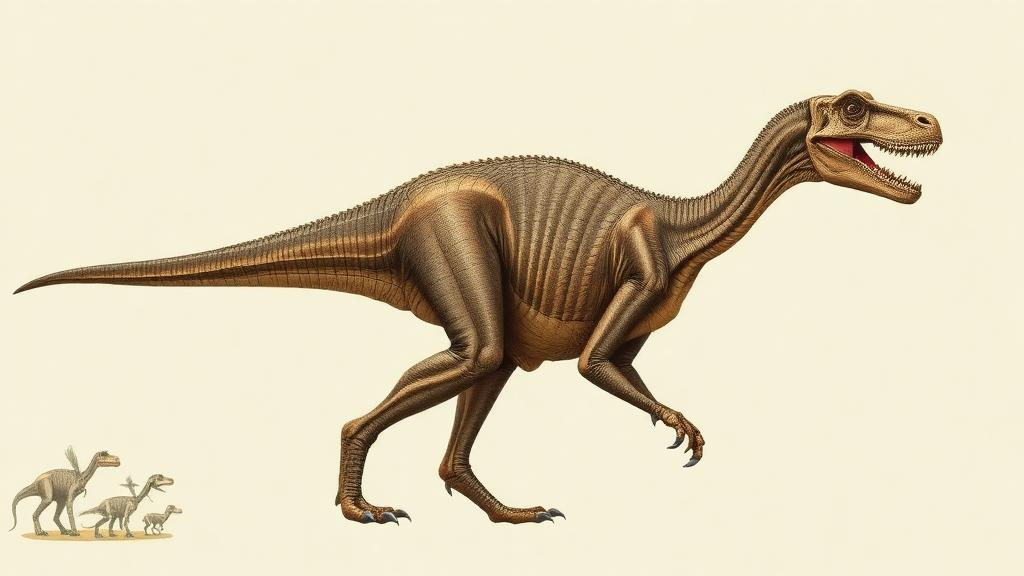
A comprehensive review identifies nine rhabdodontid dinosaur species in six genera as the most common medium-sized herbivores across much of the Late Cretaceous European Archipelago. Their fossils document a family confined to Santonian through late Maastrichtian rocks in southern France, northern Spain, eastern Austria, western Hungary and western Romania. Although their remains are abundant, the review shows that a long history of changing classifications, incomplete specimens and conflicting phylogenetic analyses continues to limit firm conclusions about their relationships, lifestyles and final disappearance.
Rhabdodontids were generally small- to medium-sized, probably habitually bipedal herbivores with stocky bodies, strong hind limbs, short forelimbs, long tails and comparatively large, triangular skulls that tapered toward pointed snouts. Their chewing apparatus included a keratinous beak at the front of the mouth and cheek teeth suited to shearing or slicing. In Zalmoxes, large jaw-adductor muscle chambers, robust jaws and a well-developed coronoid process were interpreted as indicators of high bite strength.
Other features, including the relatively narrow jaw tips of Zalmoxes and the enlarged teeth of Matheronodon, led researchers to propose selective feeding on tough or fibrous vegetation. These interpretations are supported by several lines of evidence, but no complete articulated skull has yet demonstrated the precise motions of the jaw and upper skull. The group’s taxonomic history began when Philippe Matheron named Rhabdodon priscum from material discovered in southern France in 1840s.
The original assemblage included a fragmentary left dentary and postcranial elements; the dentary, now the lectotype, was subsequently selected from the collection of the Palais Longchamp Museum. Austrian material from Muthmannsdorf became Iguanodon suessi in 1871 and Mochlodon suessi in 1881. Fossils found in Romania’s Hațeg Basin were studied extensively by Franz Nopcsa, who moved them repeatedly among Mochlodon, Rhabdodon and other groups.
A major 2003 revision separated the Romanian remains into the genus Zalmoxes and formally established the family Rhabdodontidae. The name Rhabdodon had briefly been displaced because it was already occupied by a snake, but the International Commission on Zoological Nomenclature conserved the dinosaur name in 1987 and amended the species name to Rhabdodon priscus. Research in the following decades expanded the roster from three genera to six.
Matheronodon provincialis was named in 2017 from a single right maxilla from the Aix-en-Provence Basin in southern France. Pareisactus evrostos, described in 2019, is known from a nearly complete left scapula in north-eastern Spain. Transylvanosaurus platycephalus, named in 2022, is represented by a partial skull containing the articulated basicranium and both frontals from Romania’s Hațeg Basin.
Its discovery is important because many late Maastrichtian rhabdodontid remains from Transylvania had previously been assigned to Zalmoxes without strong supporting evidence. Matheronodon and Pareisactus remain known only from their holotypes, while the completeness and taxonomic unity of the specimen assigned to Zalmoxes shqiperorum from Nălaț-Vad have also been questioned. These limitations mean the family’s true diversity could still be underestimated.
Most phylogenetic analyses place Rhabdodontidae near the base of Iguanodontia, a radiation that later included animals such as Iguanodon and hadrosaurs. The relationships within the family are less secure. Rhabdodon from France and Spain has usually been placed apart from a clade containing Mochlodon from Austria and Hungary and Zalmoxes from Romania, a pattern that has been interpreted as western and eastern European lineages.
Pareisactus was recovered as the sister taxon of Rhabdodon priscus in the single analysis that included it, whereas Matheronodon has not yet been placed in a phylogenetic analysis. Transylvanosaurus complicates the geographic division: morphological comparisons found similarities with Rhabdodon from France and differences from Zalmoxes, prompting the proposal that at least one major dispersal occurred between western and eastern parts of the archipelago. Because important taxa await revision, the review cautions against treating any single biogeographic scenario as settled.
The ancestry of the family extends further back than its European fossil record suggests. Rhabdodontids are securely known only from Upper Cretaceous rocks, but their position near the base of Iguanodontia implies a long ghost lineage in which earlier representatives left no confirmed fossils. A more inclusive group, Rhabdodontomorpha, has been proposed to include the unnamed “Vegagete ornithopod” from the Early Cretaceous of northern Spain.
That animal has alternately been placed within Rhabdodontidae, immediately outside it and as the closest relative of the family. Other proposed close relatives include Tenontosaurus from the western United States, Muttaburrasaurus from eastern Australia, Fostoria from eastern Australia and the recently described Iani from the western United States, although alternative placements have been proposed for several of them. Because derived rhabdodontids are known only from Europe, the review considers a European origin of the family likely while emphasizing that its deeper history remains uncertain.
The Sibişel Valley succession of the Hațeg Basin was deposited on a poorly channelised alluvial plain containing active channels, wetlands, floodplains and higher, drier ground. A taphonomic survey found rhabdodontid remains across those settings, including well-drained palaeoenvironments, demonstrating that the animals were not restricted to swamps or lakes. Some bone beds contain several Zalmoxes individuals of different sizes with similar taphonomic histories, and a Spanish locality attributed to the “Vegagete ornithopod” contains at least six individuals.
These associations are consistent with gregarious behavior, although they do not establish it as universal across the family. Analyses of teeth provide more specific, but taxon-dependent, evidence about diet. Stable-isotope measurements of Zalmoxes teeth from the Hațeg Basin indicate consumption mainly of C3 plants and were interpreted as showing no large-scale habitat partitioning between rhabdodontids and hadrosauroids from the same locality.
Dental microwear on Mochlodon vorosi from Hungary shows straight, parallel striations, consistent with orthal jaw movement, while its high tooth-formation rate indicates an abrasive diet. The microwear pattern further suggests a low-browsing herbivore feeding within roughly one metre of the ground on tough vegetation. Differences between M. vorosi and sympatric hadrosaurs indicate different feeding ecologies, while a contrasting pattern in the ankylosaur Hungarosaurus suggests niche partitioning between that animal and M. vorosi.
Differences in the proportions of the dentaries and dentition of Rhabdodon priscus, R. septimanicus and Matheronodon also support some dietary differentiation, although the extent of partitioning among rhabdodontid species remains uncertain. The disappearance of rhabdodontids was neither simultaneous nor geographically uniform. In the Ibero-Armorican realm, rhabdodontids and nodosaurids appear to have disappeared by the early late Maastrichtian, approximately 69 million years ago, as a titanosaur-, rhabdodontid- and nodosaurid-dominated fauna was replaced by one dominated by hadrosauroids and titanosaurs.
The arrival of hadrosauroids may have contributed to this turnover, but they could also have expanded into ecological niches left vacant if the earlier herbivores were already declining. A change in plant food is another possibility: browsing-associated pit-dominated microwear in European rhabdodontids and nodosaurids was followed by scratch-dominated microwear in hadrosauroids, potentially reflecting more open habitats and different vegetation. The Transylvanian realm showed greater faunal stability, with rhabdodontids surviving well into the late Maastrichtian and remaining among the last non-avian dinosaurs before the end-Cretaceous extinction.
The causes of these contrasting histories cannot yet be separated confidently. The review presents Rhabdodontidae as an unusually informative but unresolved branch of dinosaur evolution. Its European distribution links it to the biogeographic history of an island realm, while its changing classifications expose the difficulty of identifying taxa from jaws, teeth, shoulder bones and incomplete skulls.
Questions about movement and growth are equally open. Rhabdodontids are usually reconstructed as bipedal, but Rhabdodon has also been portrayed as quadrupedal, and recent comparisons suggest that some rhabdodontomorphs shifted from four-legged to two-legged posture during growth. Histological studies also indicate different growth patterns among taxa, including rapid growth in the “Vegagete ornithopod” and relatively slow growth in Zalmoxes.
More complete and articulated skeletons, revision of historical specimens, and complementary analyses such as biomechanical modeling, stable-isotope work, dental microwear and muscle reconstruction will be required to separate established observations from the many evolutionary and ecological interpretations that remain possible.
Subject of Research: Taxonomy, palaeoecology, biogeography and extinction of Late Cretaceous European rhabdodontid dinosaurs
Article Title: The Rhabdodontidae ( Dinosauria , Ornithischia ), an enigmatic dinosaur group endemic to the Late Cretaceous European Archipelago
Article References: Augustin, F. J., Ősi, A., & Csiki-Sava, Z. (2023). The Rhabdodontidae (Dinosauria, Ornithischia), an enigmatic dinosaur group endemic to the Late Cretaceous European Archipelago. Fossil Record, 26(2), 171-189. https://doi.org/10.3897/fr.26.108967
Image Credits: AI Generated
DOI: 10.3897/fr.26.108967
Keywords: Rhabdodontidae, ornithopod dinosaurs, Late Cretaceous, European archipelago, palaeontology, fossil taxonomy, dinosaur biogeography, herbivorous dinosaurs, dental microwear, Iguanodontia, Dinosauria, Ornithischia
Cite Scienmag News
Daisy Hatcher. (October 19, 2026). Research report: The Rhabdodontidae ( Dinosauria , Ornithischia ), an enigmatic dinosaur group endemic to the Late Cretaceous European Archipelago. Scienmag. https://scienmag.com/research-report-the-rhabdodontidae-dinosauria-ornithischia-an-enigmatic-dinosaur-group-endemic-to-the-late-cretaceous-european-archipelago/
Daisy Hatcher. "Research report: The Rhabdodontidae ( Dinosauria , Ornithischia ), an enigmatic dinosaur group endemic to the Late Cretaceous European Archipelago." Scienmag, 19 October 2026, https://scienmag.com/research-report-the-rhabdodontidae-dinosauria-ornithischia-an-enigmatic-dinosaur-group-endemic-to-the-late-cretaceous-european-archipelago/. Accessed 19 October 2026.
Daisy Hatcher. "Research report: The Rhabdodontidae ( Dinosauria , Ornithischia ), an enigmatic dinosaur group endemic to the Late Cretaceous European Archipelago." Scienmag. October 19, 2026. https://scienmag.com/research-report-the-rhabdodontidae-dinosauria-ornithischia-an-enigmatic-dinosaur-group-endemic-to-the-late-cretaceous-european-archipelago/


