


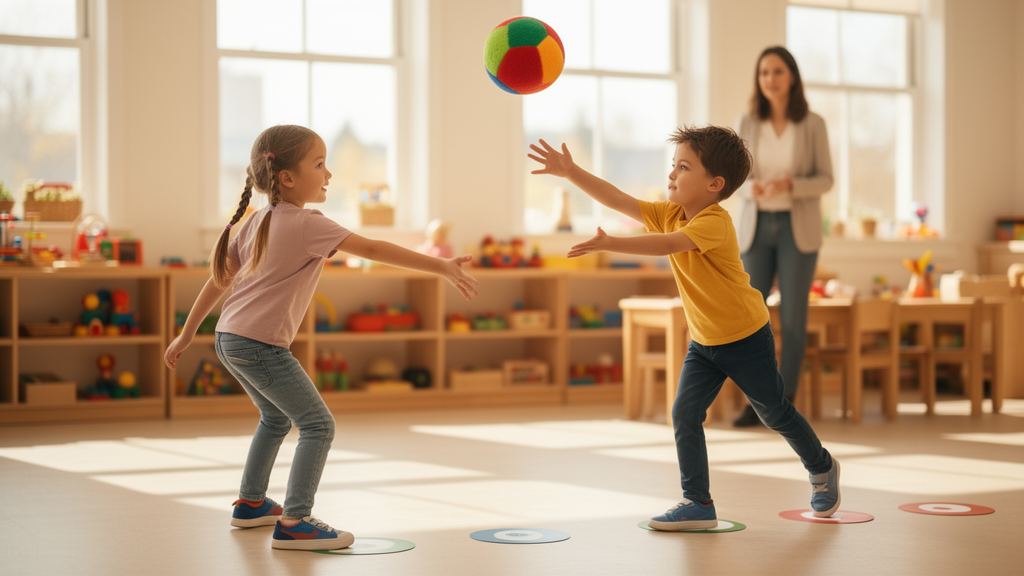
A structured program of physical games appears to sharpen both memory and attention in young children, according to a preliminary study from Shenzhen University published in the journal Frontiers in Pediatrics. In a 12-week trial involving 59 kindergarten children aged 5 to 6 years, those who took part in specially designed physical play sessions showed greater gains on memory tests and an attention task than peers who continued with routine kindergarten physical activities. The study was a pilot with randomization carried out at the class level rather than the individual level.
Two intact kindergarten classes were recruited: one class of 30 children formed the experimental group, while the other class of 29 children served as the control group. The experimental group received a structured physical game intervention three times per week, with each session lasting 60 minutes. The control group participated in the kindergarten's ordinary physical activities.
Because whole classes rather than individual children were assigned, the design reduces but does not eliminate the possibility that differences between the two groups influenced the results. The researchers designed a variety of game activities intended to promote the development of memory and attention, and the sessions were supplemented by smart interactive devices that collected motion data during play. The authors do not report in the available material which specific games were used or how the motion data were analyzed, so the precise mechanics of the program remain to be detailed in the final published version.
Children's cognitive abilities were measured before and after the 12-week period using two established instruments. Memory was assessed with subscales of the Wechsler Memory Scale, covering picture memory, visual reproduction, visual recognition, digit span forward and digit span backward. The researchers analyzed the data with a 2 × 2 repeated-measures analysis of variance, comparing the two groups before and after the intervention.
Significant interactions emerged for total short-term memory, with F(1,57) = 14.33, p < .001 and a partial eta-squared of .20, and for total immediate memory, with F(1,57) = 7.84, p = .007 and a partial eta-squared of .12. Several individual memory subtests also showed significant Group × Time interactions. Picture memory yielded F(1,57) = 6.10, p = .017, with a partial eta-squared of .10.
Visual reproduction, a task involving reproducing visual designs from memory, produced the largest effect in the study, F(1,57) = 18.40, p < .001, with a partial eta-squared of .24. Attention performance on the Schulte Grid test also improved more in the experimental group, with a significant interaction of F(1,57) = 8.17, p = .006 and a partial eta-squared of .13. In practical terms, the significant interactions indicate that the children in the physical game program improved more from the beginning to the end of the study than the children in the control classes on the memory and attention measures examined.
Notably, not every memory subtest reached significance; visual recognition and digit span backward did not show significant Group × Time interactions in the reported results, indicating that the benefits were not uniform across all memory domains measured. The authors describe the work as preliminary evidence that a structured physical game intervention was associated with improvements in memory-related task performance and task-related attentional processing in children aged 5 to 6 years. The cautious framing matters.
Because the study randomized only two classes, the effective sample size at the cluster level is very small, and any pre-existing differences between the two classrooms, their teachers or their daily routines could have contributed to the observed differences. The absence of detail on blinding, on whether assessors knew group assignments, and on the exact game content also limits how firmly conclusions can be drawn at this stage. For now, the Shenzhen team's pilot stands as an early signal rather than a prescription: a 12-week program of thoughtfully designed physical play, delivered three times a week, was followed by measurable advantages in picture memory, visual reproduction, forward digit span and attentional performance among young children.
The final formatted article, with full methodological detail, is expected to clarify how the program worked and which elements of the game design carried the cognitive benefits.
Subject of Research: Effects of a structured physical game intervention on memory and attention in children aged 5–6 years
Article Title: The effects of physical games on memory and attention in children aged 5–6 years: a preliminary study
Article References: Zhang, H., Liu, Y., Zuo, Y., & Cui, J. (2026). The effects of physical games on memory and attention in children aged 5–6 years: a preliminary study. Frontiers in Pediatrics, 14, 1860806. https://doi.org/10.3389/fped.2026.1860806
Image Credits: AI Generated
DOI: 10.3389/fped.2026.1860806
Keywords: physical games, children, memory, attention, cognitive load theory, kindergarten, pilot study, Wechsler Memory Scale, Schulte Grid, randomized trial, child development, physical activity
Cite Scienmag News
Ophelia Keating. (October 27, 2026). Research report: The effects of physical games on memory and attention in children aged 5–6 years: a preliminary study. Scienmag. https://scienmag.com/research-report-the-effects-of-physical-games-on-memory-and-attention-in-children-aged-5-6-years-a-preliminary-study/
Ophelia Keating. "Research report: The effects of physical games on memory and attention in children aged 5–6 years: a preliminary study." Scienmag, 27 October 2026, https://scienmag.com/research-report-the-effects-of-physical-games-on-memory-and-attention-in-children-aged-5-6-years-a-preliminary-study/. Accessed 27 October 2026.
Ophelia Keating. "Research report: The effects of physical games on memory and attention in children aged 5–6 years: a preliminary study." Scienmag. October 27, 2026. https://scienmag.com/research-report-the-effects-of-physical-games-on-memory-and-attention-in-children-aged-5-6-years-a-preliminary-study/


