

Thursday, October 22, 2026
Science
No Result
View All Result
  • Login
  • HOME
  • SCIENCE NEWS
  • CONTACT US
  • HOME
  • SCIENCE NEWS
  • CONTACT US
No Result
View All Result
Scienmag
No Result
View All Result
Home Science News Technology and Engineering

Research report: Simplifying the calibration of current measurement instruments with diamond quantum sensing technology

October 22, 2026
in Technology and Engineering
Katie Riggs
By Katie Riggs Scienmag Editorial Profile - Quantum Physics
Reading Time: 3 mins read
0
Research report: Simplifying the calibration of current measurement instruments with diamond quantum sensing technology

Research report: Simplifying the calibration of current measurement instruments with diamond quantum sensing technology

65
SHARES
587
VIEWS
Share on FacebookShare on Twitter
ADVERTISEMENT

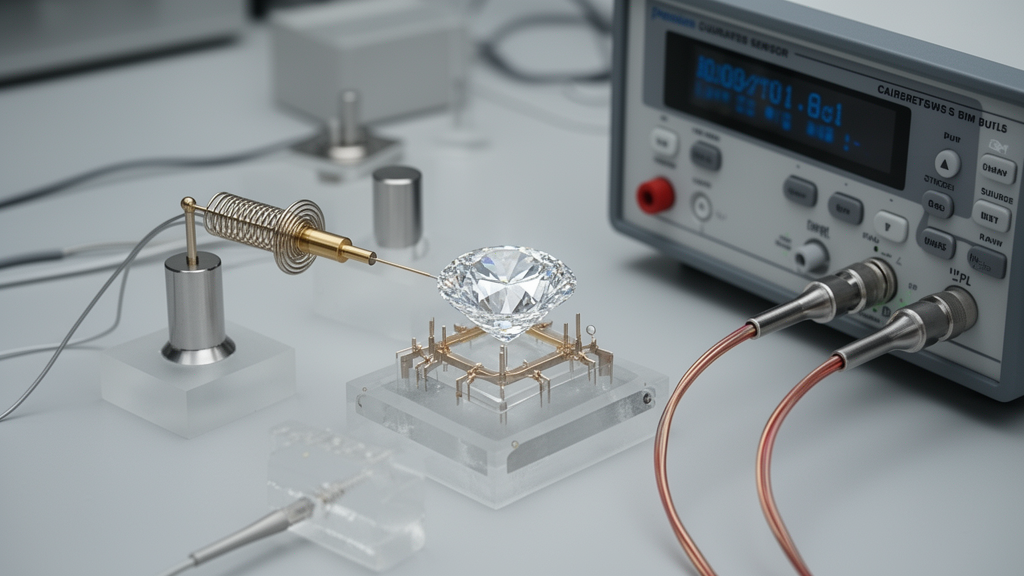
A compact current comparator based on diamond quantum sensing can evaluate both alternating-current and direct-current ratios with the same device configuration, according to an experimental study led by Japan’s National Institute of Advanced Industrial Science and Technology (AIST). Researchers from AIST, the Institute of Science Tokyo and the National Institutes for Quantum Science and Technology demonstrated that a sensor detecting the magnetic flux generated by electric current could measure both kinds of ratio with stated type-A uncertainty at the 10^-8 level. The comparator’s central section was less than one-third the size and less than one-tenth the mass of conventional current comparators, offering a route to simpler calibration systems for electrical power infrastructure.

Current comparators help determine the ratio between the large current carried by power systems and the smaller value measured after conversion by a current transformer. Transformers are needed in power generation, transmission and distribution facilities, where currents may reach several hundred amperes and cannot be fed directly into measuring instruments. Accurately establishing the relationship between the original and converted currents is therefore important for operating, maintaining and expanding those facilities.

Conventional AC comparators rely on electromagnetic induction, which can measure alternating-current ratios but not direct-current ratios. As a result, AC and DC measurements have conventionally required different instruments, measurement principles and calibration arrangements. The new design replaces that division with a diamond quantum sensor that detects magnetic flux associated with current.

Using one setup, the researchers evaluated both AC and DC current ratios with high precision. They also eliminated the detection coil based on electromagnetic induction that is normally used in conventional AC ratio measurements, allowing them to reduce the size and mass of the comparator’s central component. The study was published in Scientific Reports on 11 August 2026 under the title “Current comparator for both AC and DC ratio measurements with 10-8-level type-a uncertainty.”

The results demonstrate high-precision ratio measurements with the same comparator configuration for AC and DC current, rather than performance across every possible operating condition. The research was an experimental demonstration by a team working across three Japanese research organizations. Its scope was the evaluation and design of a current comparator; the supplied report does not present the device as a complete national calibration standard or as an immediate replacement for conventional comparators.

Researchers describe the diamond-sensor comparator as a foundational technology for combining calibration systems that were previously separated into AC and DC arrangements. By using one device configuration, the approach could reduce duplication in instrument configurations and simplify the management of measurement data. That possibility is relevant to power networks in which AC and DC coexist, including next-generation grids shaped by the growing use of renewable energy sources.

The reported findings support the feasibility of unified current-ratio calibration, while broader adoption and standardization remain future steps rather than demonstrated outcomes of the experiment.

Subject of Research: Diamond quantum-sensor current comparators for unified AC and DC calibration of electrical measurement instruments

Article Title: Simplifying the calibration of current measurement instruments with diamond quantum sensing technology

Article References: Simplifying the calibration of current measurement instruments with diamond quantum sensing technology. Original publication (Bibliographic details unavailable.)

Image Credits: AI Generated

DOI: Not provided

Keywords: diamond quantum sensing, current comparator, AC calibration, DC calibration, power-grid metrology, magnetic-flux sensing, current transformers, measurement uncertainty, electrical power systems, Scientific Reports, Simplifying, calibration

Cite Scienmag News

Katie Riggs. (October 22, 2026). Research report: Simplifying the calibration of current measurement instruments with diamond quantum sensing technology. Scienmag. https://scienmag.com/research-report-simplifying-the-calibration-of-current-measurement-instruments-with-diamond-quantum-sensing-technology/


Katie Riggs. "Research report: Simplifying the calibration of current measurement instruments with diamond quantum sensing technology." Scienmag, 22 October 2026, https://scienmag.com/research-report-simplifying-the-calibration-of-current-measurement-instruments-with-diamond-quantum-sensing-technology/. Accessed 22 October 2026.

Katie Riggs. "Research report: Simplifying the calibration of current measurement instruments with diamond quantum sensing technology." Scienmag. October 22, 2026. https://scienmag.com/research-report-simplifying-the-calibration-of-current-measurement-instruments-with-diamond-quantum-sensing-technology/

Tags: AC and DC current ratio measurementAC calibrationadvancements in current measurement accuracycalibrationcompact current comparatorscurrent comparatorcurrent measurement calibrationcurrent transformersDC calibrationdiamond quantum sensingelectrical power systemshigh-precision current ratio evaluationmagnetic-flux sensingmeasurement uncertaintypower system current measurementpower-grid metrologyquantum sensing technologyquantum sensors in electrical infrastructurequantum-based calibration toolsScientific ReportsSimplifyingsize and weight reduction in current sensors
Share26Tweet16
Previous Post

SYNGAP1 burden study will survey at least 125 U.S. caregivers

Next Post

Camel milk alters gut bacteria and liver metabolism in obese mice

Related Posts

Machine learning reveals buckling prediction limits in cold-formed steel columns
Technology and Engineering

Machine learning reveals buckling prediction limits in cold-formed steel columns

October 22, 2026
Dynamic fuzzy sets model uncertainty over time in two test scenarios
Technology and Engineering

Dynamic fuzzy sets model uncertainty over time in two test scenarios

October 22, 2026
Hierarchical Attention Model Reports Metrics for Network Threat Detection
Technology and Engineering

Hierarchical Attention Model Reports Metrics for Network Threat Detection

October 22, 2026
Research report: History of the development of FeNiMnAl(Cr) multiprincipal component alloys
Technology and Engineering

Research report: History of the development of FeNiMnAl(Cr) multiprincipal component alloys

October 22, 2026
Salt-marsh soil withstands extreme waves while vegetation breaks down
Medicine

Salt-marsh soil withstands extreme waves while vegetation breaks down

October 22, 2026
Polish Scepticism Targets Food, Not Biotechnology Itself
Science News

Polish Scepticism Targets Food, Not Biotechnology Itself

October 22, 2026
Next Post
Camel milk alters gut bacteria and liver metabolism in obese mice

Camel milk alters gut bacteria and liver metabolism in obese mice

  • Mothers who receive childcare support from maternal grandparents show more optimized

    Mothers who receive childcare support from maternal grandparents show more parental warmth, finds NTU Singapore study

    27656 shares
    Share 11059 Tweet 6912
  • University of Seville Breaks 120-Year-Old Mystery, Revises a Key Einstein Concept

    1061 shares
    Share 424 Tweet 265
  • Bee body mass, pathogens and local climate influence heat tolerance

    682 shares
    Share 273 Tweet 171
  • Researchers record first-ever images and data of a shark experiencing a boat strike

    546 shares
    Share 218 Tweet 137
  • Groundbreaking Clinical Trial Reveals Lubiprostone Enhances Kidney Function

    531 shares
    Share 212 Tweet 133
Science

Embark on a thrilling journey of discovery with Scienmag.com—your ultimate source for cutting-edge breakthroughs. Immerse yourself in a world where curiosity knows no limits and tomorrow’s possibilities become today’s reality!

RECENT NEWS

  • Camel milk alters gut bacteria and liver metabolism in obese mice
  • Research report: Simplifying the calibration of current measurement instruments with diamond quantum sensing technology
  • SYNGAP1 burden study will survey at least 125 U.S. caregivers
  • Multi-lineage reprogramming and NOTCH-associated signaling remodeling characterize the aggressive biology of early-onset colorectal cancer

Categories

  • Agriculture
  • Anthropology
  • Archaeology
  • Athmospheric
  • Biology
  • Biotechnology
  • Blog
  • Bussines
  • Cancer
  • Chemistry
  • Climate
  • Earth Science
  • Editorial Policy
  • Marine
  • Mathematics
  • Medicine
  • Pediatry
  • Policy
  • Psychology & Psychiatry
  • Science Education
  • Science News
  • Social Science
  • Space
  • Technology and Engineering

Subscribe to Blog via Email

Enter your email address to subscribe to this blog and receive notifications of new posts by email.

Join 5,151 other subscribers

© 2025 Scienmag - Science Magazine

Welcome Back!

Login to your account below

Forgotten Password?

Retrieve your password

Please enter your username or email address to reset your password.

Log In
No Result
View All Result
  • HOME
  • SCIENCE NEWS
  • CONTACT US

© 2025 Scienmag - Science Magazine

Discover more from Science

Subscribe now to keep reading and get access to the full archive.

Continue reading