


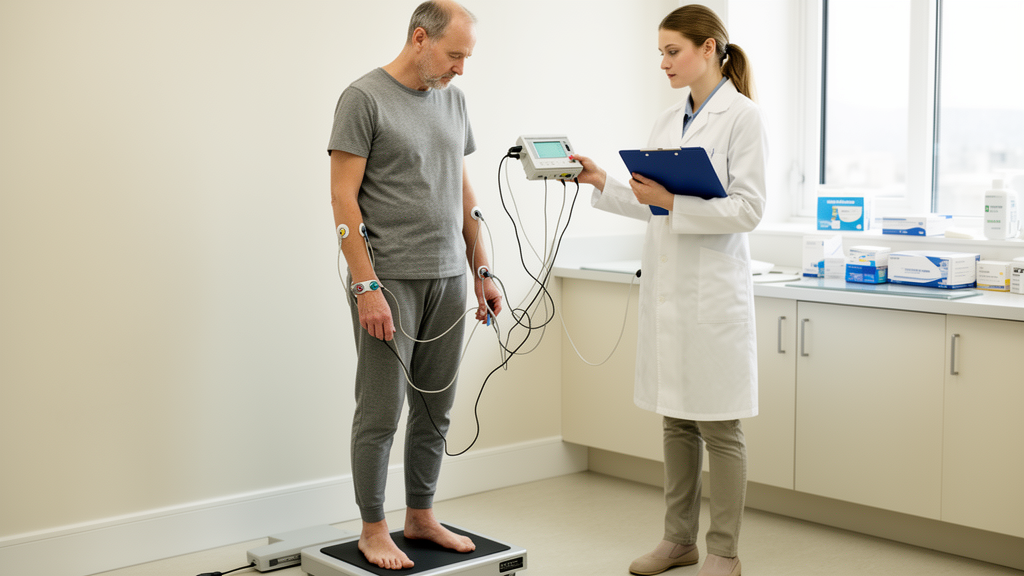
Serial bioelectrical impedance analysis detected changes in cellular and fluid-related measures during nutritional follow-up in a small cohort of adults with chronic pancreatitis, even though conventional indicators of muscle quantity did not significantly change. In the single-centre observational study, phase angle rose by 0.244 degrees at the second assessment and 0.280 degrees at the third, while body cell mass as a percentage of fat-free mass increased by 1.482 and 1.796 percentage points, respectively. Extracellular water as a percentage of total body water moved in the opposite direction, falling by 1.414 and 1.663 percentage points.
The findings identify changes that body mass index and standard muscle-mass indices did not capture, but they do not establish that nutritional treatment caused the changes. The analysis included 32 adults with probable or definitive chronic pancreatitis who were referred for dedicated nutritional assessment at IRCCS San Raffaele Hospital in Milan between March 2022 and May 2024. Participants were drawn from the BIOPANCREAS registry and were assessed with 50-kHz, single-frequency bioelectrical impedance analysis, or BIA.
The cohort had a mean age of 58.4 ± 15.8 years, and 65.6% were male. Disease was clinically advanced in many participants: 90.6% had exocrine pancreatic insufficiency, 56.3% had severe exocrine pancreatic insufficiency, 78.1% had pancreatic calcifications, and 84.4% had endoscopic ultrasound features compatible with chronic pancreatitis under the Rosemont classification. At the first nutritional consultation, mean body mass index was 22.3 ± 3.8 kg/m².
Most routine screening results were comparatively reassuring. Of the 31 patients with Malnutrition Universal Screening Tool data, 77.4% were classified as being at low nutritional risk, 12.9% at medium risk and 9.7% at high risk. BIA nevertheless showed a heterogeneous body-composition profile.
Using published sex-specific thresholds, 18.8% of the cohort, or 6 of 32 patients, had a low fat-free mass index, while 40.6%, or 13 of 32, had a low appendicular skeletal muscle mass index. These descriptive thresholds identified reduced muscle quantity; they were not used to diagnose sarcopenia, which also requires assessment of muscle strength or physical performance. The investigators did not apply a single abnormal threshold to phase angle or body cell mass index because validated chronic-pancreatitis-specific cut-offs were unavailable and phase-angle reference values depend on factors including age, sex, device and measurement conditions.
For the longitudinal analysis, bioelectrical impedance measurements were available for 32 patients at the first visit, 25 at the second and 17 at the third; 14 patients completed all three assessments. The median interval was 2.99 months between the first and second nutritional visits and 2.99 months between the second and third. Researchers fitted separate linear mixed-effects models, treating visit as a categorical fixed effect and patient as a random intercept, allowing all available measurements to be included.
Statistical significance was assessed after Benjamini-Hochberg false-discovery-rate correction across 15 bioelectrical impedance outcomes. The main pattern was an early shift by visit II, followed by relative stability between visits II and III, rather than a continuously widening change over the observation period. Three measures showed significant overall visit effects after correction.
Phase angle, derived from resistance and reactance, increased from a model-estimated mean of 5.00 degrees at visit I to 5.24 degrees at visit II and 5.28 degrees at visit III. The estimated increase was 0.244 degrees at visit II relative to baseline, with a 95% confidence interval of 0.063 to 0.425 degrees, and 0.280 degrees at visit III, with a 95% confidence interval of 0.069 to 0.491 degrees. All six baseline-to-later-visit comparisons remained significant after false-discovery-rate correction, with an adjusted p value of 0.016, but no significant differences were detected between visits II and III for these measures.
Conventional muscle-quantity measures did not show comparable longitudinal changes. None of the fat-free mass index, skeletal muscle mass, skeletal muscle index, appendicular skeletal muscle mass or appendicular skeletal muscle mass index had a significant overall visit effect. For example, the estimated change in appendicular skeletal muscle mass index was 0.03 kg/m² at visit II and 0.19 kg/m² at visit III relative to baseline, but neither contrast met the study’s corrected statistical threshold.
The observed pattern therefore distinguished between cellular and fluid-related impedance characteristics that changed over roughly three months and estimated muscle-quantity indices that did not show a statistically significant change during the same follow-up period. The analysis does not establish that the latter would have required longer to change, because the observation window was limited. The investigators also examined the raw electrical signals to determine whether phase-angle changes could simply reflect altered hydration.
They normalized resistance and reactance by height and calculated impedance vector length. Height-normalized reactance increased by 1.54 Ω/m between visits I and II, with a 95% confidence interval of 0.47 to 2.62 Ω/m; this contrast remained significant after false-discovery-rate correction, with an adjusted p value of 0.015. Neither height-normalized resistance nor impedance vector length showed a significant overall change.
Because phase angle is derived from resistance and reactance, the researchers did not interpret reactance as an independent nutritional outcome. Nevertheless, the raw-component analysis suggested that the early phase-angle increase was not explained solely by a generalized shift in body-water content and was directionally consistent with the simultaneous rise in body cell mass percentage and reduction in extracellular water percentage. Nutritional care was individualized rather than standardized.
Estimated energy requirements were generally set at approximately 30 to 35 kcal/kg ideal body weight/day, and protein requirements at 1.2 to 1.5 g/kg ideal body weight/day, with adjustments according to nutritional status and clinical needs. Patients received dietary counselling, and oral nutritional supplements were prescribed when dietary measures alone were considered insufficient to meet estimated requirements. Fourteen patients received counselling alone, while 18 received counselling plus supplements; product choice and duration were not uniform.
Body weight and BMI showed statistically significant overall visit effects in mixed-effects analyses, although individual pairwise differences did not survive correction across the planned contrasts. Pain visual analogue scores also showed an overall visit effect, with no evidence of improvement over time and no pairwise contrast surviving correction. Total daily pancreatic enzyme replacement therapy exposure did not show a significant overall change.
The result remains hypothesis-generating because the study was observational, small, selected and followed for a relatively short period. Only 32 of 282 participants in the BIOPANCREAS registry underwent the baseline assessment analysed here, and incomplete follow-up may have introduced bias. The study was conducted at one tertiary referral centre without an untreated control group, and nutritional management, supplement use and dietary adherence were not protocolized; adherence was reassessed through dietary recall and clinical interview rather than a standardized questionnaire.
The mixed-effects models used all available measurements, but missing follow-up data, regression to the mean, hydration variability, changes in disease activity and other time-varying factors cannot be excluded. The observed changes therefore cannot be causally attributed to dietary counselling, oral supplements or any other component of care. Serial BIA may provide information complementary to routine nutritional screening in chronic pancreatitis, particularly when BMI and standard screening results appear reassuring while clinical concern persists.
The current data do not show that BIA can diagnose malnutrition, predict clinical outcomes or measure the effectiveness of a specific treatment. Larger, prospective controlled studies are needed to determine whether these short-term impedance signals are reproducible, associated with clinically meaningful outcomes and influenced by nutritional care rather than by hydration or other changes in the underlying disease. Until then, the reported pattern is best viewed as an observational signal from a selected clinical cohort, not as evidence of treatment efficacy or a universal clinical rule.
Subject of Research: Serial bioelectrical impedance measurements during nutritional follow-up in adults with chronic pancreatitis
Article Title: Serial bioelectrical impedance changes during nutritional follow-up in chronic pancreatitis
Article References: Lodola, I., Zaccari, P., Abati, M., Tacelli, M., Arcidiacono, P. G., & Capurso, G. (2026). Serial bioelectrical impedance changes during nutritional follow-up in chronic pancreatitis. Frontiers in Gastroenterology, 5, Article 1933330. https://doi.org/10.3389/fgstr.2026.1933330
Image Credits: AI Generated
DOI: 10.3389/fgstr.2026.1933330
Keywords: chronic pancreatitis, bioelectrical impedance, phase angle, body composition, nutritional assessment, muscle mass, body cell mass, extracellular water, clinical nutrition, Serial, bioelectrical, impedance
Cite Scienmag News
Daisy Hatcher. (October 20, 2026). Research report: Serial bioelectrical impedance changes during nutritional follow-up in chronic pancreatitis. Scienmag. https://scienmag.com/research-report-serial-bioelectrical-impedance-changes-during-nutritional-follow-up-in-chronic-pancreatitis/
Daisy Hatcher. "Research report: Serial bioelectrical impedance changes during nutritional follow-up in chronic pancreatitis." Scienmag, 20 October 2026, https://scienmag.com/research-report-serial-bioelectrical-impedance-changes-during-nutritional-follow-up-in-chronic-pancreatitis/. Accessed 20 October 2026.
Daisy Hatcher. "Research report: Serial bioelectrical impedance changes during nutritional follow-up in chronic pancreatitis." Scienmag. October 20, 2026. https://scienmag.com/research-report-serial-bioelectrical-impedance-changes-during-nutritional-follow-up-in-chronic-pancreatitis/


