A rehabilitation team in Lisbon has reported that patients with acute cervical spinal disorders showed substantial improvements in spasticity, upper limb muscle strength and functional independence during a hospital stay in which they regularly squeezed, stretched and pressed a viscoelastic toy product similar to slime. The findings, published in Frontiers in Medicine, come from a retrospective case series of just 14 people, and the authors themselves stress that the changes cannot be attributed to the intervention itself. Still, the study offers one of the first clinical descriptions of a low-cost, patient-directed sensorimotor exercise in this population, and it arrives at a moment when rehabilitation researchers are actively searching for accessible ways to keep patients practising between formal therapy sessions.
The study was led by Inês Margarida Oliveira Agostinho of Universidade Católica Portuguesa and Unidade Local de Saúde de Lisboa Ocidental, together with colleagues at several Portuguese research and clinical institutions. It took place on a surgical inpatient unit over a 14-month period running from January 2025 to March 2026. During that window, 22 patients were assessed for eligibility and 14 were included; eight were excluded because their neurological problems originated in the brain rather than the cervical spine. The included participants carried a deliberately heterogeneous mix of diagnoses: four had disc herniations, four had fractures, three had space-occupying lesions, two had spinal cord trauma without fracture, and one had myelopathy. Ages ranged from 30 to 79 years, with a mean of 56.2, and hospital stays ranged from 4 to 106 days, averaging 41.4 days.
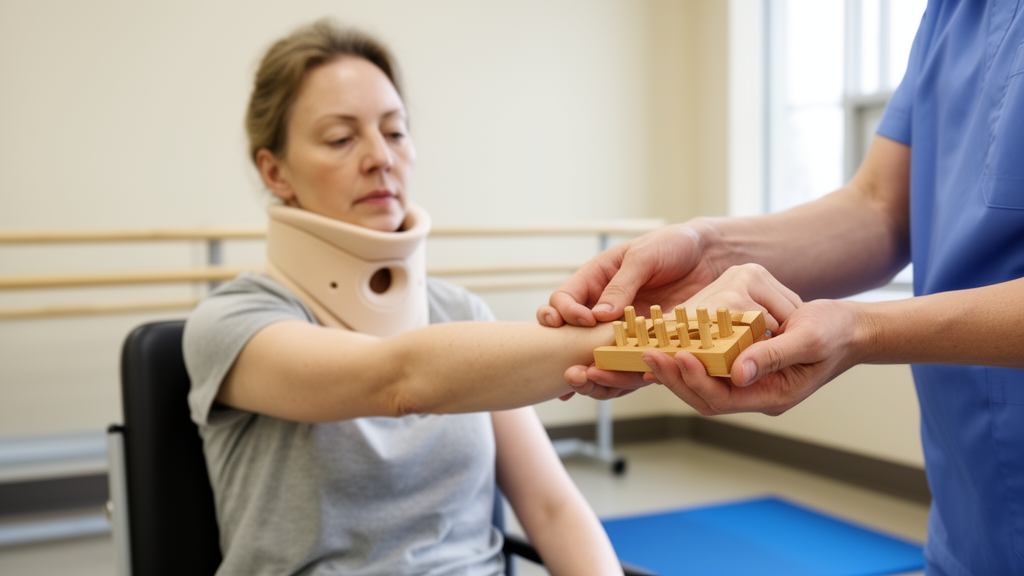
The intervention itself was strikingly simple. Each participant received an individual, non-transferable container of a viscoelastic product manufactured by Canal Toys, bearing CE marking and composed of materials the manufacturer describes as non-toxic. Seated in a stable position with a hard surface supporting the forearms, participants manipulated the material with the affected upper extremity, performing active finger flexion, extension, abduction and adduction, along with stretching, pressing and circular movements. The intended protocol called for sessions of 10 to 15 minutes, up to three times per day, adjusted to each person’s tolerance and clinical condition. Healthcare professionals or family members assisted when needed, and all participants were recorded as performing exercises outside supervised sessions as well. The documented number of supervised sessions ranged from three to 21 per participant, averaging 8.9, but the authors note that unsupervised practice could not be quantified retrospectively, so the total intervention dose remains unknown.
Because the material is viscoelastic, it responds to applied force with a nonlinear resistance, and the authors argue that manipulating it may combine tactile and proprioceptive input with active, resistance-based movement practice. The cervical region is densely populated with mechanoreceptors, including muscle spindles and Golgi tendon organs, whose afferent signals contribute to postural control and sensorimotor integration. The authors hypothesise that enriching peripheral sensory input during upper limb movement could support this integration, but they are explicit that the present study did not measure muscle relaxation, reflex excitability or any neurophysiological response, so any mechanism linking the material’s sensory properties to the observed changes remains hypothetical.
The outcome measures were standard clinical instruments applied at baseline and at discharge by the same rehabilitation nurse specialist. Spasticity was graded with the Modified Ashworth Scale, muscle strength in the fingers, wrist, forearm, elbow and shoulder with the Medical Research Council scale, and functional independence in activities of daily living with the Barthel Index. Tactile sensitivity in the affected limb was also recorded; eight participants had no documented tactile sensation at baseline. Notably, all 14 participants reported perceiving a cooling sensation when handling the material, which the authors interpret as a perception of the product’s sensory character rather than evidence of recovered sensation.
The statistical picture showed consistent change across every outcome. At the participant level, Wilcoxon signed-rank tests comparing baseline and discharge measurements found significant changes in spasticity (Z = −3.093, exact p < .001, r = 0.83), in strength at the fingers (Z = −3.330, p < .001, r = 0.89), wrist (Z = −3.324, p < .001, r = 0.89), forearm (Z = −2.953, p < .001, r = 0.79), elbow (Z = −3.084, p < .001, r = 0.82) and shoulder (Z = −2.555, exact p = .008, r = 0.68), and in Barthel Index scores (Z = −3.297, p < .001, r = 0.88). The Hodges–Lehmann estimate of the median spasticity difference was −1.50 with a 95 percent confidence interval of −2.00 to −1.00. Descriptively, Modified Ashworth grades shifted from a spread across categories 1 to 4 at baseline, with grade 1 most common, to grade 0 in 71.4 percent of participants at discharge. MRC grades moved from predominantly 1 to 2 at baseline towards 4 to 5 at discharge, and Barthel Index classifications shifted from total or severe dependence towards moderate or slight dependence, with two participants becoming fully independent.
The authors are unusually emphatic that these numbers describe change, not treatment effect. Because the design was an uncontrolled, before-and-after retrospective case series with no comparator group, spontaneous neurological recovery, surgical management, conventional rehabilitation, nursing care and simply the passage of hospitalisation time may all have contributed to the improvements. The heterogeneity of the underlying diagnoses, which differ in pathophysiology and expected recovery trajectories, further limits interpretation of the pooled results, and subgroup analysis by diagnosis was not feasible with so few participants per category. The absence of a sham or placebo material also means non-specific factors such as attention, therapeutic interaction and participant expectations cannot be separated from any specific effect of the viscoelastic product itself.
The limitations section catalogues further caveats. The sample of 14 was small, no a priori power analysis was performed, and no adjustment was made for the multiple statistical comparisons, raising the risk of type I error. The before-and-after design is susceptible to regression to the mean and other temporal effects. Intervention exposure varied widely, hospital stays ranged from 4 to 106 days, and retrospective chart review may have introduced documentation and measurement bias, particularly for sensory findings. Outcome assessment was unblinded, and the same clinician who delivered the intervention performed the assessments, so assessor-related bias cannot be excluded. For the muscle strength analysis, bilateral involvement in six participants required averaging the two limb scores into a single participant-level value, which constrains how limb-level changes can be generalised. No long-term follow-up after discharge and no neurophysiological or imaging measures were available.
Where does the wider evidence stand? The authors note that published research specifically addressing slime-type viscoelastic products in cervical rehabilitation is very scarce, making the study exploratory by necessity. Broader literature offers indirect context: systematic reviews of exercise-based rehabilitation after cervical spinal cord injury report improvements in upper limb strength and function, though with heterogeneous evidence and methodological limitations, and studies of sensorimotor-oriented rehabilitation in chronic neck pain have reported benefits for disability, range of motion and proprioception. A quasi-randomized trial of multisensory stimulation in patients in a minimally conscious state showed effects on neurophysiological and functional measures, but the authors flag that this comes from a clinically different population. None of these studies can isolate the contribution of a viscoelastic product.
What the study does establish is feasibility and a hypothesis. A cheap, safe, CE-marked toy material was used daily by every participant, including independently and with family support, and no participant experienced skin wounds or allergic reactions requiring interruption. The authors frame the results as preliminary clinical observations intended to inform future prospective cohort studies or controlled trials with larger samples, standardised intervention protocols, appropriate comparison groups, blinded assessment, clearly defined intervention doses and long-term follow-up. Until such studies exist, the appropriate reading is the one the authors give: meaningful-looking changes occurred during a rehabilitation period that included this intervention, but the retrospective, uncontrolled design means the changes cannot be credited to the slime itself. For now, the humble tub of viscoelastic gel remains a promising, unproven adjunct rather than an established therapy for acute cervical spinal disorders.
Subject of Research: Sensorimotor rehabilitation using a viscoelastic product in patients with acute cervical spinal disorders
Article Title: Sensorimotor rehabilitation and changes in upper limb function after acute cervical spinal disorders: a retrospective case series (n = 14)
Article References: Agostinho, I. M. O., Temudo, A., Bacelo, S. M. O. G., Picoito, R., Bernardes, R., & Sousa, L. (2026). Sensorimotor rehabilitation and changes in upper limb function after acute cervical spinal disorders: a retrospective case series (n = 14). Frontiers in Medicine, 13, Article 1958604. https://doi.org/10.3389/fmed.2026.1958604
Image Credits: AI Generated
DOI: 10.3389/fmed.2026.1958604
Keywords: spinal cord, cervical spine, rehabilitation, sensorimotor, spasticity, muscle strength, Barthel Index, case series, viscoelastic, nursing, upper limb, neurorehabilitation
Cite Scienmag News
Ophelia Keating. (October 28, 2026). Research report: Sensorimotor rehabilitation and changes in upper limb function after acute cervical spinal disorders: a retrospective case series (n = 14). Scienmag. https://scienmag.com/research-report-sensorimotor-rehabilitation-and-changes-in-upper-limb-function-after-acute-cervical-spinal-disorders-a-retrospective-case-series-n-14/
Ophelia Keating. "Research report: Sensorimotor rehabilitation and changes in upper limb function after acute cervical spinal disorders: a retrospective case series (n = 14)." Scienmag, 28 October 2026, https://scienmag.com/research-report-sensorimotor-rehabilitation-and-changes-in-upper-limb-function-after-acute-cervical-spinal-disorders-a-retrospective-case-series-n-14/. Accessed 28 October 2026.
Ophelia Keating. "Research report: Sensorimotor rehabilitation and changes in upper limb function after acute cervical spinal disorders: a retrospective case series (n = 14)." Scienmag. October 28, 2026. https://scienmag.com/research-report-sensorimotor-rehabilitation-and-changes-in-upper-limb-function-after-acute-cervical-spinal-disorders-a-retrospective-case-series-n-14/