

Wednesday, October 21, 2026
Science
No Result
View All Result
  • Login
  • HOME
  • SCIENCE NEWS
  • CONTACT US
  • HOME
  • SCIENCE NEWS
  • CONTACT US
No Result
View All Result
Scienmag
No Result
View All Result
Home Science News Social Science

Research report: From architecture to action: developing and validating the shared student success model (SSSM) for higher education institutions

October 21, 2026
in Social Science
Courtney Benton
By Courtney Benton Scienmag Editorial Profile - Science and Technology Policy
Reading Time: 2 mins read
0
Research report: From architecture to action: developing and validating the shared student success model (SSSM) for higher education institutions

Research report: From architecture to action: developing and validating the shared student success model (SSSM) for higher education institutions

65
SHARES
587
VIEWS
Share on FacebookShare on Twitter
ADVERTISEMENT

A design-based research study at one higher education institution in India found significant improvements in psychological capital, career and life preparedness, and perceived holistic success across two implementation cycles of the Shared Student Success Model (SSSM). The framework is intended to support coordinated institutional action for student development, rather than define success mainly through narrow, placement-focused outcomes. The study addresses Gen Z students in Indian STEM institutions, whom the researchers describe as seeking autonomy, meaning, satisfaction, and holistic well-being beyond transactional career outcomes.

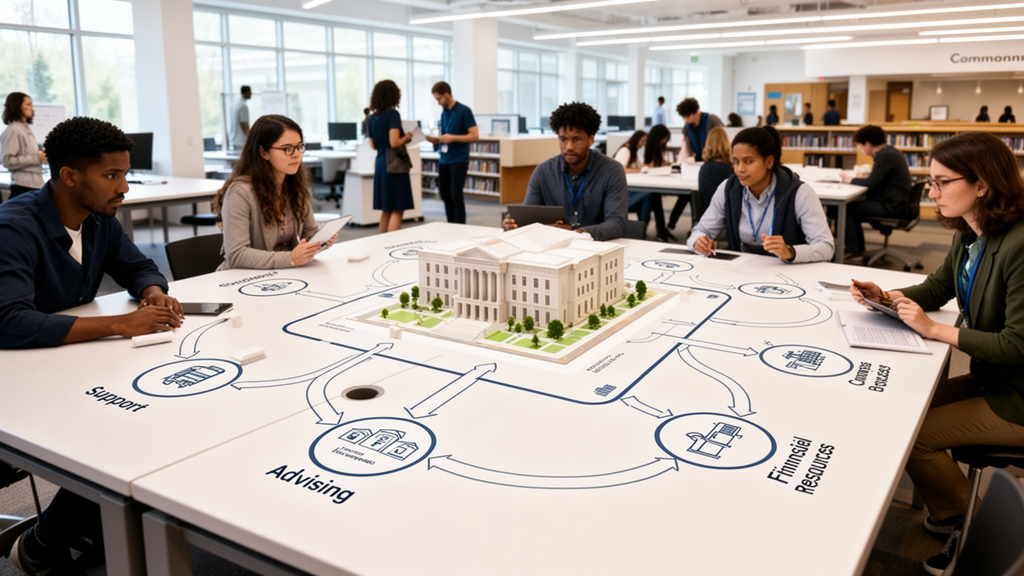
Earlier work established the Holistic Success Architecture, which specifies that perceived holistic success is fully mediated by psychological capital, or PsyCap, and career and life preparedness. The SSSM translates that framework into a staged institutional model designed to address the practical question of how those developmental outcomes can be supported. The SSSM has five dimensions: Student, Faculty and Staff Capacity, Technology and Data, Institutional Climate and Governance, and Infrastructure and Support Services.

Its defining requirement is that all five dimensions advance together through six maturity levels. Researchers developed and validated the model across two implementation cycles at the Indian institution, using a cohort measured before SSSM implementation as a baseline. Both cycles showed statistically significant improvements in PsyCap, career and life preparedness, and perceived holistic success.

Cycle 2 showed larger effect sizes, which the authors interpret as consistent with the co-advancement hypothesis and institutional progression through maturity levels. The accessible report does not provide sample sizes, numerical effect sizes, confidence intervals, or detailed methods for assessing maturity progression. The research also introduced a Co-Creation Quality Index, or CQI, to assess whether students experienced institutional co-creation as meaningful.

The abstract reports that the CQI indicated that co-creation was genuinely meaningful from students’ perspectives, although the available evidence does not specify its components, scoring method, or numerical results. They do not establish that SSSM caused the changes, or that the same outcomes will occur across other institutions, student populations, or implementation settings. The single-site design and limited detail in the accessible report therefore constrain conclusions about general effectiveness and causal impact.

Subject of Research: Development and validation of a five-dimension, six-level institutional framework for student success in higher education

Article Title: From architecture to action: developing and validating the shared student success model (SSSM) for higher education institutions

Article References: Bhan, A., Singh, S., & Gupta, A. (2026). From architecture to action: developing and validating the shared student success model (SSSM) for higher education institutions. Higher Education. https://doi.org/10.1007/s10734-026-01798-9

Image Credits: AI Generated

DOI: 10.1007/s10734-026-01798-9

Keywords: higher education, student success, psychological capital, career preparedness, holistic success, institutional maturity, Gen Z students, design-based research, co-creation, India, architecture, action

Cite Scienmag News

Courtney Benton. (October 21, 2026). Research report: From architecture to action: developing and validating the shared student success model (SSSM) for higher education institutions. Scienmag. https://scienmag.com/research-report-from-architecture-to-action-developing-and-validating-the-shared-student-success-model-sssm-for-higher-education-institutions/


Courtney Benton. "Research report: From architecture to action: developing and validating the shared student success model (SSSM) for higher education institutions." Scienmag, 21 October 2026, https://scienmag.com/research-report-from-architecture-to-action-developing-and-validating-the-shared-student-success-model-sssm-for-higher-education-institutions/. Accessed 21 October 2026.

Courtney Benton. "Research report: From architecture to action: developing and validating the shared student success model (SSSM) for higher education institutions." Scienmag. October 21, 2026. https://scienmag.com/research-report-from-architecture-to-action-developing-and-validating-the-shared-student-success-model-sssm-for-higher-education-institutions/

Tags: actionarchitecturecareer preparednessco-creationDesign-Based Researchdesign-based research in educationeducational technology and data useGen Z student engagement and well-beingGen Z studentshigher educationhigher education institutional developmentholistic student success modelholistic successIndiainfrastructure support services in higher educationinstitutional maturitypsychological capitalpsychological capital in studentsshared student success frameworkSTEM education in Indiastudent career and life preparednessStudent successStudent success developmentuniversity climate and governance
Share26Tweet16
Previous Post

French Alps Show Stronger Autumn Daily Extremes in the South

Related Posts

Closer to the Sea Is Not Always Happier: Tourist Emotions Along the Coast Follow a Nonlinear Path
Social Science

Qingdao travelogue study finds tourist emotions near coast are nonlinear

October 21, 2026
Climate Policy Uncertainty Pushes Chinese Firms Toward Green Mergers
Social Science

Climate policy uncertainty associated with more green M&A among Chinese listed firms

October 21, 2026
Doing Good With Tech Pays Off: Chinese Firms Show Social Innovation Boosts Performance
Social Science

Technology for social good linked with stronger corporate performance in Chinese listed firms

October 21, 2026
Research report: Framing science in the digital age: exploring the relationships between general, social media-specific, and research-specific news values and audience engagement with science news on Sina Weibo
Social Science

Research report: Framing science in the digital age: exploring the relationships between general, social media-specific, and research-specific news values and audience engagement with science news on Sina Weibo

October 21, 2026
Upward Moves Link Elite Chinese Academics to Stronger Research Outcomes
Social Science

Upward Moves Link Elite Chinese Academics to Stronger Research Outcomes

October 21, 2026
Shared Boundaries Reduce Escalation in Territorial Conflict Game
Social Science

Shared Boundaries Reduce Escalation in Territorial Conflict Game

October 21, 2026
  • Mothers who receive childcare support from maternal grandparents show more optimized

    Mothers who receive childcare support from maternal grandparents show more parental warmth, finds NTU Singapore study

    27656 shares
    Share 11059 Tweet 6912
  • University of Seville Breaks 120-Year-Old Mystery, Revises a Key Einstein Concept

    1061 shares
    Share 424 Tweet 265
  • Bee body mass, pathogens and local climate influence heat tolerance

    682 shares
    Share 273 Tweet 171
  • Researchers record first-ever images and data of a shark experiencing a boat strike

    546 shares
    Share 218 Tweet 137
  • Groundbreaking Clinical Trial Reveals Lubiprostone Enhances Kidney Function

    531 shares
    Share 212 Tweet 133
Science

Embark on a thrilling journey of discovery with Scienmag.com—your ultimate source for cutting-edge breakthroughs. Immerse yourself in a world where curiosity knows no limits and tomorrow’s possibilities become today’s reality!

RECENT NEWS

  • Research report: From architecture to action: developing and validating the shared student success model (SSSM) for higher education institutions
  • French Alps Show Stronger Autumn Daily Extremes in the South
  • Connected-car vulnerabilities shift toward cloud services
  • HemiBot robot passes technical tests for adaptive neglect rehabilitation

Categories

  • Agriculture
  • Anthropology
  • Archaeology
  • Athmospheric
  • Biology
  • Biotechnology
  • Blog
  • Bussines
  • Cancer
  • Chemistry
  • Climate
  • Earth Science
  • Editorial Policy
  • Marine
  • Mathematics
  • Medicine
  • Pediatry
  • Policy
  • Psychology & Psychiatry
  • Science Education
  • Science News
  • Social Science
  • Space
  • Technology and Engineering

Subscribe to Blog via Email

Enter your email address to subscribe to this blog and receive notifications of new posts by email.

Join 5,150 other subscribers

© 2025 Scienmag - Science Magazine

Welcome Back!

Login to your account below

Forgotten Password?

Retrieve your password

Please enter your username or email address to reset your password.

Log In
No Result
View All Result
  • HOME
  • SCIENCE NEWS
  • CONTACT US

© 2025 Scienmag - Science Magazine

Discover more from Science

Subscribe now to keep reading and get access to the full archive.

Continue reading