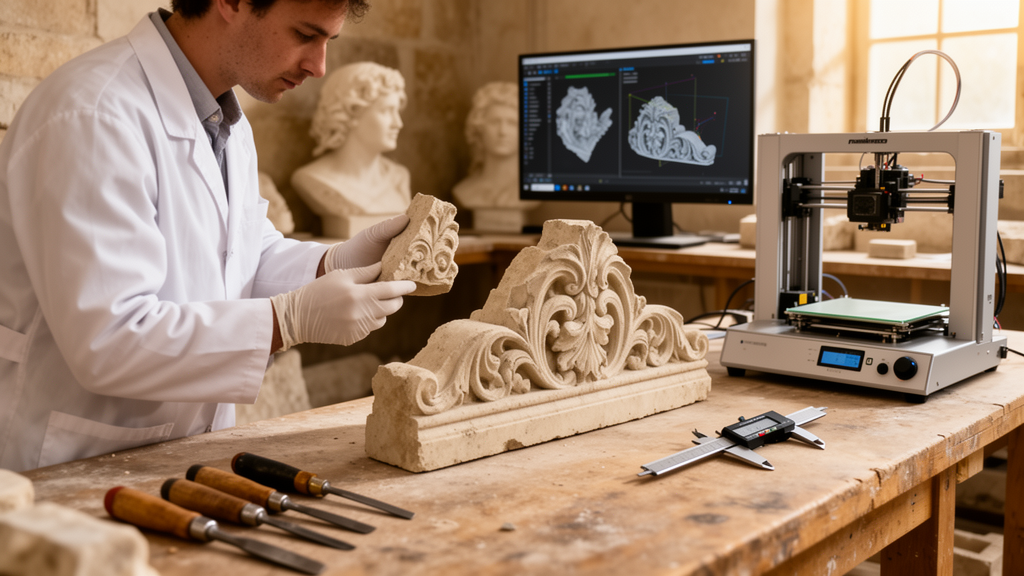
Conservation researchers have developed and validated a digital stone grafting methodology that reconstructs missing volumes of carved architectural sculpture by combining high-resolution 3D scanning, digital modelling, and robotic CNC machining in stone of the same lithology as the original. The workflow was tested on a full-scale reproduction of a Romanesque capital from the Basilica of Sainte-Marie-Madeleine of Vézelay in Burgundy, France, and produced a stone insert whose geometry closely matched the digital model, with an overall root mean square deviation of 0.6772 mm between the digitally modelled insert and the fabricated stone piece.
The study, published in the journal Built Heritage, addresses a persistent problem in heritage conservation: when sculptural-ornamental features lose material through breakage, fragmentation, disintegration, or human action, the legibility, integrity, and interpretation of the artwork suffer. Traditional reintegration approaches, including stone inserts and mortar-based reconstructions, typically require direct intervention on the original material and carry limitations related to compatibility, durability, and process control. The new methodology aims to minimise that contact by performing nearly all analysis, planning, and fabrication away from the object itself.
At the heart of the method is what the researchers call a digital clone: a high-resolution, metrically reliable three-dimensional replica of the original element obtained through non-contact recording. The term digital stone grafting is defined as the reconstruction of a missing volume through a virtual model metrically and morphologically adjusted to the original geometry, subsequently materialised in stone of identical lithology. The analogy to an organic graft is deliberate, since the original work incorporates a stone element of the same nature, promoting physical, chemical, and mechanical continuity between insert and substrate.
For the case study, the team selected Capital No. 13 from the Chapel of Saint Francis within the Vézelay complex, one of the most outstanding Romanesque ensembles in Western Europe and a key site of medieval cultural heritage. The capital measures approximately 30 by 20 by 20 centimetres in height, width, and depth, and is carved in local Burgundian limestone of the Massangis type. Its decoration features a schematised vegetal composition with fleshy, lobed leaves emerging symmetrically from an axial motif, forming volutes at their extremities, with spherical fruits interpretable as pomegranates in the upper zone beneath the abacus.
Because the original capital holds high historical and artistic value, the validation was deliberately carried out on a faithful 1:1 scale reproduction carved in stone rather than on the original itself. The researchers justified this choice on several grounds: adherence to minimal intervention and minimal contact with the original; the use of compatible materials, restricting those that may exhibit divergent long-term behaviour such as resins and mortars; the selection of natural stone of the same nature as the original to ensure greater physicochemical, mechanical, and aesthetic compatibility; and the possibility of disseminating the process through an aesthetically representative and manageable object that can be viewed and handled at realistic distances and angles.
The three-dimensional recording relied on sub-millimetric lasergrammetry using a HandySCAN Silver Elite scanner from Creaform, which offers geometric accuracy of up to 0.03 mm, operated with VXelements software. The system was parameterised at a resolution of 0.6 mm, allowing topographic details at that threshold to be recorded while maintaining the stated geometric accuracy. The resulting point cloud was processed into a coherent polygonal mesh faithful to the original geometry, with corrections for surface noise, inverted polygons, intersecting polygons, redundant geometry, and other mesh defects. According to the authors, this active laser-based approach offers greater stability under varying lighting conditions than alternative techniques and is particularly suitable for documenting fractures and sculptural detail.
Digital modelling of the insert volume was performed in ZBrush, combined with Geomagic Wrap for subtraction operations and optimisation prior to fabrication. Crucially, the modellers began with fragments selected from the recorded element itself, together with stylistic references identified in other capitals within the same architectural context. This procedure significantly limited subjective stylistic interpretation and reduced the risk of generating historical falsifications. Once the reintegration volume was complete and its fit to the fracture area verified, Boolean operations subtracted the volume of the original support from the generated insert, producing the negatively projected topography of the fracture interface on the insert. The digital insert was then exported in STL format for machining preparation.
The fabrication phase used a seven-axis robotic machining system based on an anthropomorphic ABB robotic arm assisted by an additional rotational axis, a configuration chosen for its kinematic versatility, expanded working envelope, and capacity to adapt to heritage-specific configurations. Machining proceeded through a hierarchical sequence of roughing, semi-finishing, and finishing. Roughing used large-diameter tools, beginning with a 209 mm diameter disc, followed by semi-finishing with a 32 mm cylindrical tool and a 13 mm conical tool. Finishing employed a 1.2 mm conical tool, with a final directional pass generating a subtle rigatino effect of roughly 0.3 mm thickness through projected profile toolpaths, a deliberate strategy to enhance the discernibility of the insert in accordance with restoration principles. Feed rate was initially set at 1000 mm/min and spindle speed at 5000 rpm, then adjusted manually according to the actual behaviour of the material and tool.
The validation results showed a high degree of correspondence between the digital model and the physical insert. The deviation analysis yielded an overall RMS value of 0.6772 mm, with mean deviations of +0.4512 mm and −0.4752 mm. Importantly, the distribution of deviations was not homogeneous: the fracture interface, the critical area for fitting and assembly, presented comparatively lower deviations than other areas of the insert, indicating close geometric correspondence precisely where it matters most for reintegration. Higher deviations concentrated in deep recesses, undercuts, and areas with restricted tool accessibility, where the minimum tool diameter limits machining and selective manual finishing becomes necessary. The authors note these deviations should not be read solely as manufacturing inaccuracies, but also as the result of geometric constraints inherent to machining and of deliberate manual adjustments during finishing.
The study also acknowledges limitations. Implementation requires access to 3D recording technologies, digital modelling environments, and CNC fabrication systems, along with qualified personnel across all workflow stages. Data acquisition, processing, modelling, and programming add working time compared with certain conventional procedures, although the researchers argue that 3D recording represents a permanent metric archive that can be preserved, consulted, and reused in future interventions, and that CNC programming costs should be assessed against a wider spectrum of applications including sculptural reproduction, architectural element fabrication, and heritage documentation. CNC machining also cannot fully reproduce certain textures and micro-irregularities inherent to manual workmanship, making artisanal finishing an essential complementary phase, particularly for sculptural elements of high artistic value where surface qualities play a crucial role in perception.
Beyond the Vézelay case, the authors report that the method has been applied in recent years at the Estate of Versailles, the Louvre Museum, Sens Cathedral, and the Basilica of Saint-Denis, among other heritage contexts, demonstrating its adaptability to diverse settings. The digital clone itself introduces a documentation dimension: it enables remote study, the generation of interactive conservation states, and the establishment of reference repositories in the event of potential loss due to degradation, conflict, or disaster. The researchers frame the methodology not as a replacement for alternative conservation approaches or a resolution of ongoing ethical debates about volumetric reintegration, but as an additional tool for professionals in contexts where reintegration is considered appropriate, consistent with principles of compatibility, reversibility, and minimal intervention.
As a future line of research, the team proposes further development of the sealing system implemented in the study, developed in collaboration with an engineering firm. The procedure is based on structural anchoring using braided basalt dowels fixed with epoxy resin, combined with joint sealing using hydraulic lime mortars with pozzolanic aggregates, and has demonstrated high initial effectiveness in terms of mechanical performance, material compatibility, and hygrothermal response. Future work will focus on scientific validation through physicomechanical characterisation of the assembled system, durability assessment under environmental agents, and evaluation under real service conditions, with results to form the basis of a dedicated publication.
Subject of Research: Digital stone grafting methodology for volumetric reintegration of architectural sculptural-ornamental stone elements using 3D recording, digital modelling, and CNC fabrication
Article Title: Digital stone grafting for volumetric reintegration and reconstruction of architectural sculptural-ornamental elements: case study in cultural heritage
Article References: Niquet-Herrero, N. D., Vidal, F. J., Bottineau, C., & Mas-Barberà, X. (2026). Digital stone grafting for volumetric reintegration and reconstruction of architectural sculptural-ornamental elements: case study in cultural heritage. Built Heritage, 10(1), Article 73. https://doi.org/10.1186/s43238-026-00323-2
Image Credits: AI Generated
DOI: 10.1186/s43238-026-00323-2
Keywords: digital stone grafting, heritage conservation, 3D scanning, CNC machining, volumetric reintegration, Romanesque capital, Vézelay, digital clone, stone inserts, robotic fabrication, minimal intervention, material compatibility
Cite Scienmag News
Courtney Benton. (October 28, 2026). Research report: Digital stone grafting for volumetric reintegration and reconstruction of architectural sculptural-ornamental elements: case study in cultural heritage. Scienmag. https://scienmag.com/research-report-digital-stone-grafting-for-volumetric-reintegration-and-reconstruction-of-architectural-sculptural-ornamental-elements-case-study-in-cultural-heritage/
Courtney Benton. "Research report: Digital stone grafting for volumetric reintegration and reconstruction of architectural sculptural-ornamental elements: case study in cultural heritage." Scienmag, 28 October 2026, https://scienmag.com/research-report-digital-stone-grafting-for-volumetric-reintegration-and-reconstruction-of-architectural-sculptural-ornamental-elements-case-study-in-cultural-heritage/. Accessed 28 October 2026.
Courtney Benton. "Research report: Digital stone grafting for volumetric reintegration and reconstruction of architectural sculptural-ornamental elements: case study in cultural heritage." Scienmag. October 28, 2026. https://scienmag.com/research-report-digital-stone-grafting-for-volumetric-reintegration-and-reconstruction-of-architectural-sculptural-ornamental-elements-case-study-in-cultural-heritage/