


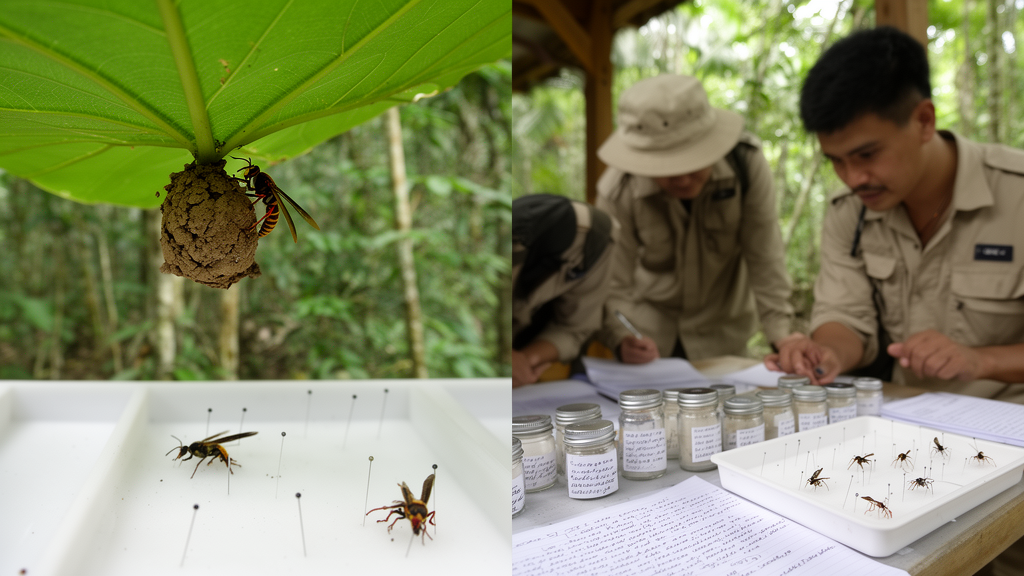
A taxonomic study of potter wasps has formally described a new species, Euodynerus furvus, from Vietnamese specimens and reported the first description of the male genitalia of Euodynerus trilobus. The research also documented additional Vietnamese distribution records for three previously known members of the genus and presented an identification key for all Oriental Euodynerus species except Euodynerus carinatus, whose taxonomic status remains uncertain. The study was based on mature, pinned and dried specimens deposited in the Institute of Ecology and Biological Resources in Vietnam.
The researchers examined external morphology and coloration, measured structures with an ocular micrometer, and dissected the terminal sterna and genitalia of male specimens. The genus was treated in two subgenera, Euodynerus and Pareuodynerus, following the recent synonymization of Incolepipona under Pareuodynerus. On that basis, the study recognized 16 valid species and six subspecies in the Oriental region, including the newly described species.
The holotype of E. furvus is a female collected on 11 June 2018 in Lan Nghe, Huu Lien Nature Reserve, Lang Son Province, at an elevation of 289 metres. Four female paratypes were examined, from Son La, Vinh Phuc, Dak Lak and Ha Tinh. The five locality records therefore include Lang Son, Son La, Vinh Phuc, Dak Lak and Ha Tinh, with specimens from Ea So and Vu Quang national parks among the collection sites.
The body length of the new species is 10–12 millimetres, with a holotype body length of 12 millimetres, while fore-wing length is 9.0–10.0 millimetres, including a 10-millimetre fore wing in the holotype. The formal diagnosis of E. furvus is based on a combination of head, thorax, propodeum and metasomal characters. Its clypeus is as wide as high and has two apical teeth separated by about one-fifth of the clypeus’s maximum width; these teeth are reflexed and carinate.
The lateral surface of the pronotum is concave, with the concavity clearly separated from the dorsal surface by a blunt carina. The apical margin of the second metasomal tergum is broadly lamellate and reflexed, whereas the second metasomal sternum is strongly convex in lateral view and lacks a basal mediolongitudinal furrow. The first and second terga have deep, strong punctures, and the mesoscutum is densely and coarsely punctured, with raised interspaces forming reticulation.
Colour provides a conspicuous additional feature of the new species. The body is black, with light-yellow markings on a small spot behind the compound eye, the anterior margin of the pronotum, the apical margin of the second tergum and a small area at the lateral corner of the second sternum. The underside of the antennal scape is reddish brown, and the wings are dark brown.
The specific epithet furvus is the Latin adjective for “black” and refers to the predominantly black body. The male of E. furvus remains unknown in the examined material, so the description and diagnosis are based on female characters. The new species was compared most closely with Euodynerus koenigsmanni because both possess a noticeably reflexed, carinate clypeus and a concave lateral pronotal surface.
E. furvus can be distinguished by the well-developed, lamellate and reflexed apical margin of its second tergum, which is not reflexed in E. koenigsmanni. A second distinction occurs on the second sternum: E. furvus lacks the short basal mediolongitudinal furrow present in E. koenigsmanni. The study presents these features as the basis for recognizing the specimens as a separate species rather than as another representative of a previously described taxon.
In Euodynerus dantici violaceipennis, the digitus is exceptionally broad, approximately 2.5 times as long as wide at its widest point, and densely covered with long setae before narrowing abruptly near its pointed apex. In Euodynerus nipanicus tonkinensis, the digitus is about three times as long as wide, remains wide through most of its length and bears only sparse, long setae along one side. For E. trilobus, the authors described the genitalia for the first time: the digitus is thick and approximately trapezoidal, the surface lacks setae, and short setae occur along one side.
Its penis valves are about 1.9 times as long as the basal apodeme and terminate in a bluntly pointed apical lobe. The examination of E. dantici also revealed a possible taxonomic problem involving E. carinatus, a species described from Sichuan, China. Vietnamese specimens identified as E. dantici had a clypeus longer than wide, a strong longitudinal carina and a broadly shaped digitus that narrows apically, closely resembling the published illustration for E. carinatus.
The study retained the current status of both names because the available observations did not establish their relationship conclusively. It specifically identified the shape of the digitus and penis valve in the male genitalia of E. carinatus as requiring direct comparison with E. dantici before a synonymy could be assessed, and consequently omitted E. carinatus from the regional key. Its first major division separates Euodynerus from Pareuodynerus using the number and form of the propodeal teeth, the shape of clypeal punctures and the punctation of the tegulae.
Later couplets draw on antennal segment number, male flagellomere shape, body markings, setal length, puncture density, clypeal proportions, and the form of the second tergum and sternum. For E. furvus, the key combines a concave pronotal lateral surface, a blunt carina separating that concavity from the dorsal surface and an almost entirely black body. Species such as E. koenigsmanni and E. nipanicus are separated from it using the condition of the second tergum, clypeal setae and male antennae.
The study also expanded the documented Vietnamese distribution of three known taxa. Euodynerus dantici violaceipennis was newly recorded from Bac Kan. E. nipanicus tonkinensis was newly recorded from Ha Giang, Yen Bai, Tuyen Quang, Bac Kan, Lang Son, Son La and Thanh Hoa, in addition to its previously listed distribution in China.
E. trilobus was newly recorded from Lang Son, while its wider reported range includes several Chinese provinces, Taiwan, Hong Kong, Malaysia, Indonesia, Japan and islands in the western Indian Ocean. These records were based on identified museum specimens and were presented as collection-based distribution documentation, without an inference that the newly reported localities define the full geographic range of each species. Body length was defined as the combined lengths of the head, mesosoma and first two metasomal segments.
Male terminal sterna and genitalia were treated with TE-Proteinase K solution, incubated for 24 hours at 56 °C, and mounted in hand-washing gel for observation and photography. Images were made with a Nikon SMZ 800N digital stereomicroscope and Sony α6000 camera, stacked in Helicon Focus version 7 and assembled into plates in Adobe Photoshop CS6. The resulting account provides a formal description, specimen-based distribution data, comparative genital anatomy and a practical regional key for the documented Oriental fauna of Euodynerus.
Subject of Research: Taxonomic description of a new Vietnamese Euodynerus potter wasp and documentation of the Oriental genus
Article Title: Contribution to the knowledge of the potter wasp genus Euodynerus Dalla Torre, 1904 ( Hymenoptera , Vespidae , Eumeninae ) from Vietnam, with description of a new species and a key to the Oriental fauna
Article References: Tran, T. V., Vu, T. T., Nguyen, C. Q., & Nguyen, L. T. P. (2025). Contribution to the knowledge of the potter wasp genus Euodynerus Dalla Torre, 1904 (Hymenoptera, Vespidae, Eumeninae) from Vietnam, with description of a new species and a key to the Oriental fauna. Journal of Hymenoptera Research, 98, 467-482. https://doi.org/10.3897/jhr.98.150250
Image Credits: AI Generated
Keywords: Euodynerus furvus, potter wasps, taxonomy, Vietnam, Hymenoptera, Vespidae, Eumeninae, new species, male genitalia, Oriental fauna, species identification, morphology
Cite Scienmag News
Gavin Prescott. (October 20, 2026). Research report: Contribution to the knowledge of the potter wasp genus Euodynerus Dalla Torre, 1904 ( Hymenoptera , Vespidae , Eumeninae ) from Vietnam, with description of a new species and a key to the Oriental fauna. Scienmag. https://scienmag.com/research-report-contribution-to-the-knowledge-of-the-potter-wasp-genus-euodynerus-dalla-torre-1904-hymenoptera-vespidae-eumeninae-from-vietnam-with-description-of-a-new-species-and-a-key-to/
Gavin Prescott. "Research report: Contribution to the knowledge of the potter wasp genus Euodynerus Dalla Torre, 1904 ( Hymenoptera , Vespidae , Eumeninae ) from Vietnam, with description of a new species and a key to the Oriental fauna." Scienmag, 20 October 2026, https://scienmag.com/research-report-contribution-to-the-knowledge-of-the-potter-wasp-genus-euodynerus-dalla-torre-1904-hymenoptera-vespidae-eumeninae-from-vietnam-with-description-of-a-new-species-and-a-key-to/. Accessed 20 October 2026.
Gavin Prescott. "Research report: Contribution to the knowledge of the potter wasp genus Euodynerus Dalla Torre, 1904 ( Hymenoptera , Vespidae , Eumeninae ) from Vietnam, with description of a new species and a key to the Oriental fauna." Scienmag. October 20, 2026. https://scienmag.com/research-report-contribution-to-the-knowledge-of-the-potter-wasp-genus-euodynerus-dalla-torre-1904-hymenoptera-vespidae-eumeninae-from-vietnam-with-description-of-a-new-species-and-a-key-to/


