Heavy metals in the bottom sediments of four small tidal estuaries in North Vancouver, British Columbia, are controlled less by the size of sediment particles than by how much organic matter those sediments contain, according to a new study of the Mackay Creek, Mosquito Creek, Lynn Creek and Seymour River estuaries, all of which empty into Burrard Inlet. The finding, published in Anthropocene Coasts, comes from a detailed survey of sediment cores collected at low tide along stretches of urban shoreline that have been reshaped for more than a century by industry, railways, ports and roads.
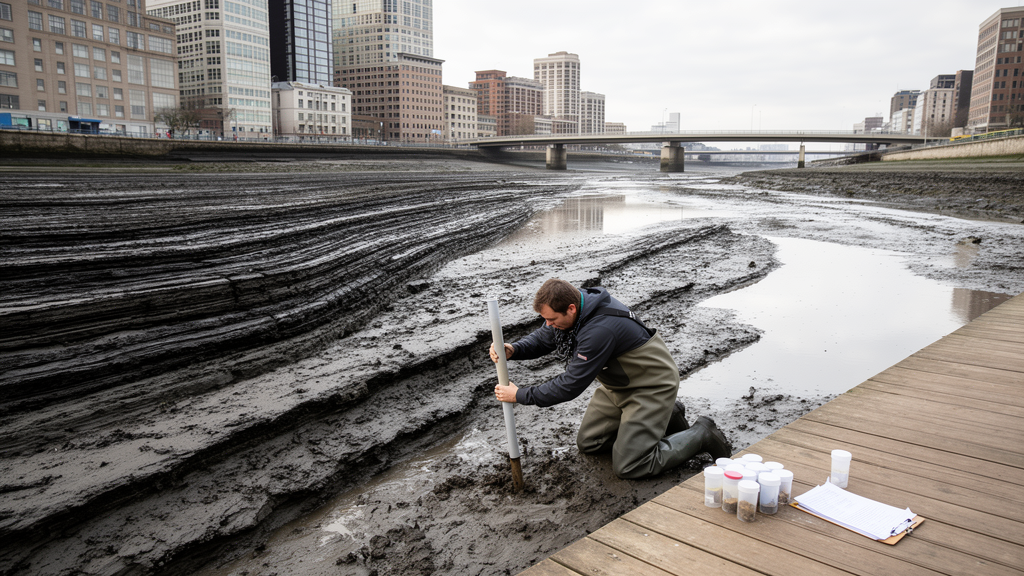
The research team, led by Vasily D. Kazmiruk and Tamara N. Kazmiruk, collected 51 sediment samples in total: 16 from the Mackay Creek estuary, 10 from Mosquito Creek, 9 from Lynn Creek and 16 from the Seymour River estuary. Using a hand-held core sampler with a molybdenum-alloyed stainless steel tube, they pushed cores as deep as 25 centimetres into the sediment at Mackay Creek, 24 centimetres at Mosquito Creek, 29 centimetres at Lynn Creek and 22 centimetres at the Seymour River estuary. Each core was sectioned into layers roughly 1 to 5 centimetres thick, then frozen and transported to the laboratory, where the samples were analysed for grain size distribution, organic matter content measured as loss on ignition, and the concentrations of copper, zinc, lead and cadmium using flame atomic absorption spectroscopy after aqua regia digestion.
Quality control included blank and duplicate samples as well as the certified marine sediment reference material MESS-3 from the National Research Council of Canada, with a coefficient of variation below 5.0 percent. Statistical processing was carried out in Microsoft Excel 2013 and IBM SPSS Statistics 22.0, with normality and homoscedasticity verified before two-way analysis of variance and significance set at p < 0.05.
The sediments proved remarkably heterogeneous in both space and depth, but one fraction dominated nearly everywhere: coarse sand between 2 and 0.25 millimetres. The maximum proportion of this fraction reached 70.5 percent in the Mackay estuary, 79.0 percent at Mosquito Creek, 79.8 percent at Lynn Creek and 91.4 percent at the Seymour River estuary, the largest of the four systems, where the highest river discharge and water velocities produced the coarsest deposits. At the tip of a spit in the Seymour estuary, a single site consisted of 96.7 to 99.4 percent gravel and coarse sand throughout the entire sampling depth. The gravel fraction showed the greatest variability of any fraction, ranging from 1.0 to 81.8 percent in the Seymour estuary, while the highest proportion of fine particles, 55.0 percent, was found in a stagnation zone behind a retaining wall in the Mosquito Creek estuary, a zone that was later filled with rock fill during engineering work to reconstruct the estuary.
Organic matter was equally patchy. Because the catchments of all four watercourses are covered in dense mountain forest, leaf litter, tree bark and decaying wood are the predominant sources of the allochthonous organic material that washes into the estuaries, aided by a maritime climate in which average annual precipitation is roughly 2,500 millimetres. Even within a single estuary, the organic content of sediments varied by tens of times, from 1.3 to 47.2 percent at Mackay Creek, 0.5 to 31.4 percent at Mosquito Creek, 1.1 to 37.5 percent at Lynn Creek and 1.0 to 71.2 percent at the Seymour estuary.
Measured concentrations of the four metals spanned wide ranges: copper from 5.4 to 320.2 micrograms per gram dry weight, zinc from 12.9 to 146.3, lead from 4.3 to 118.5 and cadmium from 0.1 to 4.9, with corresponding averages of 34.9, 49.5, 26.1 and 0.6 micrograms per gram. Maximum and minimum values for individual metals differed by up to sixty-fold. On average, the descending concentration series ran zinc, copper, lead, then cadmium, indicating that zinc contributes the most to heavy metal accumulation in these sediments overall, although copper or lead predominated in certain areas.
The extremes told a consistent story about the physical conditions under which metals accumulate. The highest copper value, 320.2 micrograms per gram, was recorded in the Mackay estuary about 20 metres below a low head dam at a site rarely reached by high tides or floods, where the sediment contained 61.3 percent fine sands and 17.5 percent silts and 20.8 percent organic matter, and where plant litter and dust particles from a railway crossing the estuary could settle. By contrast, the lowest copper values, 5.4 micrograms per gram in the Seymour estuary and 5.8 at a Mosquito Creek site constricted by a retaining wall, occurred where coarse fractions dominated and organic matter was scarce, at 13.6 and 2.2 percent respectively. In the same Mosquito Creek estuary, a bar shoal formed where the river flow is damped, trapping fine sands, silts and 24.2 percent organic matter, and there the estuary’s maximum copper concentration of 92.7 micrograms per gram was recorded. The highest zinc value, 146.3 micrograms per gram, came from the subsurface layer of the same Mosquito Creek bar bank.
Not every hotspot could be explained by natural sorting. The maximum lead concentration appeared in a 17-to-21-centimetre layer at a Mackay estuary site near a shipyard operated by Vancouver Shipyards Co Ltd, where waste containers sit tens of metres from the sampling point. The same layer also held a cadmium peak of 3.75 micrograms per gram and elevated copper and zinc of 117.02 and 69.98 micrograms per gram, values the authors describe as anomalous given that the sediment there is dominated by coarse sand and gravel and contains only 5.5 percent organic matter. The site’s geomorphology, a bar shoal downstream that promotes the retention and deposition of pollutants, the sample’s distinct layering, and a bluish tint uncharacteristic of typical estuary sediments all supported the interpretation that the layer reflects anthropogenic pollution. The largest variation in cadmium, a factor of 24, occurred in the Mosquito estuary, where the absolute maximum was found at the site with the highest concentration of fine particles.
Comparing the four systems, the Lynn Creek estuary stood out for its stability. Its catchment runs through protected, undeveloped and densely forested mountain slopes, including Lynn Headwaters Regional Park, the largest such park in Metro Vancouver, and industrial and port facilities line the creek only within the last 700 metres before it flows into Burrard Inlet. The estuary showed the smallest ranges for zinc and lead, and it was the only estuary in which significant correlations appeared between all four metals, with coefficients of 0.64 to 0.76, a pattern the authors suggest can be used to assess anthropogenic disturbance of sediments in other similar water bodies. In the more polluted estuaries, those relationships were absent or limited to individual element pairs, such as copper and zinc in the Mackay and Mosquito estuaries and lead and cadmium in the Mackay estuary.
The study’s central conclusion concerns what binds metals to sediment. The authors report that they could not confirm the widely repeated assertion that fine-grained particles are the main accumulators of heavy metals, noting that clay and organic silt particles of similar size differ sharply in chemical composition and sorption capacity. Instead, organic matter emerged as the more significant factor, with linear relationships between organic content and metal concentrations showing relatively high correlation coefficients in 56 percent of cases, the strongest for zinc at 0.51 to 0.80 and, among the estuaries, in the Lynn estuary, where the coefficients for copper, zinc, lead and cadmium reached 0.72, 0.63, 0.71 and 0.68. Maximum concentrations exceeded the Canadian Interim Sediment Quality Guideline thresholds at low-tide depth, reaching nine times the guideline for copper, twice for zinc and eight times for cadmium in Mackay Creek and Mosquito Creek, and three times for lead in Mackay Creek and the Seymour estuary. The authors caution that the role of organic matter, particularly plant litter, in metal accumulation and sediment formation requires further detailed investigation, and that sediment quality guidelines differ significantly between countries in the thresholds they deem hazardous to living organisms.
Subject of Research: Heavy metal accumulation in the bottom sediments of four small tidal estuaries in urban North Vancouver, Canada
Article Title: Bottom sediments of small tidal estuaries located in urban areas
Article References: Kazmiruk, V. D., & Kazmiruk, T. N. (2026). Bottom sediments of small tidal estuaries located in urban areas. Anthropocene Coasts, 9(1), Article 37. https://doi.org/10.1007/s44218-026-00150-z
Image Credits: AI Generated
DOI: 10.1007/s44218-026-00150-z
Keywords: heavy metals, bottom sediments, tidal estuaries, urban pollution, organic matter, grain size, Burrard Inlet, copper, zinc, lead, cadmium, sediment quality guidelines
Cite Scienmag News
Violet Maxwell. (October 28, 2026). Research report: Bottom sediments of small tidal estuaries located in urban areas. Scienmag. https://scienmag.com/research-report-bottom-sediments-of-small-tidal-estuaries-located-in-urban-areas/
Violet Maxwell. "Research report: Bottom sediments of small tidal estuaries located in urban areas." Scienmag, 28 October 2026, https://scienmag.com/research-report-bottom-sediments-of-small-tidal-estuaries-located-in-urban-areas/. Accessed 29 October 2026.
Violet Maxwell. "Research report: Bottom sediments of small tidal estuaries located in urban areas." Scienmag. October 28, 2026. https://scienmag.com/research-report-bottom-sediments-of-small-tidal-estuaries-located-in-urban-areas/