


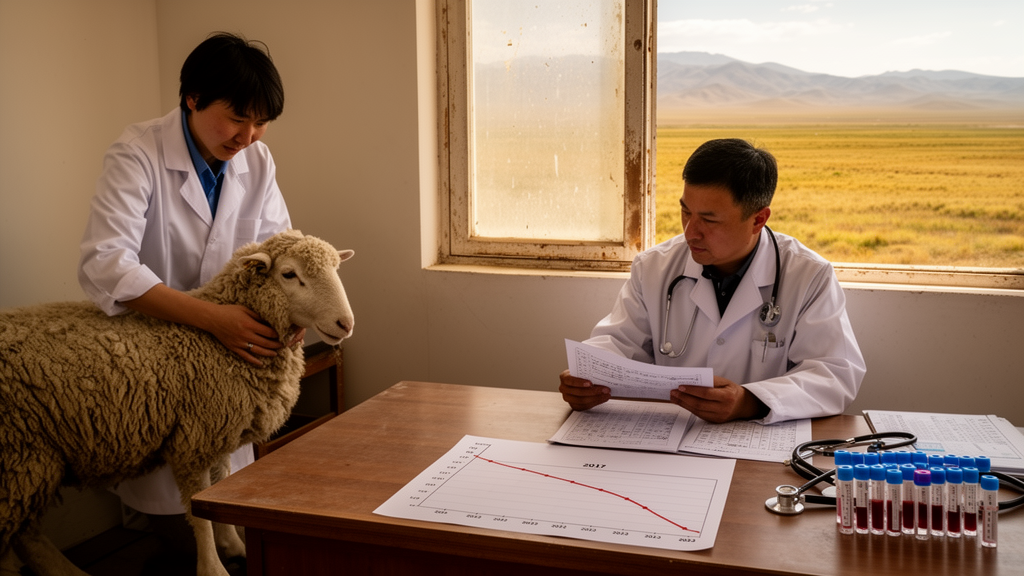
Reported cases of echinococcosis in Xinjiang, China, followed a rise-then-fall trajectory over fifteen years, peaking in 2017 and reaching their lowest reported level in 2022, according to an analysis of national surveillance records published in BMC Infectious Diseases. The study, which examined 20,302 reported cases between 2010 and 2024, also put five different forecasting methods through a head-to-head comparison and found that which model performs best depends heavily on how the comparison is run. The research team drew its case data from the China Infectious Disease Surveillance and Reporting System.
To characterize long-term trends, they applied Joinpoint regression, a statistical technique that identifies points in time where the direction of a trend changes, and computed the Annual Percentage Change (APC) for each segment as well as an overall Average Annual Percentage Change (AAPC). Monthly reporting patterns were summarized descriptively to see whether the rhythm of notifications shifted over the study period. The results revealed an inflection around 2017 in the one-joinpoint specification.
Reported cases rose during 2010 to 2017, with an APC of 8.91 percent (95 percent confidence interval: 2.93 to 22.25 percent), and then declined during 2017 to 2024, with an APC of −12.56 percent (95 percent confidence interval: −23.20 to −7.49 percent). Yet across the full fifteen-year span, the overall AAPC was −2.42 percent, with a confidence interval spanning −5.80 to 0.83 percent, an interval that includes zero. The authors report that segment-specific trend inference was sensitive to model specification, meaning that the apparent rise-then-fall pattern depends in part on the analytical choices made.
Monthly reporting patterns also changed over time. The second half of the study addressed a different question: which time series model best predicts future case counts over a long horizon, evaluated across the COVID-19 pandemic period? The team compared five approaches: a Naive method, a Seasonal Naive method, the SARIMA framework, the Prophet model, and a Long Short-Term Memory (LSTM) neural network.
Each model was trained exclusively on data from 2010 through 2019 and then asked to forecast the 2020 to 2024 period without being updated or refitted with observed test-period values, under a common fixed-origin framework. Performance was scored using four standard error metrics: root mean square error (RMSE), mean absolute error (MAE), mean absolute percentage error (MAPE), and symmetric mean absolute percentage error (sMAPE). In this primary fixed-origin analysis, the LSTM network, run with a fixed random seed of 42, yielded the lowest errors, with an RMSE of 47.08, an MAE of 39.24, a MAPE of 105.91 percent, and an sMAPE of 46.07 percent.
However, the ranking changed when the team ran a sensitivity analysis using an expanding-window rolling-origin framework. In that setup, models were repeatedly refit to produce one-month-ahead forecasts, with each new month of observed data folded back into the training set. Under this scheme, SARIMA delivered the lowest RMSE, MAE, and sMAPE, while the LSTM showed comparable performance but no longer led the rankings.
The study's stated conclusion is that comparative model performance depended on the forecasting framework itself. A model that achieved the lowest errors in a single long-range extrapolation from a fixed 2019 origin did not dominate when forecasts were refreshed monthly with updated data. The findings therefore speak to methodology as much as to epidemiology: benchmark results for forecasting models can flip depending on whether the evaluation is fixed-origin or rolling-origin.
On the disease trend itself, the study describes a cautious picture. Reported cases peaked in 2017, declined afterward in the one-joinpoint specification, and reached their minimum in 2022. What the study establishes is a quantitative account of fifteen years of echinococcosis notifications in Xinjiang, along with a transparent demonstration that different but defensible forecasting designs can produce different answers about which model predicts best.
Subject of Research: Temporal trends and comparative time series forecasting of reported echinococcosis cases in Xinjiang, China, 2010–2024
Article Title: Temporal trends and comparative forecasting of echinococcosis in endemic Xinjiang (2010–2024): changes during and after the COVID-19 pandemic
Article References: Yin, Z., Simay, A., Shi, G., Maimaitiyiming, Y., Wang, Q., Hu, Z., & Zhao, J. (2026). Temporal trends and comparative forecasting of echinococcosis in endemic Xinjiang (2010–2024): changes during and after the COVID-19 pandemic. BMC Infectious Diseases. https://doi.org/10.1186/s12879-026-14672-x
Image Credits: AI Generated
DOI: 10.1186/s12879-026-14672-x
Keywords: echinococcosis, Xinjiang, time series forecasting, SARIMA, LSTM, Prophet, Joinpoint regression, COVID-19 pandemic, surveillance data, annual percentage change, BMC Infectious Diseases, Temporal
Cite Scienmag News
Phoebe Ingram. (October 24, 2026). Reported Echinococcosis in Xinjiang Peaked in 2017 and Fell to a 2022 Low, but the Best Forecast Model Depends on the Test. Scienmag. https://scienmag.com/reported-echinococcosis-in-xinjiang-peaked-in-2017-and-fell-to-a-2022-low-but-the-best-forecast-model-depends-on-the-test/
Phoebe Ingram. "Reported Echinococcosis in Xinjiang Peaked in 2017 and Fell to a 2022 Low, but the Best Forecast Model Depends on the Test." Scienmag, 24 October 2026, https://scienmag.com/reported-echinococcosis-in-xinjiang-peaked-in-2017-and-fell-to-a-2022-low-but-the-best-forecast-model-depends-on-the-test/. Accessed 24 October 2026.
Phoebe Ingram. "Reported Echinococcosis in Xinjiang Peaked in 2017 and Fell to a 2022 Low, but the Best Forecast Model Depends on the Test." Scienmag. October 24, 2026. https://scienmag.com/reported-echinococcosis-in-xinjiang-peaked-in-2017-and-fell-to-a-2022-low-but-the-best-forecast-model-depends-on-the-test/


