


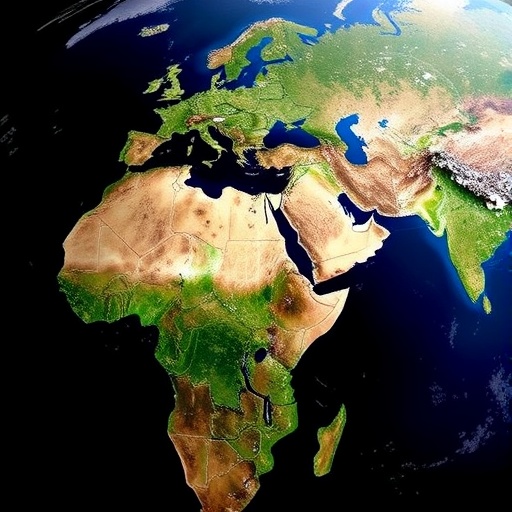
In a world increasingly inundated with plastic waste, the quest for innovative and effective monitoring solutions becomes paramount. Recent advancements in remote sensing technology have sparked a significant interest in how these methods can revolutionize our ability to detect, quantify, and track plastic pollution in various environments. The forthcoming review by Potiracha and Baars, entitled “A Review of Remote Sensing Technology for Plastic Waste Monitoring,” promises to shed light on these methodologies, which hold the potential for unprecedented understanding of plastic proliferation and its environmental impact.
Plastic pollution has evolved into a global crisis, with millions of tons entering oceans, rivers, and landscapes annually. Traditional monitoring methods often fall short, strained by limitations in scalability and accessibility. Remote sensing technology, leveraging various spectral and imaging techniques from satellites to drones, emerges as a beacon of hope in addressing these challenges. The review meticulously compiles and synthesizes the latest developments, offering insights that could spur further innovations in environmental monitoring.
At the core of remote sensing lies the principle of capturing data from a distance. This technique exploits electromagnetic radiation interaction with materials, such as plastics, to identify their presence and distribution. By analyzing gathered data, scientists can create detailed maps and models that visualize plastic accumulation hotspots. This capability to render a seemingly invisible problem into tangible data is perhaps one of the most compelling aspects of this technology.
The authors explore a variety of platforms employed in remote sensing applications ranging from high-resolution satellites to unmanned aerial vehicles, commonly referred to as drones. Each platform presents its unique advantages and challenges, offering insights into which scenarios they excel in. For instance, satellite sensors capable of collecting data over vast areas provide a macro view of plastic waste, while UAVs can zoom in to capture higher-resolution imagery of specific locations, making them excellent tools for localized studies.
Another exciting aspect covered in the review is the role of spectral imaging in differentiating between types of plastics. Various polymers exhibit distinct spectral signatures, allowing remote sensing technologies to discriminate between them. This capability is critical in not only assessing the amount of plastic pollution but also understanding its composition, which is vital for crafting effective mitigation strategies. By identifying the types of plastics present in specific environments, authorities can better tailor their cleanup operations and recycling efforts.
The review details current research endeavors that leverage machine learning and artificial intelligence, enhancing the processing and analysis of remote sensing data. The integration of these advanced computational techniques allows for real-time monitoring and tracking of plastic waste, thereby offering a more dynamic understanding of how plastic pollution evolves over time. This aspect is particularly relevant in assessing the impact of policy changes or environmental initiatives aimed at reducing plastic usage.
Moreover, the authors draw attention to the potential for international collaboration fostered by remote sensing technology. Global databases built from remotely sensed data can facilitate cross-border environmental assessments and enable countries to collectively tackle plastic pollution. Such cooperative efforts are essential, given that oceans and waterways do not recognize national boundaries; thus, pollution in one region can affect ecosystems far away.
While the promise of remote sensing technology is vast, the review does not shy away from addressing the limitations and challenges that still linger. Issues such as data accuracy, resolution, and weather-related interferences are prominently discussed. The authors emphasize the need for continuous improvement in sensor technology and the importance of developing robust algorithms capable of addressing these challenges effectively.
Importantly, the review also raises ethical considerations regarding the deployment of remote sensing technologies. The surveillance aspects inherent in it could lead to privacy concerns, necessitating a careful deliberation of the balance between environmental monitoring and individuals’ rights. Stakeholders must engage in open dialogues to establish protocols that respect privacy while advancing our understanding of plastic waste.
The ultimate goal of the review is to inspire both researchers and policymakers to embrace these technologies in their fight against plastic pollution. By highlighting successful case studies and the tangible outcomes of utilizing remote sensing technologies, Potiracha and Baars aim to create a roadmap that showcases the practical implications and benefits of implementing these strategies on a broader scale.
Anticipation builds as the academic world awaits the publication of this comprehensive review. As awareness of environmental issues grows, the importance of innovative monitoring solutions cannot be overstated. Remote sensing technology provides a promising avenue to not only enlighten our understanding of plastic waste but also galvanize action toward sustainable practices and policies.
Through this synthesis of knowledge and technology, Potiracha and Baars are poised to make a significant contribution to the burgeoning discourse surrounding plastic pollution. Their work is a testament to the potential for scientific innovation to catalyze environmental change, reaffirming the role of technology in addressing one of the most pressing issues of our time.
As advocates for a cleaner and healthier planet, the challenge now rests on the global community to heed the insights shared in this review. Armed with advanced remote sensing methodologies, we have the capability to monitor, analyze, and ultimately mitigate the impacts of plastic pollution. It is paramount that researchers, policymakers, and citizens unite in this endeavor to ensure that future generations inherit a world free from the clutches of plastic debris.
The path ahead is fraught with challenges, yet the promise of remote sensing technologies illuminates a hopeful future where we can fundamentally shift our relationship with plastic waste. By fostering interdisciplinary collaborations and committing to comprehensive environmental strategies, we can forge a sustainable path forward and protect the delicate ecosystems upon which our lives depend.
As we approach the publication date, the momentum is building for this review to serve as a catalyst for renewed focus on plastic waste monitoring through remote sensing—ushering in a new era of environmental stewardship and responsibility.
Potiracha, Y., Baars, R.C. A review of remote sensing technology for plastic waste monitoring.
Environ Sci Pollut Res (2026). https://doi.org/10.1007/s11356-025-37347-7
Cite Scienmag News
Violet Maxwell. (January 17, 2026). Remote Sensing Advances in Plastic Waste Tracking. Scienmag. https://scienmag.com/remote-sensing-advances-in-plastic-waste-tracking/
Violet Maxwell. "Remote Sensing Advances in Plastic Waste Tracking." Scienmag, 17 January 2026, https://scienmag.com/remote-sensing-advances-in-plastic-waste-tracking/. Accessed 3 September 2026.
Violet Maxwell. "Remote Sensing Advances in Plastic Waste Tracking." Scienmag. January 17, 2026. https://scienmag.com/remote-sensing-advances-in-plastic-waste-tracking/


