


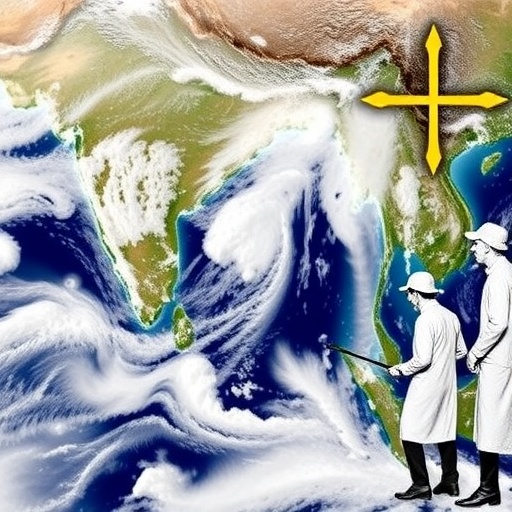
The dynamics of the South Asian High and its consequential influence on the Afro-Asian summer monsoon rainfall represent a focal point in contemporary climate research. Recent studies, including the breakthrough work led by Zhang, Huang, Zhou, and colleagues, have sought to refine projections concerning these critical climate features over the near-term future. Understanding the behavior of the South Asian High, a formidable upper-tropospheric anticyclone that significantly modulates monsoonal circulation, is paramount to anticipating shifts in precipitation patterns across vast swaths of the Afro-Asian continent, which directly affect the livelihoods of billions.
Historically, the South Asian monsoon system—one of the most intense and complex climatic phenomena—has exhibited substantial interannual and decadal variability. This variability is driven by a confluence of factors including sea surface temperature anomalies, Tibetan Plateau heating intensities, and teleconnections with global climate oscillations such as El Niño-Southern Oscillation (ENSO). Central to this system is the South Asian High, which functions as a crucial atmospheric engine orchestrating the summer monsoon by modulating the jet stream patterns and upper-level divergence dynamics, thereby steering moisture transport and atmospheric convection.
Projecting future monsoonal rainfall trends presents a profound challenge compounded by model uncertainties, the intricacies of regional feedback mechanisms, and the sensitivity of monsoon dynamics to global warming. Zhang and collaborators tackle this by employing advanced climate modeling tools enhanced with observational constraints to narrow the range of potential outcomes. Their approach integrates multi-model ensembles with sophisticated statistical techniques to delineate how the intensity, spatial extent, and altitude of the South Asian High may evolve in the upcoming decades, alongside resultant shifts in Afro-Asian summer precipitation.
One of the core contributions of the study involves constraining the near-term projections of the South Asian High through synergistic use of satellite observations, reanalysis data, and high-resolution general circulation models (GCMs). The researchers meticulously examined vertical temperature profiles over the Tibetan Plateau, discovered to be a sensitive hotspot influencing the strength and persistence of the High. These thermal anomalies induce modifications in the upper troposphere, which cascade to affect large-scale monsoon circulation patterns. Through this integrated methodology, uncertainties in monsoon rainfall projections are markedly reduced, enhancing predictive confidence.
The Afro-Asian summer monsoon system itself is a vast and interconnected domain where the Indian summer monsoon interplays with the African monsoon systems. Zhang et al. underscore how changes in the position and vigor of the South Asian High modulate moisture inflow not only into South Asia but extend westward, affecting arid and semi-arid regions in East Africa and the Sahel. This synoptic-scale modulation has implications for regional hydrology, agricultural productivity, and water resource sustainability, especially under the dual pressures of climate warming and demographic growth.
Their findings articulate a nuanced picture: while the overall trend predicts a strengthening of the South Asian High in the near term, the spatial heterogeneity is significant. Eastern extents of the High may retreat, whereas western intensification could amplify convection and precipitation anomalies in adjacent monsoon regions. This spatial asymmetry is attributed to complex land-atmosphere interactions, including soil moisture feedbacks and vegetation changes, alongside differential heating of continental surfaces.
Importantly, Zhang and colleagues highlight that conventional climate models frequently overestimate the expansion and intensification of the South Asian High because of biases in simulating Tibetan Plateau surface temperatures and upper-air thermal gradients. By incorporating observation-based constraints, their refined projections signal a more moderated intensification than previously reported, which bears significant consequences for climate adaptation strategies in monsoon-dependent nations.
The study’s sophisticated analytical framework also reveals shifting seasonal timings within the monsoon period, with potential earlier onset and variable withdrawal phases. These temporal changes are intricately linked to the evolving dynamics of the South Asian High and associated jet stream perturbations. Such phenological alterations could exacerbate mismatches between monsoon rainfall timing and agricultural cycles, thereby impacting food security across densely populated regions.
Moreover, the projected changes in summer monsoon rainfall patterns possess acute implications for hydrological extremes. Enhanced variability governed by the South Asian High’s modulation could increase the frequency of both drought episodes and extreme rainfall events, elevating risks of floods and water scarcity. Policymakers and disaster preparedness agencies must then brace for heightened volatility as partial mitigation through human interventions may be constrained by the fundamental atmospheric drivers elucidated in this research.
This research underscores the interconnectedness of global climate subsystems and regional atmospheric circulations. The Afro-Asian monsoon ensemble’s sensitivity to upper tropospheric dynamical shifts including the South Asian High, illustrates how remote forcings and internal feedbacks collectively determine monsoonal behavior. It also accentuates the pressing need for continued investment in observational networks over the Tibetan Plateau and adjacent regions to sustain advancements in model validation and refinement.
Beyond climate projection improvements, the study by Zhang et al. offers foundational insights into the physical mechanisms governing monsoon variability. Their detailed interrogation of the role of orographic heating, cloud-radiative feedbacks, and dynamical jet stream interactions contribute to a more intricate theoretical framework. Such enhanced mechanistic understanding is crucial for the next generation of climate modeling and for disentangling anthropogenic influences from natural variability.
The possible implications of this work extend to global climate policy dialogues, especially those focusing on adaptation and resilience within South Asia and Africa. Reliable climate forecasts are indispensable for strategic agricultural planning, water resource management, and urban infrastructure development. By mitigating predictive uncertainties, this refined understanding of the South Asian High’s future behavior enables more informed decision-making processes at both national and transboundary scales.
In sum, the research epitomizes a significant leap forward in regional climate science. It harnesses state-of-the-art data assimilation and model intercomparison methods to chart a more credible trajectory for the South Asian High and Afro-Asian summer monsoon rainfall in an era of rapid climate change. The study intertwines complex atmospheric physics with practical societal concerns, making it an indispensable reference point for scientists and policymakers alike.
As global warming accelerates, the insights from this research illuminate pathways to anticipate and potentially mitigate the multifaceted risks posed by monsoon variability. Zhang and team’s work fosters a deeper appreciation of atmospheric dynamics’ subtleties driving one of the world’s most critical seasonal phenomena, underscoring the intricate balance between natural forces and human influence shaping our climatic future.
Cite Scienmag News
Violet Maxwell. (June 15, 2026). Refining Near-Term South Asian and Afro-Asian Monsoon Forecasts. Scienmag. https://scienmag.com/refining-near-term-south-asian-and-afro-asian-monsoon-forecasts/
Violet Maxwell. "Refining Near-Term South Asian and Afro-Asian Monsoon Forecasts." Scienmag, 15 June 2026, https://scienmag.com/refining-near-term-south-asian-and-afro-asian-monsoon-forecasts/. Accessed 3 September 2026.
Violet Maxwell. "Refining Near-Term South Asian and Afro-Asian Monsoon Forecasts." Scienmag. June 15, 2026. https://scienmag.com/refining-near-term-south-asian-and-afro-asian-monsoon-forecasts/


