


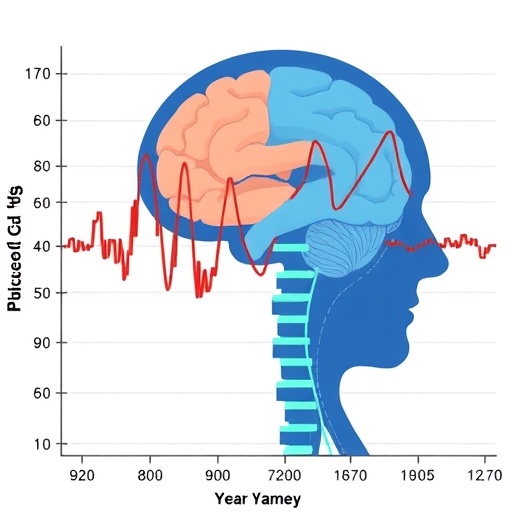
In an exciting development poised to reshape our understanding of schizophrenia, a groundbreaking study published in Translational Psychiatry unveils a novel neural signature linked to this complex mental health disorder. The research, led by Racz, F.S., Farkas, K., Becske, M., and colleagues, probes the diminished variability of alpha and beta band-limited power within the brain—a phenomenon that may unlock new pathways for diagnosis and treatment. This discovery comes at a pivotal time when the neuroscience community has intensified its search for reliable biomarkers that can clarify the neural underpinnings of schizophrenia, a disorder that affects millions globally.
At the heart of this study lies the intricate dance of brain oscillations, particularly focusing on alpha (8–12 Hz) and beta (13–30 Hz) frequency bands. These rhythmic electrical activities have long been associated with fundamental cognitive processes such as attention, memory, and sensorimotor integration. Variability in brain signals is crucial, reflecting the brain’s dynamic adaptability and functional flexibility. The researchers found that schizophrenia is characterized by a notable reduction in the variability of these band-limited powers, suggesting a core disruption in the brain’s intrinsic capacity to modulate its activity patterns.
The diminished variability in alpha and beta oscillations points towards a neural rigidity that may underlie several hallmark symptoms of schizophrenia, including cognitive deficits, disorganized thinking, and sensory processing anomalies. By leveraging advanced electrophysiological techniques, the study meticulously quantified these changes, demonstrating that the fluctuations in power within these bands are significantly less pronounced in individuals diagnosed with schizophrenia compared to neurotypical controls. Such findings provide compelling evidence that variability metrics offer a sensitive and objective biomarker that complements traditional clinical assessments.
From a technical perspective, the study employed cutting-edge magnetoencephalography (MEG) and electroencephalography (EEG) modalities to capture the subtle temporal dynamics of brain activity. These non-invasive methods allow researchers to track neuronal oscillations with millisecond precision, capturing the ebb and flow of electrical rhythms that escape other imaging techniques like fMRI. The analysis centered on calculating band-limited power variability—a measure of how much the power within specific frequency bands changes over time. This approach highlights the nuanced ways in which neuronal populations synchronize and desynchronize during cognitive tasks or at rest.
Crucially, the reduced variability did not merely reflect a global dampening of oscillatory power but indicated a targeted attenuation within these frequency bands. The researchers propose that this phenomenon arises from an impairment in the delicate balance between excitatory and inhibitory neural circuits—a mechanism that is essential for maintaining cognitive agility and responsiveness to external stimuli. This insight aligns with prevailing theories that link schizophrenia to disruptions in GABAergic interneurons and NMDA receptor-mediated glutamatergic transmission, offering a mechanistic substrate for the oscillatory dysregulation observed.
Moreover, the study’s findings may reconcile inconsistencies from prior research where absolute power differences in alpha and beta bands produced mixed results. By shifting the emphasis from static power metrics to dynamic variability indices, the authors illuminate a more refined dimension of brain dysfunction in schizophrenia. This paradigm shift underscores the importance of temporal dynamics in understanding psychiatric conditions and opens up avenues for designing interventions that target oscillatory flexibility rather than simply boosting or suppressing brain activity.
The implications extend beyond diagnostics. If variability in alpha and beta band-limited power can be reliably modulated, it could pave the way for novel neuromodulatory treatments. Techniques such as transcranial alternating current stimulation (tACS) or neurofeedback training might be adapted to restore optimal oscillatory patterns, potentially ameliorating symptoms or improving cognitive function. Personalized therapeutic approaches targeting these neural signatures hold promise for enhancing treatment efficacy and reducing adverse effects compared to current pharmacological options.
From a broader neuroscientific perspective, this research also highlights the fundamental role that oscillatory variability plays in healthy brain function. Variability reflects a brain’s capacity for flexibility and adaptability, allowing for efficient information processing and seamless integration across distributed networks. The reduction of this variability in schizophrenia may thus represent a tipping point where the neural ecosystems become less resilient, leading to the characteristic cognitive and perceptual disturbances of the disorder.
Interestingly, the findings also suggest potential overlaps with other neuropsychiatric disorders where altered oscillatory activity has been noted, such as autism spectrum disorder and major depression. This raises provocative questions about shared pathophysiological mechanisms across mental illnesses, pointing to oscillatory variability as a transdiagnostic biomarker. Future research might explore whether interventions targeting these neural dynamics could have wider therapeutic applications.
The methodological rigor of the study is noteworthy. The sample included a carefully matched cohort of individuals with schizophrenia and healthy controls, and analyses accounted for confounding factors such as medication status, age, and cognitive performance. Such thorough control enhances confidence that the observed differences are genuinely attributable to disease processes rather than extraneous variables. Additionally, the robust statistical framework employed ensures that the detected reductions in variability were not false positives but meaningful neurophysiological markers.
Further investigations are warranted to elaborate on the clinical utility of these findings. Longitudinal studies could ascertain whether diminished variability precedes symptom onset, serving as a predictive biomarker for at-risk populations. Similarly, exploring correlations between variability measures and specific symptom dimensions or cognitive domains might refine our understanding of schizophrenia’s heterogeneous presentation. Integration with genetic and molecular data could also elucidate the biological pathways driving oscillatory disturbances.
In summary, this landmark study by Racz and colleagues provides a fresh lens through which to view schizophrenia—not just as a disorder of static brain abnormalities but as one of disrupted neural dynamics. By focusing on the diminished variability in alpha and beta band-limited power, the research opens new frontiers in biomarker discovery and neuromodulatory treatment strategies. As our knowledge of brain oscillations deepens, so too does our potential to transform how schizophrenia is diagnosed, managed, and ultimately, understood.
This breakthrough has already captured the imagination of the neuroscience community and beyond. It exemplifies the power of marrying advanced technological tools with innovative analytical frameworks to unravel the enigmatic rhythms of the human brain. As we continue to decode these oscillatory signatures, the prospects for early detection and personalized therapies in schizophrenia grow ever brighter, promising a future where haunting cognitive disruptions might be silenced by the very waves that once betrayed them.
Cite Scienmag News
Cassandra Pierce. (May 3, 2026). Reduced Alpha and Beta Power Variability in Schizophrenia. Scienmag. https://scienmag.com/reduced-alpha-and-beta-power-variability-in-schizophrenia/
Cassandra Pierce. "Reduced Alpha and Beta Power Variability in Schizophrenia." Scienmag, 3 May 2026, https://scienmag.com/reduced-alpha-and-beta-power-variability-in-schizophrenia/. Accessed 3 September 2026.
Cassandra Pierce. "Reduced Alpha and Beta Power Variability in Schizophrenia." Scienmag. May 3, 2026. https://scienmag.com/reduced-alpha-and-beta-power-variability-in-schizophrenia/


