


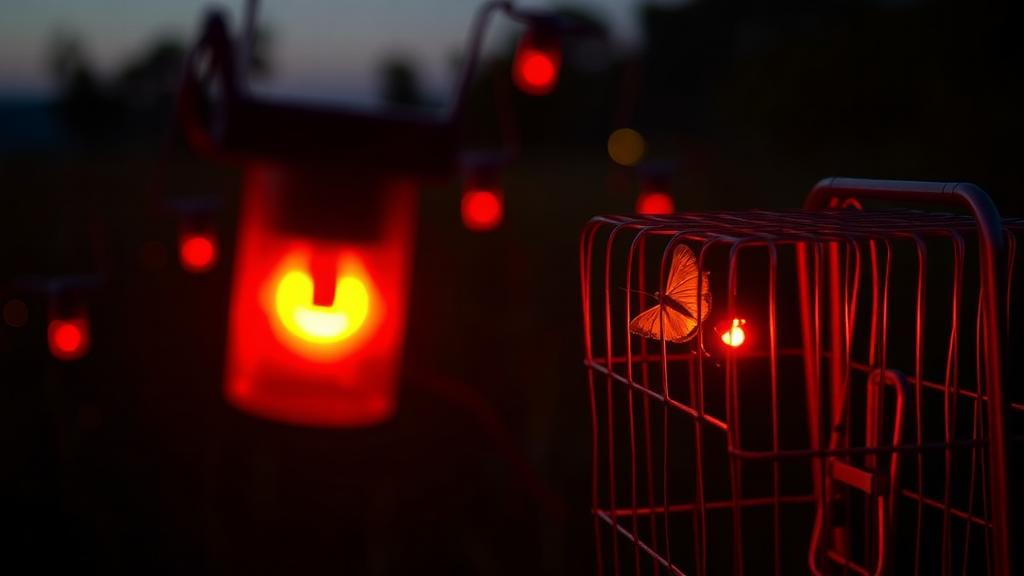
Red light has become the darling of wildlife-friendly lighting campaigns across Europe, promoted in parks and outdoor spaces on the premise that long wavelengths are the least harmful option for nocturnal animals. But a new field and laboratory study from Malaysia shows that the strategy can backfire spectacularly for at least one group of night dwellers: fireflies. Adult male Lamprigera fireflies, large glow-worm beetles that persist in urban forests near Kuala Lumpur, were strongly attracted to red artificial light, mistaking it for the bioluminescent signals of potential mates. The findings, published in Nature Conservation, reveal that red light, widely recommended as a mitigation tool for light pollution, can actively disrupt firefly courtship.
Fireflies are among the most conspicuous victims of artificial light at night, or ALAN. These beetles rely on bioluminescence for reproductive communication, with males and females exchanging precisely timed light signals to find each other in the dark. Exposure to artificial light, particularly at short wavelengths, suppresses firefly signalling activity, and ALAN has been identified as a leading factor in the decline of firefly populations worldwide. For glow-worm fireflies, whose wingless adult females emit a constant glow, intense artificial light extinguishes the very displays that make them visible to mates, reducing mating success. Because courtship displays are essential for reproduction, this suppression strikes directly at the heart of firefly fitness.
The research team, working in Bukit Kiara, a secondary forest fragment near the Malaysian megacity of Kuala Lumpur, chose Lamprigera as their study organism for good reason. The genus is notable for its large size, a bright continuous green glow peaking at 556 nanometres, and striking sexual dimorphism in which neotenic adult females retain juvenile characteristics. Adults are crepuscular, active only during a narrow twilight window of roughly 30 minutes, while their larvae are nocturnal and forage later at night. Despite their urban adaptability, Lamprigera remains understudied, and the specimens in Bukit Kiara have not yet been identified to the species level.
To probe how these beetles respond to different kinds of artificial light, the researchers ran two complementary experiments between November 2023 and April 2024. In the field, they placed an RGB LED along a randomly selected forest trail in Bukit Kiara and, for 20 minutes starting at sunset, tallied every adult male observed within five metres of the device. If an individual flew towards the light and attached itself to it for more than 30 seconds, the behaviour was scored as attraction. In the laboratory, 43 larvae collected from the same forest were placed in a 120-centimetre arena with an LED at one end, and their position, movement, direction, and bioluminescent display were recorded every five minutes. The LED emitted three commercially common colours, red peaking at 630 nanometres, warm-white with peaks at 580 and 470 nanometres, and cool-white with peaks at 550 and 470 nanometres, at intensities spanning 10 to 1000 lux, the highest approximating extreme urban lighting and the lowest representing dim conditions.
The field results were unambiguous. Significantly more adult males were observed during exposure to red and warm-white light compared with control conditions, and attraction behaviour was documented under both spectra. Red light proved the most seductive: 97.1 percent of observed males were attracted at low intensity and 85.2 percent at high intensity, compared with 43.9 and 51.4 percent under warm-white light. Cool-white light, which contains the most intense blue component, produced no significant attraction at all. Intriguingly, higher light intensity drew more males to the area but did not increase attraction rates, which the team suspects reflects visual impairment as males approach intense artificial light.
Perhaps the most striking observation came from the males’ behaviour at the light itself. Attracted individuals were seen extending their abdomens and exposing their genitalia towards the LED, an attempted mating response in which the males mistook the artificial light for the bioluminescent signal of a female. After a brief period of manipulating their genitalia towards the light, the males departed, seemingly realising they were engaging not with a female but with an object that mimicked female cues. The researchers suggest this may indicate an adaptive capacity to discriminate non-biological light sources, though repeat visits by the same individuals could not be excluded.
Why would fireflies known to be unresponsive to red wavelengths in other studies fall so readily for a red LED here? The team suspects that Lamprigera cannot discriminate between red and green wavelengths, likely sharing a single photoreceptor for both, consistent with nocturnal insects that typically prioritise light sensitivity over spectral discrimination. Since Lamprigera emit a green glow at 556 nanometres, males likely perceive the red spectrum as a potential mate signal. The more consistent attraction under red light compared with warm-white may stem from the additional blue peak in the warm-white spectrum, which is known to harm insects. Short-wavelength exposure below 533 nanometres has been associated with reduced signalling, decreased mate-attraction success, and impaired larval development, explaining the absence of attraction under cool-white light.
The larvae told a very different story. Unlike adult males, Lamprigera larvae showed no response to red light at any intensity, a difference the researchers attribute to their simpler visual systems, which consist of rudimentary bilateral stemmata rather than the larger, more complex eyes of adult males. Larvae also ignored low-intensity light across all wavelengths, likely an adaptation to natural nocturnal illumination during lunar cycles. But high- and very high-intensity warm-white and cool-white light significantly reduced larval movement and bioluminescent activity, with movement dropping from 66.1 percent under control conditions to as little as 5.4 percent under very high-intensity cool-white light. Since larval bioluminescence during foraging serves as an aposematic warning to predators, this suppression increases their vulnerability. Notably, larvae showed no consistent directional movement away from light sources or shelter-seeking behaviour, supporting previous findings of maladaptive spatial responses in fireflies, though under very high-intensity cool-white light, 42.3 percent of larvae were observed excavating underground, a protective behaviour that emerged only under extreme conditions.
The ecological implications are substantial. Given the narrow 30-minute twilight window during which adult males are active, artificial light attraction could critically impair mating success by drawing males away from females and creating competition for female signals. Meanwhile, high-intensity white lights suppress larval foraging and aposematic display, compounding the threat across the life cycle. The findings reveal the genuine complexity of developing effective ALAN mitigation strategies: although adding blue wavelengths can adversely affect larval behaviour, this colour shift reduces artificial light attraction in adult males. The researchers conclude that successful lighting solutions for fireflies may still require a blue wavelength component to prevent mating attraction in adults, while maintaining lower light intensities remains critical for minimising ecological impact. Balancing spectral composition and intensity levels, so that ecological harm is minimised while preserving adequate human visibility, may be the only way to keep both fireflies and people seeing clearly at night.
Subject of Research: Behavioural responses of fireflies to artificial light across life stages
Article Title: Behavioural responses of fireflies to artificial light: red lights attract adult Lamprigera ( Coleoptera , Lampyridae )
Article References: Muharraran, F. A., Tan, W. J., & Jusoh, W. F. A. (2026). Behavioural responses of fireflies to artificial light: red lights attract adult Lamprigera (Coleoptera, Lampyridae). Nature Conservation, 61, 95-111. https://doi.org/10.3897/natureconservation.61.146507
Image Credits: AI Generated
DOI: 10.3897/natureconservation.61.146507
Keywords: Behavioural, responses, fireflies, artificial, light, lights, attract, adult, Lamprigera, Coleoptera, Lampyridae, scientific research
Cite Scienmag News
Margaret Porter. (October 19, 2026). Red lights, meant to protect wildlife, lure fireflies into a mating trap. Scienmag. https://scienmag.com/red-lights-meant-to-protect-wildlife-lure-fireflies-into-a-mating-trap/
Margaret Porter. "Red lights, meant to protect wildlife, lure fireflies into a mating trap." Scienmag, 19 October 2026, https://scienmag.com/red-lights-meant-to-protect-wildlife-lure-fireflies-into-a-mating-trap/. Accessed 19 October 2026.
Margaret Porter. "Red lights, meant to protect wildlife, lure fireflies into a mating trap." Scienmag. October 19, 2026. https://scienmag.com/red-lights-meant-to-protect-wildlife-lure-fireflies-into-a-mating-trap/


